Near Speed of Light Travel in the Atmosphere

When physics classes learn about relativity, typical problems involve calculating relative velocities, masses, or distances for objects moving near the speed of light, 3 * 10^8 m/s.  These objects might be objects like spaceships, travelling in outer space, but they are often more common objects like cars and trains, or even baseballs.  The two different locations (space and Earth) have radically different conditions.  There are a lot more things to run into here on Earth.  This begs the question: what would happen if an object were capable of moving near the speed of light in the atmosphere?  Randall Munroe, the brilliant creator of the webcomic xkcd, answers this specific question on his what-if? page: “What would happen if you tried to hit a baseball pitched at 90% the speed of light?”  The answer is not as pretty as one might believe.

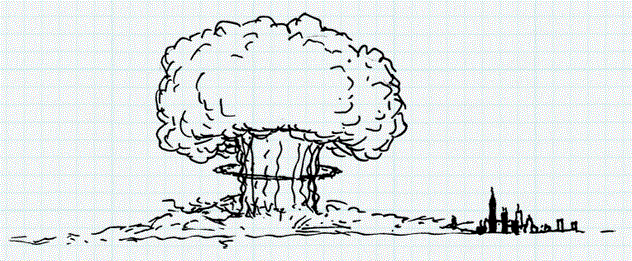
Mr. Munroe does an excellent job of explaining exactly what happens (you should check it out), but I will summarize it here.  The baseball actually fuses with the air molecules in front of it, releasing gamma rays.  The gamma rays scatter and form an ever-expanding sphere of plasma, which moves at nearly the speed of light.  It only takes 70 nanoseconds for the ball to reach home plate.  When it does, the batter has no idea because the light that has just reached his eyes told him the pitcher only just let go of the ball.  The bubble of superhot plasma makes short work of the bat, batter, and catcher, and proceeds to destroy the stadium and everything within a mile radius.
This “relativistic baseball” shows us just how fast light is.  Nothing man-made exists that can possible compete with the speed of light.  Light can cover the distance from the Earth to the Sun, an incredible 93 million miles, in only eight minutes.  Once we have an appreciation for how fast light travels, we can begin to appreciate the true size of space.  The nearest star to us, Proxima Centauri (along with its stellar neighbors, Alpha Centauri A and Alpha Centauri B), is located over 4.2 light years away.  Light, travelling at an unmatchable speed, takes 4 years and 2½ months to get to Earth.  If we will ever be able to reach another star, we’re going to have to come up with some non-traditional methods of travel that do not just involve moving yourself from point A to point B.


Posted in Light, Physics, Space Travel | Tagged , , , , | Comments Off on Near Speed of Light Travel in the Atmosphere

Once in a Blue Moon

Ok, so literally a blue moon is actually when two full moons are seen in a single calendar month, but what I am talking about today isn’t totally off topic because it is something that really is pretty rare: eclipses. As we learned recently that there are two general types of eclipses, a solar and a lunar eclipse. Now the general concept seems pretty easy:

  • A solar eclipse occurs when the Moon is in its new phase and it falls directly in front of the Sun from the Earth’s perspective.
  • A lunar eclipse happens when a full Moon falls into the darkness of the Earth’s shadow (caused by the Sun).

However, I was struggling to understand initially why these eclipses didn’t happen on a regular basis (the moon orbits the Earth roughly once a month after all–well, once every 29.5 days). After reading and doing some basic searching online (google search: understanding eclipses), the crucial point that I was missing is that the Moon doesn’t actually orbit the Earth in the same plane that the Earth orbits the Sun. In fact, the Moon’s orbit around the Earth is actually slightly offset by about 5 degrees, meaning that the Moon doesn’t intersect the nodes of the Sun’s ecliptic every time there is a full or new Moon (Source: Lunar Eclipses for Beginners). If you still don’t understand it, don’t feel alone. It wasn’t until I saw a diagram of the different orbits of the Earth and the Moon that I really started to grasp the concept (check out the diagram blow). Hence, eclipses are somewhat rare–at least more so than I initially thought.

moonorbb

Here is a picture I found helpful in explaining eclipses
Source: Astronomy Without a Telescope

But, because they are so rare, they make for some pretty incredible pictures whenever we do actually get to see them. Consider for instance this total eclipse (meaning that the Moon had moved completely into the Earth’s umbra) that was seen in Bangkok on December 10, 2011. Here we see this beautiful total lunar eclipse causing the moon to turn an amazing shade of red. Sadly, even the picture doesn’t do the colors any justice. When we see pictures like this, or pictures of solar eclipses, it seems easy to me to imagine why civilizations have worshiped the Moon for so long. It’s quite an amazing feat of nature.

Pretty breathtaking. So, see you all for the solar eclipse in Nashville in 2017? I wouldn’t miss it.


Posted in Light | Tagged , , , , , | Comments Off on Once in a Blue Moon

So about those New Year’s resolutions…

Right we are about a month into the New Year. Actually by now you have probably already given up on those New Year’s resolutions that you set with such fervor just 25 short days ago. And despite what us seniors may think—no matter how many things are left on our Vandy bucket list—the world does not revolve around us. More importantly, the universe doesn’t even revolve around us. We are actually just the smallest of fractions of a blip on what we—well, Carl Sagan—call the Cosmic Calendar. According to this Calendar, which Sagan presented in one of the installments of his Cosmos series, we haven’t been around for really any time at all (Source: Cosmic Calendar). (Actually, the literally number is so small that it isn’t even worth reporting.)

cosmiccalendar

The Cosmic Calendar
Source: The Cosmic Timeline

The general premise behind this Cosmic Calendar is that we can put all of the major events from the entire course of the universe into a 12-month calendar year. This means that looking at midnight on January 1st, we would see the Big Bang listed as the “big event” for the day. (Now take a second and think about where you were 25 days ago… You feel insignificant, don’t you?) And, the events taking place right now, as I write this, are happening in fractions of fractions of a second to midnight on December 31st. This concept of the Cosmic Calendar was an idea that was presented by Carl Sagan during a portion of his Cosmos series (Source: Cosmic Calendar). The beauty of the Calendar is that it gives us an easy way to conceptualize a lofty concept: the vast development, and the vast amount of time, that our universe has gone/lived through. Based off of the Cosmic Calendar, we can see how the roughly 14 billion years that our universe has existed is divided up. For instance, while our Sun and planets have been around since August (roughly 4.6 billion years if you do a little math), we–humans–have really only been around since 9:24pm on December 31st (making us roughly 3.9 million years old). I think the most interesting part is that just the last 10 seconds on the Calendar represents most of; on the Cosmic Calendar scale that’s about the same time as the development of Astronomy since human years don’t matter too much on such large scales (Source: The Cosmic Timeline)! Comparing that with the fact that dinosaurs ruled the “universe” for 6 days makes my math homework seem pretty minuscule. But the overall purpose of this Calendar isn’t to make us feel insignificant–even though it may–but rather, it should give us a little bit of perspective. It helps us understand why our relatively short time on Earth is worth using to study the amazing formations found in the Universe’s past and present.

So really, when you start thinking about those New Year’s resolutions that you wanted to keep for the full year of 2014, feel energized about it. Because really, you only have to stick to the resolution for a small fraction of a second according to the Cosmic Calendar. (Actually, on second thought, maybe that makes us feel a little silly that we can’t keep them for even just one real year.)


Posted in Universe | Tagged , , , , | Comments Off on So about those New Year’s resolutions…

Lunar Phases

Screenshot of the Lunar Phases and Moon Calendar app, available for Android.

Screenshot of the Lunar Phase app, available for Android.

While searching for a good astronomy application to blog about, I found a lot of interesting moon apps, but I think the most helpful app for this class would have to be Lunar Phase. It’s a free app available for Android that not only shows you the current phase of the moon and the moon phases for the rest of the month, but also gives you pictures exactly like those we saw in lecture on Wednesday that are going to be on the test.

In the screenshot above, you can see that the app shows you an estimation of what the moon currently looks like (this one is a Waxing Gibbous). It also shows you a picture of how the sun, earth, and moon are aligned, which is going to be super helpful to practice with and study for the test on Monday. It’s even got the moon shaded properly, which I know confused me in Wednesday’s lecture. The bottom picture looks exactly like the clicker question we were shown Wednesday, with a view of where the moon currently appears in the sky. This screenshot was taken at midnight, and the moon is almost at its highest point. This tells us that it’s almost a full moon, since the full moon is at its highest point in the sky at midnight.

But this app isn’t just helpful in preparing for the test. Lunar Phase tells you the times that both the moon and sun will rise and set for a given day and lets you know the Altitude and Azimuth of the sun (wouldn’t that have been helpful for the last homework). Although it does have a few too many buttons – many of which I haven’t quite figured out yet – this little app is impressive. I would highly recommend using it as you study for Monday’s test.


Posted in Class | Tagged , , , , | Comments Off on Lunar Phases

The Cosmic Calendar

Although I doubt it will ever be entirely possible to comprehend the enormity of an amount of time as great as 13.7 billion years, I’ve found the Cosmic Calendar to be a good way to think about just how old the universe is.  The Cosmic Perspective scales the history of the universe down to one year in order to express that the entire course of human history is barely a few seconds

In order to understand this even better, I would like to shrink the entire history of the universe into a length of time that is perhaps even more familiar for me, which is my age, 21 years.  According to the chart above and my calculations, apes would have appeared 36 hours, 45 min ago, anatomically modern humans would have appeared 2 hours, 6 minutes ago, and Columbus would have arrived in the New World only about 21 seconds ago!  It’s amazing to think that if the history of the universe coincided with the history of my life, I would have began drafting this blogpost before writing was even invented.


Posted in Class | Tagged , , , , | Comments Off on The Cosmic Calendar

Astronomy Smartphone Apps

Image

This image comes from the Star Chart App for smartphones.  This app is really cool because it tells you the location of stars, planets, and constellations, etc.  It has charts of what the night sky will look like all over the world, and it can even tell you what stars are in the sky during the day when they are not visible from Earth.  The coolest part of this app is the GPS capabilities.  With the built in positioning, this app can tell you exactly what you are looking at in the sky when you point it upwards.  Based on your location, you can easily identify constellations, stars, and planets.  In addition to showing constellations, this app has artistic overlays to help the viewer understand the shapes/pictures that constellations make.  Not only can you see what you are looking at in the sky, if you want to know what people on the opposite side of the globe are seeing, you simply point your phone down, and the app will tell you.  This Star Chart app is one of many astronomy apps that are growing in popularity.  I think that the new fascination with these types of apps is really expanding peoples’ interest in astronomy.  For example, people who live in large cities with lots of light pollution don’t really get a chance to see the starry night sky in all of its glory, but with this app, they can get a better glimpse of what the night sky really has to offer.


Posted in Instruments, Stars | Tagged , , , | Comments Off on Astronomy Smartphone Apps

The Cosmic Calendar

ImageThis image was taken from the personal blog of Michael Arney.  It is an image of the explanation that the famous astronomer Carl Sagan gave to enable the public to grasp “the immensity of time” and the Cosmic Calendar.  In addition to the visual given in our textbook, I feel that this graphic is a clear and concise way of explaining the Cosmic Calendar.  Squishing the entire life of the Universe into one of our calendar years is a very helpful tool in understanding the size and scope of the Universe because it puts it into terms that we can wrap our heads around.  It also puts everything into perspective.  When you think about the physical size of the Universe and the fact that we are basically just specks, it can make the Universe seem very vast and yourself seem very small.  Additionally, when you think about how long humans have been around compared to the entire timeline of the Universe (which is more easily understood thanks to the Cosmic Calendar), you feel even smaller.  This phenomenon can have two effects on people; some people may feel small and unimportant, and other people may feel shocked and awed by the scope of the Universe.  Either way, the Cosmic Calendar is one of the most, if not the most, effective ways of communicating the timeline of the Universe to the average person.


Posted in General, Universe | Tagged , , | Comments Off on The Cosmic Calendar

App-stronomy

a cool new app to get stars on the go!

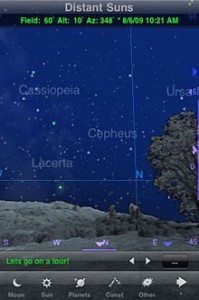
I downloaded the app “Distant Suns” on my i-phone after reading about cool astronomy apps online.  “Distant Suns” is an app that uses your location to show you the night sky right above your head.  It has labeled constellations, planets, and it shows data for any point that you wish to select in the sky.  It also has a top scroller with pertinent space news, so you are always aware of what is going on in the astronomy world.  Additionally, there is an “events” page, detailing when there are important meetings or camps relevant to the field of astronomy.  The best part about it- ITS FREE! It took only a few minutes to download onto my I-phone and get it running.

The app has the horizon, cardinal directions and both poles built into the interactive map, allowing observers to easily locate where they are in the sky.  The resolution on the pictures is also pretty realistic given that this is projected onto your smart phone. One new important feature about “Distant Suns” is that it now allows you to point your phone to the sky and is able to use its GPS to slew the proper view of the star map in order to perfectly match what you should see outside.  Great for a day like today when it is 40 degrees and I want to snuggle up and look at the stars from the indoors. Overall I would recommend this app to any students or astronomy buffs looking to observe the night sky!

http://www.iphoneness.com/iphone-apps/top-astronomy-applications-for-iphone/

http://www.distantsuns.com/

Posted in Class | Tagged , , , , | Comments Off on App-stronomy

App-stronomy

a cool new app to get stars on the go!

I downloaded the app “Distant Suns” on my i-phone after reading about cool astronomy apps online.  “Distant Suns” is an app that uses your location to show you the night sky right above your head.  It has labeled constellations, planets, and it shows data for any point that you wish to select in the sky.  It also has a top scroller with pertinent space news, so you are always aware of what is going on in the astronomy world.  Additionally, there is an “events” page, detailing when there are important meetings or camps relevant to the field of astronomy.  The best part about it- ITS FREE! It took only a few minutes to download onto my I-phone and get it running.

The app has the horizon, cardinal directions and both poles built into the interactive map, allowing observers to easily locate where they are in the sky.  The resolution on the pictures is also pretty realistic given that this is projected onto your smart phone. One new important feature about “Distant Suns” is that it now allows you to point your phone to the sky and is able to use its GPS to slew the proper view of the star map in order to perfectly match what you should see outside.  Great for a day like today when it is 40 degrees and I want to snuggle up and look at the stars from the indoors. Overall I would recommend this app to any students or astronomy buffs looking to observe the night sky!

http://www.iphoneness.com/iphone-apps/top-astronomy-applications-for-iphone/

http://www.distantsuns.com/


Posted in Class | Tagged , , , , | Comments Off on App-stronomy

App-stronomy

a cool new app to get stars on the go!

I downloaded the app “Distant Suns” on my i-phone after reading about cool astronomy apps online.  “Distant Suns” is an app that uses your location to show you the night sky right above your head.  It has labeled constellations, planets, and it shows data for any point that you wish to select in the sky.  It also has a top scroller with pertinent space news, so you are always aware of what is going on in the astronomy world.  Additionally, there is an “events” page, detailing when there are important meetings or camps relevant to the field of astronomy.  The best part about it- ITS FREE! It took only a few minutes to download onto my I-phone and get it running.

The app has the horizon, cardinal directions and both poles built into the interactive map, allowing observers to easily locate where they are in the sky.  The resolution on the pictures is also pretty realistic given that this is projected onto your smart phone. One new important feature about “Distant Suns” is that it now allows you to point your phone to the sky and is able to use its GPS to slew the proper view of the star map in order to perfectly match what you should see outside.  Great for a day like today when it is 40 degrees and I want to snuggle up and look at the stars from the indoors. Overall I would recommend this app to any students or astronomy buffs looking to observe the night sky!

http://www.iphoneness.com/iphone-apps/top-astronomy-applications-for-iphone/

http://www.distantsuns.com/


Posted in Class | Tagged , , , , | Comments Off on App-stronomy