King of the Galaxies

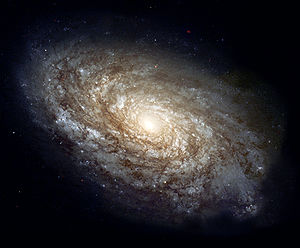
NGC 6872, pictured above, is the largest of the spiral galaxies. Source: Discovery News

It’s hard to imagine things on a galactic scale. I have trouble just picturing how big the Earth really is. Now try imagining something larger than Earth, larger than the Solar System, and larger than our entire galaxy.

That’s this guy, NGC 6872. It’s a spiral galaxy five times the larger than the Milky Way. It takes light half a million years to travel across it. Compare this to our galaxy, which light crosses in 100,000 – 120,000 years.  This galaxy’s size, however, isn’t its only mind-boggling quality. A galaxy 5 times larger than our own also has 5 times as many stars and 5 times as many planets orbiting those stars. That’s billions and billions of stars and planets and asteroids and comets and who knows what else. And all of that stuff is 212 million light-years away from us here on Earth. If some alien was watching us right now from that galaxy, the Jurassic age wouldn’t have even happened yet.

While this galaxy may be the largest spiral galaxy so far, chances are it’s not the biggest we’ll ever find, and even if it is, the fact that there are hundreds of billions of galaxies out there – each with billions and billions of stars and planets – is hard enough to wrap your head around. The universe is huge beyond belief. The good news? Astronomers aren’t likely to be bored anytime soon.


Posted in Class, Galaxies, General, Light | Tagged , , , | Comments Off on King of the Galaxies

Intro for ASTR201

Hey,

I am a senior math major and earth and environmental science minor.  I spend most of my free time on horseback, but am also working as a grader and other math-y things on campus.

by my friend Liz


Posted in Class | Tagged , | Comments Off on Intro for ASTR201

#B1 Cosmic Calendar

This video put the extensive history of the universe into perspective. Our history as humans that we take years of education to understand are so minuscule compared to the creation of the universe. In our society, we are so focused about ourself and making sure we our success, comfort, etc are our priorities. With this attitude, it’s not surprising that we focus so much attention about the greatness of the human race and not realizing the dramatic effect we have had upon on Earth and environment in the very short time span we have in fact inhabited the Earth. As active participants who make daily decisions that affect our beautiful Earth, we have a choice that can enhance it or bring destruction to it. I hope people would watch this video and realize how important it is to have a universal perspective rather than an individualistic view of not only our existence, but our impact upon this Earth.


Posted in Class, Science | Tagged , , , | Comments Off on #B1 Cosmic Calendar

#B2 Earth’s Orbit and Understanding

One of the most interesting concepts of our Earth is its orbit around the sun. As the Earth rotates each day, the point as which it achieves a full 360 degree rotation is slightly different than the day before (either longer as it orbits away from the Sun or shorter as it orbits nearer the Sun). Typically, we consider a year to be 365 days, but if we view it from a space perspective, we would notice that our year is slightly longer (about 1.25 days) due to the massive orbit the Earth must travel.
This video did an exactly job of explaining how seasons occur depending on the position of the Earth in orbit as well as the angle of the Sun on the Earth around the equator. A fact that I learned from this video is that depending on the distance the Earth is away from the Sun determines how fast the Earth will orbit around the Sun due to the strength of the gravitational pull. Putting this into perspective, this is why our summer days in the Northern hemisphere are longer because we are farther away from the Sun and thus the Sun is shining longer because it takes longer for the Earth to rotate around the Sun.
Amazingly, it was about 750 days to travel the Earth 200 billion years ago. This is an interesting fact and I wonder how this length has changed. Did our orbit change? Did this cause major environmental factors to change on Earth? Did our seasons change? Will this change again over time and we will travel the earth in 180 days eventually? What would it look like if our seasons were shorter and we traveled faster around the Sun?


Posted in Class | Tagged , , , , | Comments Off on #B2 Earth’s Orbit and Understanding

Perspective of the Cosmic Calendar

school.discoveryeducation.com

school.discoveryeducation.com

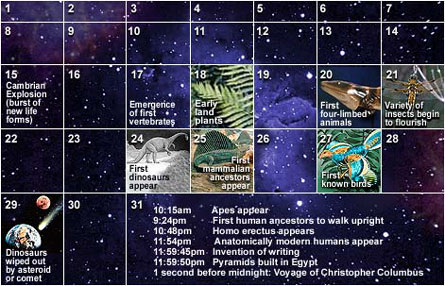
What do you think of when someone mentions the word old? Turning 21, grandparents, black and white photos? Maybe even cave men or the dinosaurs? However, all these things are insanely young on the cosmic scale! If you were to take the time from the creation of the universe until present day and squeeze it all into one year, our human history would only span the last couple hours of December 31st! Go back a couple of days and you’d see the creation of dinosaurs. In fact, our very solar system didn’t come into formation until the month of September.

As humans, we love to put finite numbers on things . Even considering the age of the universe as 14 billion years old, makes it seem almost young. Our perception is so skewed by these numbers that we don’t really understand just how small our existence has been compared to the existence of the universe. While realizing this may make us feel small or belittled, it is truly a testament to our unique ability to understand where we come from and where we are going. In our extremely short period on earth we have gained tremendous knowledge of the “world” around us, and with this, the potential to expand our own existence throughout the universe.


Posted in Class | Tagged , , | Comments Off on Perspective of the Cosmic Calendar

ASTR 201

Make a fish.  Any fish will do.

Me, my dad, and my grandad with a good haul of fish.

So this is my blog for ASTR 201. Here I’ll post things of an astronomical nature over the coming weeks. Picture of me is unrelated, but just look at those fish!


Posted in Class | Tagged , | Comments Off on ASTR 201

UFO sighting

UFO sighting

“thumbpress”


Posted in Class | Tagged , , | Comments Off on UFO sighting

The Cosmic Calendar

visual representation of cosmic calendar

A concept that “wowed” me from these first couple weeks of material was the Cosmic Calendar.  Our universe has a lifetime of 13.7 billion years, which is scaled into a year-long calendar. The cosmic calendar is a way to scale the events allowing introductory astronomers, like myself, to conceptually view the order of events.  The amount of time between the creation of our solar system and the evolution of man is incredible to consider.  To me the most amazing thing about the cosmic calendar is December 31st, in which the first humans are developed, writing is invented, Christ is born, and without a second to spare Columbus finds the New World.  The fact that this scaled all happens in one day is amazing to think about how young the Earth is relative to our universe.


All of this information I received from notes taken in Dr. Grundstrom’s Astronomy 201 class.


Posted in Class | Tagged , , | Comments Off on The Cosmic Calendar

Is there anything more interesting?

Is there anything more interesting?

Wikipedia http://en.wikipedia.org/wiki/File:NGC_4414_(NASA-med).jpg


Posted in Class | Tagged | Comments Off on Is there anything more interesting?

The Great Wall

Imageby me

A picture of the Great Wall from when I studied abroad in China.  Unfortunately, it actually cannot be seen from space.  Sorry to anyone whose dream I may have crushed…

http://www.nasa.gov/vision/space/workinginspace/great_wall.html, http://www.scientificamerican.com/article.cfm?id=is-chinas-great-wall-visible-from-space


Posted in Class | Tagged , , , | Comments Off on The Great Wall