NASA meteor counter


NASA has released an iPhone app that encourages people to go outside and observe the nights sky, particularly meteors. Not only does this app benefit the people using it, but it also helps NASA research with meteors and meteor showers.

This app was initially developed to be a fun way for people to explore the nights sky and learn some information while doing so. It was made to accomodate both experts in the field as well as first time novice users. The really cool part about this app is that while the user is viewing the nights sky, they are collecting data for NASA research. This data is uploaded at the end of every session and collected and reviewed by NASA analysts. This app also includes an optional voice recording feature that allows the observer using the meteor counter to add comments. The app provides calendars for upcoming meteor showers and other events.

Sources:

http://www.nasa.gov/

https://itunes.apple.com/


Posted in Class, Instruments, Observables | Tagged , , , , | Comments Off on NASA meteor counter

The Moon’s Appearance

Following class on Wednesday, in which we discussed the lunar cycle and the moon’s appearance to us here on Earth, I looked up at the Moon while walking to my car.  It appeared to be in the waxing gibbous portion of its cycle, which made sense because it was late in the afternoon and fairly low in the sky, and waxing gibbous moons rise in the afternoon.

However, I was anticipating that the shadow on the moon would essentially be at a vertical, like in the picture above, but I noticed it was tilted, like in the picture below.

Stellarium Screenshot by Colin Gerrety

Stellarium Screenshot by Colin Gerrety

Upon further investigation in Stellarium, I discovered that the tilt of the Moon’s shadow actually changes throughout the course of the night.  This is not because of any change to the shadow, but how we are viewing the moon from Earth.  The way we view the Moon in the northern hemisphere, the first picture of a waxing gibbous moon is how we view the Moon when it is highest in the sky.  However, when it is lower in the sky, the shaded part of the Moon appears slightly tilted.  This is because we are facing different directions while viewing the Moon at different points in the night.  At moonrise, we face East to view the moon, and when it is highest in the sky, we face South.  The “non-shaded” side of the waxing gibbous moon always faces West, and when we face East to view the Moon at moonrise, the side facing West is the upper half.


Posted in Class | Tagged , , | Comments Off on The Moon’s Appearance

Deep Time and the Cosmic Calendar

As an Earth & Environmental Sciences major, I’ve become very familiar with the concept of Deep Time over the past few years. In addition to making a great  band name (alas, it has been done), deep time is the easiest way to think about time on a geological or cosmological scale. The Cosmic Calendar provides a handy visualization of the entire history of the universe, condensed into one calendar year. The Cosmic Calendar is remarkable to look at. The Big Bang occurs on New Year’s Day, and then it appears that nothing happens for quite some time. Our own Sun and Solar System were created in August, about 4.6 billion years ago. Earliest single-celled life appears just one month later in September, and two more “months” pass before multi-cellular life hits the scene in November. December witnesses the rapid evolution of life on Earth, from the Cambrian Explosion of life on the 15th to the dramatic extinction of the dinosaurs on December 30th. The Cosmic Calendar makes humans seem rather insignificant. After all, the entire history of the human race is packed into about the last five minutes of the year. The written record documents only the last 15 seconds.

I think when most people look at the calendar, they feel rather small. When I look at the calendar, I am inspired by how far we have come as citizens of the cosmos, and I long to know what happens “tomorrow.” The extinction of humans? The immigration of humans to another planet in our Solar System? Only some seriously deep time will tell.


Posted in Class | Tagged , , | Comments Off on Deep Time and the Cosmic Calendar

The Unseen Universe

The Unseen Universe

The size of the Universe is one of the most amazing topics that is brought up through astronomy. The universe is so large that we are able to look back billions of years to see the beginning of time. As we look back in time, we are able to discover the different changes that occurred to form the universe as we know it. This vast distance of space also means that we will never actually be able to see the universe as it is. We will always be seeing it as it was. This is due to the speed of light. We think of the speed of light as incredibly fast, and it is! But even at the speed of light, It takes billion of years to reach us from the other side of the universe. With the speed of light being the fastest thing able to move in our universe, it will be our limiting factor on how far we can see and how recently that image is. So when we think about this unobtainable fast speed of light, we must also think of how slow it is compared to the size of our universe.


Posted in Class, Light, Universe | Tagged , | Comments Off on The Unseen Universe

A Light Perspective

Image

Source

The fact that I have been unable to truly grasp the size of the universe–much less be able to put into perspective things like the speed of sound and light–I believe is largely attributed to this topic (Astronomy) involving surreal and almost unimaginable concepts.

Much of my experience with the concept of the speed of light has in large part come from cartoons and televisions shows I watched as a child: superheroes described as “faster than the speed of light” or “stronger than a bullet train” etc.  The speed of light was always some amazing phenomenon that I would never be able to fully understand much less see for myself.  However, now when compared to the vast size of the universe, the speed of light isn’t ‘the fastest thing ever!’ if we look at the time it takes for it to travel long distances.

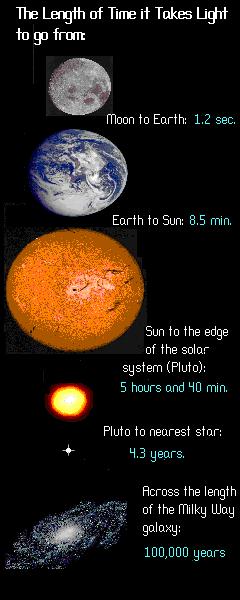
I think the speed of light is most useful for measuring distances (something I was not aware of until most recently). It’s amazing how much time it actually takes for light to travel long distances.  299,792,458 m/s purely as a number seems so unbelievably fast, yet when we remember that it takes light 100,000 years to cross the length of the Milky Way Galaxy, it seems so slow and us as individuals so small.


Posted in Class, Light, Space Travel | Tagged , , , , | Comments Off on A Light Perspective

The Moon and its Lunar Eclipse

Photo courtesy of Dan Karau.

Photo courtesy of Dan Karau.

People travel all over the world to catch a glimpse of the rare phenomenon known as a lunar eclipse. In the past, this misunderstood event inspired some fear as the Moon became darker and darker until in turned blood-red, signifying an act of some god or deity. Now, we know this event occurs every so often in places all over the world, and the fear that was accompanied by this experience has turned into pure awe and amazement. But what really causes our bright Moon to randomly change into this seemingly inflamed ball of rock in our night sky?

As most people know, our Earth orbits around the Sun about every 365 days and each day the Earth completes a full rotation. However, the whole time this is happening our Moon is also orbiting earth about every 30 days. This orbit is what gives us the different phases of the Moon as our perspective of its illuminated surface changes ever so slightly every day. In the Full-Moon phase, the Sun, Earth, and Moon are aligned with each other. This causes a shadow to be cast from the Earth to somewhere in space. Because of their alignment with each other, one might believe that the Earth should then eclipse the Moon every Full-Moon phase. What makes this such a rare phenomenon is the fact that the Moon’s orbit does not lie on the same plane as the Earth’s orbit with the Sun. This, coupled with the great distance our Moon is from us, makes the angle needed for a total lunar eclipse very difficult to achieve. If this does happen to take place, an interesting event can occur as light from the Sun bends through our atmosphere producing a red glow on the dark Moon.

The rarity, as well as the beauty, of this event produces a lot of allure for astronomers and for those simply intrigued by nature and science. It is one of those “once in a lifetime” moments that few rarely get to experience and for those that do, a moment that will never be forgotten.


Posted in Class | Tagged , , , | Comments Off on The Moon and its Lunar Eclipse

Just how big is the universe?

It is impossible to comprehend just how big the universe is simply from a description. I could tell you that the Earth is approximately 150 million km from the sun and that it takes over 8 minutes for the sun’s light to reach us but understanding it is completely different. This video uploaded by stormeindustries gives my words some meaning.

In the video you can see that the Milky Way galaxy is 100,000 light years in diameter but that is much less than a fraction of a percent of the whole universe that we can see which is 13.7 billion light years big. It is estimated that there are 400 billion stars in our galaxy alone, each with their own orbiting planets. Another great visualization is The scale of the universe which is an interactive website that lets you zoom in and out of the universe. It is crazy to think that there are so many more galaxies throughout the universe, some of which that are even bigger than our own.


Posted in Class, Universe | Tagged , , , | Comments Off on Just how big is the universe?

Why does the moon look red?

If you have ever seen an image of a lunar eclipse, or have had the privilege of viewing one in person, you probably noticed that the moon does not retain its bright, whitish color; instead, the moon turns a shade of orange or red.  If you don’t know what I’m talking about, this very cool youtube video gives you a time lapse version of a total lunar eclipse:

So, what causes a lunar eclipse, anyway?  A total lunar eclipse happens when the sun, earth, and moon are in alignment, in that order.  This causes the Earth’s shadow to be cast on the moon.  A total solar eclipse, on the other hand, happens when the alignment order is sun, moon, earth.  This causes the moon to block out the sun’s light.

Interestingly, in a solar eclipse, the moon blocks out most of the sun’s light (there’s still a ring of light around the moon even in total solar eclipses), but in total lunar eclipses the moon is actually visible during the peak of the eclipse.  But, as I have mentioned, the moon does not look its normal color.  The reason the moon appears a reddish color during the peak of the eclipse is because the light from the sun passes through the Earth’s atmosphere and changes the color of the shadow.  The amount of dust and clouds in Earth’s atmosphere affects the color of the moon for a particular eclipse.  This means that the moon can be a pale yellow-brown all the way to an almost creepy dark red, like the one below.

Source


Posted in Light, Moons | Tagged , , , , , | Comments Off on Why does the moon look red?

The Cosmic Calendar

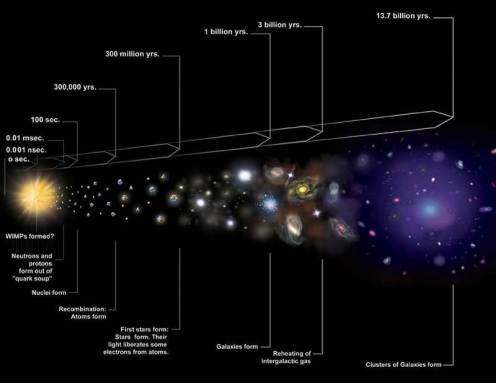
The purpose of the cosmic calendar is to put into perspective the relative time frame in which everything has happened in the universe. The 13.7 billion years of the universe’s life is condensed down into one Earth calendar year, with the big bang happening on the midnight of January 1st.

Even though the big bang happened in January, our Milky Way did not form until some time in May. In real time, that’s about 5 billion years after the creation of the universe. Even after the Milky Way formed in May, our solar system did not come to be as we know it until around September–more than 9 billion years after the big bang. Later in September we also had single-cell life, and come October we started seeing photosynthesis in some of these cells. By November there was multi-cellular life and gender distinction; however, things start to get even more interesting in December–nearly 13 billion years after the big bang.

Around the 14th of December there was simple life such as arthropods and sea sponges, and by the 17th there were more complex fish. It wasn’t until the 20th to the 21st that we started to see plants and insects living on land, and reptiles didn’t come about until the 23rd. A few days later, some of those reptiles evolved into the first of the Dinosaurs–and around the same time that mammals became more common. The super-continent Pangaea began to split on the 27th, and birds and flowers evolved a day later. The dinosaurs ruled the Earth as a whole for two more days, until suddenly dying off on the 30th. The last day of the year, the 31st, is when mammals finally begin to rise in the food chain.

Mammals spend most of the day of the 31st evolving, and it isn’t until around 8pm on the 31st that humans become distinct from chimpanzees. By 11:54pm humans had evolved up to Homo sapiens, and four minutes later they began to migrate out of Africa and into other parts of the world. At one minute to midnight the neanderthals finally died out, and with 47 seconds left to midnight the first groups migrating to the Americas begin to arrive. Agriculture and the idea of permanent settlement was not formed until about 23 seconds to midnight, and the big Mesopotamian cities weren’t around until 16 seconds to the new year. With six seconds left the Romans reached their peak, and with five Christ was born. With one second until midnight Columbus discovered the New World and we are here today at the metaphoric midnight, one second later.

It really puts into perspective the time scale at which everything thus far has happened. Dinosaurs roamed the world for five to six days while humans haven’t even existed for more than about four hours, much less been at the top. Humans have only topped the food chain for about six minutes. With those timings in mind, it took our galaxy about five months to form, and another four on top of that for our solar system. It’s all really mind blowing when you take the time to think about it.


Posted in Class | Tagged , , , | Comments Off on The Cosmic Calendar

Moon App!

Image

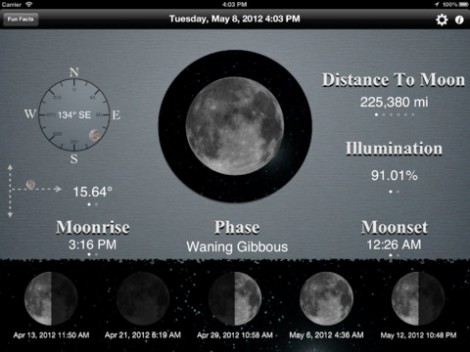
Apple has an application for your iPod and iPad that helps you easily learn everything you would want to know about the moon. It is kind of like Stellarium for your phone! Whether you want to know the phase the moon is currently in, its Azimuth or altitude, this app can tell you. I think it’s great that this is a free application because it encourages people to get interested in the sky. When it is so easy to find out the distance the moon is from your location, or when you have alarms going off for the day it is going to be a full or new moon, people are much more likely to get interested in astronomy. I think it is great progress that all of this information is at your fingertips, because it tells people that they don’t need to take an astronomy class to start learning about the sky.

I’m sure that if someone was interested, they could check this app regularly and learn the patterns that I am currently being taught in a classroom. It wouldn’t take long after looking at a phase chart to see the pattern that the moon goes through throughout the month- before long just anyone will be able to be an expert in the field!

Source:

https://itunes.apple.com/


Posted in Class, Instruments, Observables | Tagged , , , | Comments Off on Moon App!