The Moon Illusion and How to Resolve It

The moon is always the same size. It seems like an easy enough concept to grasp, but it doesn’t explain why the moon doesn’t always look like it’s the same size. I’m sure you’ve all seen it. You go out early on the night of a full moon, and the moon looks HUGE. In high school, I remember watching the Full Moon rise during a football game. I watched as the huge orange (yes, orange) circle rose slowly from the eastern horizon, brightly illuminated behind a telephone pole. By the time the game ended, the moon was quite a bit higher in the sky and appeared quite a bit smaller. I’ve had a lot of trouble grasping this “Moon Illusion,” but an article that Dr. G sent me recently (found here) has helped clear up the confusion a bit.

From Susquehanna University in Pennsylvania, Joseph Antonides and Toshiro Kubota have proposed a new theory to explain the moon illusion. According to Antonides and Kubota, the illusion is the brain’s way of dealing with a discrepancy in our binocular vision and our perceptual model of the world. Our two eyes give our brain an image of a distant moon. Our perceptual model of the world complicates this picture when the moon is near the horizon. Near the horizon, trees and telephone poles appear relatively close, so when the moon is poised behind them, our perceptual model tells us that the moon is also close. High in the sky, with no trees or skyscrapers in the way, the moon appears as it is–distant, both from our perceptual model and our binocular vision. Only near the horizon do the two conflict, and that is when we see a “larger” moon.

Seeing is believing, so I’ll need to test this out for myself before I’ll completely come to terms with the fact that the beautiful huge, orange moon on the horizon is exactly the same size as the beautiful small, white moon high in the sky. It seems you can test this out by viewing the moon upside down. Some night soon, you may find me outside, standing on my head, remarking “It really is the same size, after all!”


Posted in Class, Moons | Tagged , , , | Comments Off on The Moon Illusion and How to Resolve It

Twin Paradox

One of my favorite concepts in physics is relativity, so I thought it would be fun to discuss the twin “paradox”. The twin paradox occurs when one twin travels away from earth at a speed close to the speed of light and then returns. The result is that the traveling twin returns younger than the twin who stayed on earth.

Here is a video that illustrates the concept well. (it moves a little slow so skip to 1:50)

I thought this was really cool but I had some questions. Why would both twins not see each other as older? Wouldn’t each twin see each other traveling away at approximately the speed of light? I decided to figure out why this happens and then do some of my own calculations for fun.

It turns out that because the traveling twin has to change directions and accelerate to come back to the earth, he would be returning to the original reference frame. So in fact, he would seem younger and he would view his twin as older than himself.

Here is my work for one of the calculations mentioned in the video

∆t=∫√(〖1-(v(t)/c)〗^2 ) dt

v(t)/c= .999 because the twin was traveling at 99.9 % the speed of light.

∆t=∫√(〖1-(.999)〗^2 ) dt

∆t=∫〖.0447〗 dt

=.0447t (this is the 4.5% percent slower that was shown in the video)

Let t = 110 (the age of the old person from the video)

And you find that the traveling twin will only age about 4.918 years!

Sorry the equations didn’t copy from word well.


Posted in Class, Light | Tagged , , | Comments Off on Twin Paradox

Moore’s Law & The Cosmic Calendar

Moore's Law & The Cosmic Calendar

Carl Sagan’s Cosmic Calendar is an insightful concept that provides essential perspective for the development of the universe. The universe itself is apparently organic, and as a natural entity it seemingly evolves over time. By packing roughly 14 billion years of existence into a relative calendar of one Earthly year, Sagan enables people to grasp something as boundless as the evolution of the universe on a tangible and relatable scale. What is possibly most impactful about the Cosmic Calendar perspective is the notion that humans arrived on Earth as recently as December 30th. So, if one year represents the entire existence of our universe, all that humans have known and accomplished occurred in a period of about two days. If it took the Milky Way Galaxy four months to form, another three months for our solar system to form, and one day to go from the extinction of dinosaurs to the beginning of the human age, it seems like the universe exponentially evolves.

In his 2005 book, The Singularity is Near: When Humans Transcend Biology, Ray Kurzweil presents an alternative model of the Cosmic Calendar that consists of 6 Epochs, arranged according to the evolution of information:
Epoch 1 – Physics and chemistry (information in atomic structures)
Epoch 2 – Biology (information in DNA)
Epoch 3 – Brains (information in neural patterns)
Epoch 4 – Technology (information in hardware and software designs)
Epoch 5 – Integrated Technology and Human Intelligence (human biology integrated with human technology)
Epoch 6 – Universal Awakening (patterns of matter and energy in the universe)

Kurzweil theorizes that we are entering Epoch 5 and approaching what he calls a “technological singularity,” the point when non-biological intelligence matches the power and subtle capabilities of the brain. Kurzweil’s work is supported by Moore’s Law (Figure above), which shows the exponential growth of complexity for semiconductor circuits (computer chips). According to current mathematical models, some believe a technological singularity will happen by 2045. The potential for integrating technology into biological systems was born in science fiction and is slowly becoming a reality. In fact, professor Kevin Warwick in England is a cybernetics professor and pioneer. In his book, I Cyborg, you can read about his experiments with cybernetic technology in his own body. Although these ideas are outlandish and almost uncomfortable to think about, it is becoming necessary to consider technology as a factor in our cosmic evolution. In a few decades, it may even be that December 31st on the Cosmic Calendar represents a new age of bio-technological humans.


Posted in Class, Science | Tagged , , , , , | Comments Off on Moore’s Law & The Cosmic Calendar

Solar System Website

Solar System Website

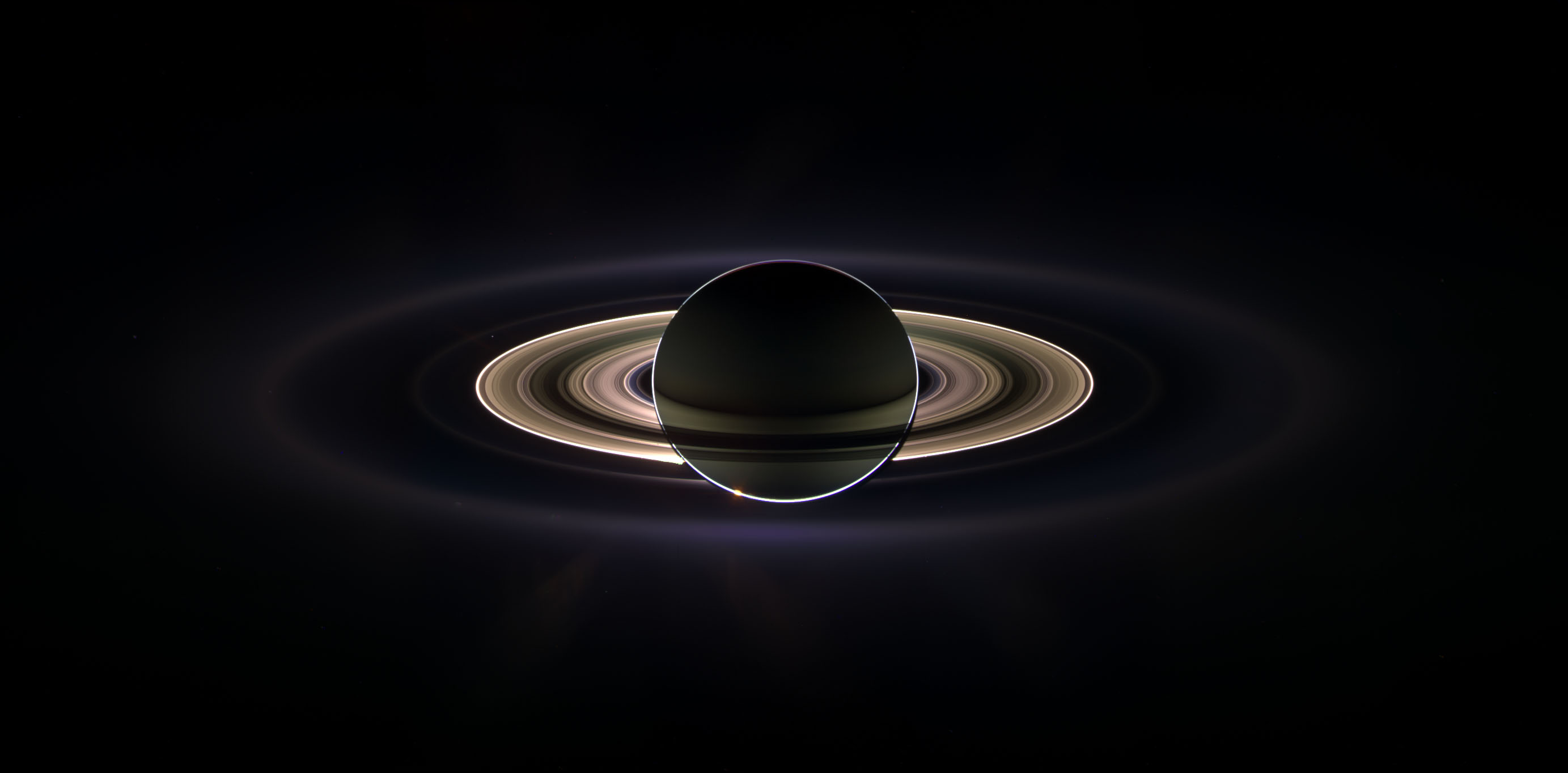
This image comes from solarviews.com, a cool website that has lots of info on our Solar System. It has pages about each of the planets, their moons, asteroids and much more. It also has info about other things like exoplanets and the Oort Cloud, which is a spherical cloud that surrounds our Sun and extends 3 light years. I didn’t know it even existed, much less how large it is! However, the best part of the website are the cool pictures like this one of Saturn (click on the photo for the link to the full size image). It was taken by the Cassani Orbiter and is one of my favorite images of space. I love how the Sun, which is directly behind Saturn, illuminates the rings and how you can see the atmosphere of Saturn diffracting the light from the Sun. There’s tons more photos taken from various sources, all one has to do is click on the subject and see the high-res images. Enjoy!


Posted in Exoplanets, Terrestrials | Tagged , , , , | Comments Off on Solar System Website

Jump to Light Speed

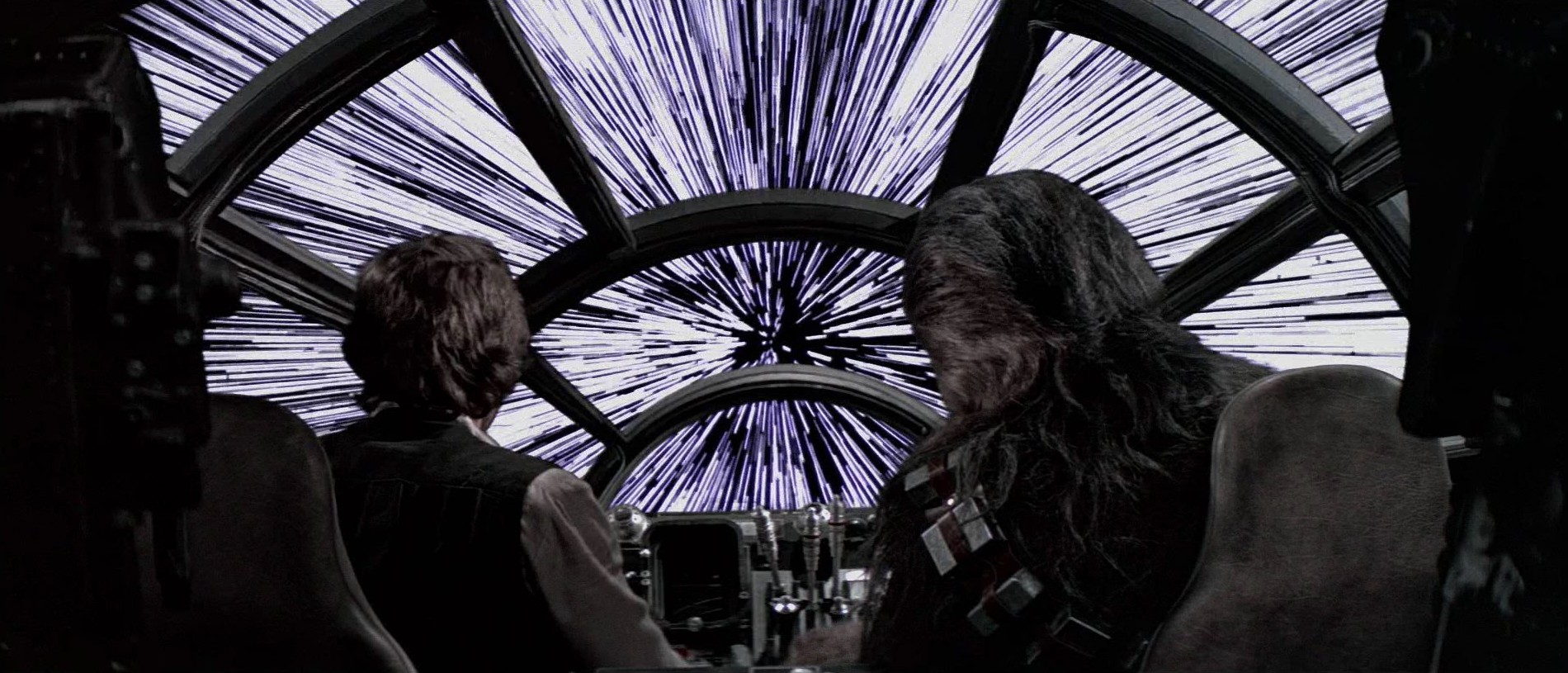
Many Sci-fi movies, shows, books, comics, etc. are based around the premise the being able to travel at the speed of light would finally allow a civilization as paltry as ours to traverse the stars and make the final frontier finally accessible. One slight hole in this logic that I have never seen addressed, however, is how one controls an object moving at light speed. Many people seem to have a hard enough time processing information and responding fast enough to avoid collisions in cars today. How could the same people possible be able to handle moving at the speed of light? It seems simply beyond man to truly comprehend moving this fast, much less how to steer something moving this fast. The idea, I suppose, would be that computer guidance systems would handle most of the actual piloting of the craft. This then means that each system  would have to be connected to a real-time map of EVERY body moving in whatever star system or area of space it found itself in. This in turn would require centuries of observation and mapping before any sane person would hurl themselves at a speed faster than they can conceive across a Universe as random and chaotic as ours. Many dream of the day that humanity can harness the speed of light to expand across the stars, but who dreams of all the years of logistical work that must be done even once we figure out how to move that fast?

Imagestarwars.wikia.com http://starwars.wikia.com/wiki/Lightspeed


Posted in Class | Tagged , , | Comments Off on Jump to Light Speed

The Speed of Light and Time Dilation

Relativity is probably the most interesting area of physics in my opinion, and this video does a great job of succinctly explaining the concept of time dilation. To summarize, objects moving at speeds close to the speed of light experience time more slowly from the perspective of a stationary observer because the speed of light is the same in all reference frames. This is truly incredible and almost unbelievable to me. Suppose one of my classmates got on a rocket ship, traveled off at near the speed of light and returned when I am an old man. That classmate would have experienced only a fraction of the time that I had, and as a result would be younger than me even if we were the same age to begin with. Every time I think about this I am amazed at the genius of Einstein and other scientists who developed this theory. Here is the link to the video.


Posted in Light | Tagged , , | Comments Off on The Speed of Light and Time Dilation

Farthest Supernova Yet!

English: Diagram showing accretion by a binary...

English: Diagram showing accretion by a binary white dwarf star, leading to a type 1a supernova (Photo credit: Wikipedia)

A few weeks ago, it was announced that a type 1a supernova had been discovered that was 10 billion light years away! Officially named SN SCP-0401 but nicknamed “Mingus” after a jazz composer, this supernova is remarkable not just for its distance but for the detail in its spectrum. Scientist will be able to use the supernova’s large redshift to study the ancient expansion of the universe. Because the supernova is ten billion light years away, that means that the light we are seeing is ten billion years old! That means it happened not only before life existed on Earth, but before the Earth and the Sun even existed!

Type 1a supernova are not the typical supernova that people think of. Instead of a star exploding towards the end of its life cycle, a type 1a supernova occurs when a white dwarf takes mass from a companion giant star until it reaches critical mass and explodes! These types of supernovae are the most useful for determining the age of distant objects because they all explode similarly, making it easy to adjust for distance. This quality of similarity is why they are called “standard candles.”

The original article can be found here.


Posted in Class, Stars | Tagged , , , | Comments Off on Farthest Supernova Yet!

Know your constellations, impress your friends!

When observing the night sky, most usually it is when going home from a late practice or study session around 10-midnight. One can always look up and be able to spot Orion and the belt, and look further up to find Jupiter, and if one looks even closer to spot the Pleidaes cluster.  Other familiar objects include the big and little dipper, and the “M” shaped constellation. However, I went out the other night very late at around 4-5AM, and when looking at the sky it looks totally different. While the cause of this is obvious (the rotation of the earth, not the movement of the stars!), it is still quite neat to see how different the sky can be after a time span of only a few hours. I almost had no idea what any of the stars or constellations in the sky were, as these constellations are rarely seen due to their late rising time. Some of the most fascinating formations in the sky include seeing Virgo, Hercules,  Libra, and especially Scorpius (seen around 5-7AM!). So, if you get bored of seeing the same thing in the sky tonight and want a change of scenery, try waking up really early or staying up really late and you’ll be fascinated by the different formation of the sky.  These constellations deserve some attention!

Scorpius

Libra

Hercules


Posted in Class | Tagged , | Comments Off on Know your constellations, impress your friends!

The Power of Ten, Blog #1

The Power of Ten Video:

This video made in 1977 is a brilliant piece of work that helps display the sheer magnitude of our universe. The video zooms out from a point in chicago by a factor of 10 in meters every 10 seconds, eventually leaving the earth untraceable in the sky as we zoom out many millions of light years away. The most striking parts of this video is how far away the closest stars to us are, and how the earth is incredibly small in relation to the universe. The video highlights the amazingness of space exploration, and how there is essentially still an infinite amount of explorations to be made in the universe. It is also interesting how the video zooms back in in the second half of the video all the way to the atomic particles, which serves to reiterate the fact of how small our earth really is in comparison with the scope of our universe.

This video culminates with the magnitude of 1 * 10^24 m^2, which the sky appearing relatively empty. The narrator discusses how this state of emptiness is relatively normal, which is a really frightening and fascinating statement. The fact that the universe can be so empty at this scale, yet there is so much activity happening on Earth demonstrates how special we really are, at least until we discover other forms of life. This is a great video that needs to be seen by all to foster an appreciation for the scope of our universe.


Posted in Class | Tagged , | Comments Off on The Power of Ten, Blog #1

Mysterious as the Dark Side of the Moon

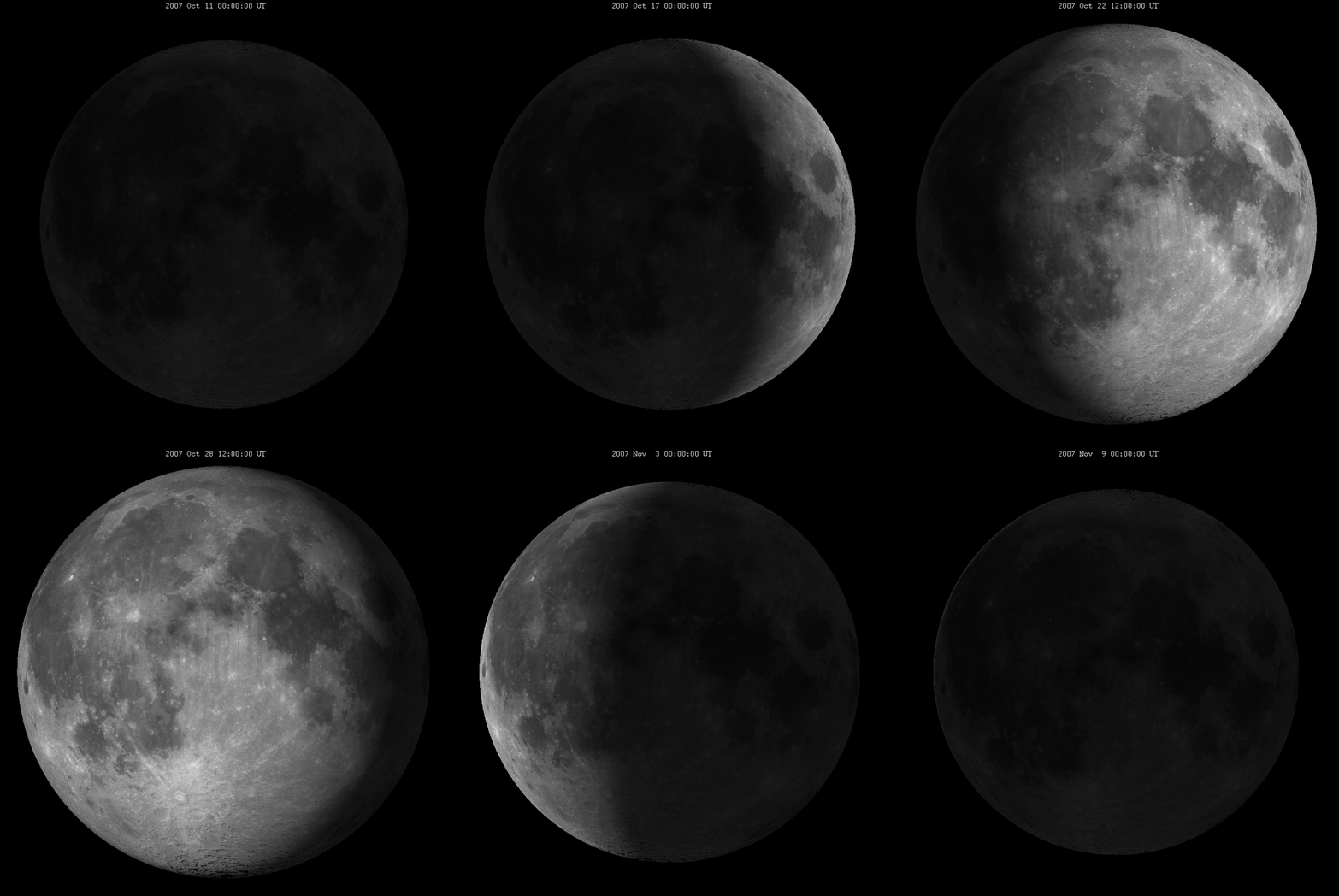
If you’ve ever watched the Disney movie Mulan, then you’ve heard the phrase “mysterious as the dark side of the moon.” This is a pretty common–although somewhat incorrect–phrase to say that something is unknown, much like the side of the moon that we can’t see. The moon is in synchronous orbit with the Earth, meaning the same side is always facing us, however the misnomer comes from the use of the word “dark” as the dark side of the moon technically changes with the moon’s phases. More often than not we actually can see at least part of the dark side of the moon, which is to say the side of the moon facing away from the sun.

The moon rotates around the Earth in approximately a one month cycle (or if you prefer, a “moonth”). As it rotates, different parts of the moon are exposed to sunlight, causing exactly half of the moon to be illuminated. The moon is never more or less than half lit–always exactly half. As the moon rotates around the Earth, we see more or less of the lit/dark halves, which is why we see the phases as we do.  The following diagram should help illustrate the motion of the moon about Earth:

As you can see, only half of the moon is ever lit, however as the moon moves about the Earth that half becomes more or less visible to observers based on where the moon currently is. The phases of the moon, in order, are: new moon, waxing crescent, first quarter, waxing gibbous, full moon, waning gibbous, third quarter, waning crescent, and back to new moon. It is worth noting that the orbital axis of the Moon is off by a few degrees, which explains the relative rarity of lunar eclipses. If the moon had a perfect orbital path, a lunar eclipse would happen every month.


Posted in Class | Tagged , , , | Comments Off on Mysterious as the Dark Side of the Moon