Historical Astronomers in Context

Galileo Galilei: 15 February 1564–8 January 1642

Occurrences during Galileo’s life:

The Thirty Years’ War began in 1618 and was fought throughout Europe largely because of religious turmoil between Catholics and Protestants. The war was noteworthy because it was so destructive and long-lasting, and therefore had a large impact on European culture as a whole.

Rene Descartes published Discourse on Method in 1637, toward the end of Galileo’s life. Descartes’s treatise outlines rationalism as an alternative philosophy to the prevailing empiricism of the time that has been presented by philosophers like John Locke. Descartes’s theme of rational intuition as the most reliable means of attaining knowledge is still pervasive in modern conversations about epistemology.

Another famous figure of the time:

William Shakespeare also lived at the same time as Galileo–he was born (historians guess) 26 April 1564 and died 23 April 1616. Shakespeare, of course, is renowned for the literature he produced, including the famous plays Hamlet, Macbeth, A Midsummer Night’s Dream, and so on.

___

Taking a closer look at the historical context of the lives of so many influential astronomers helps create a backdrop for thinking about science at this time. All these astronomers lived during the Enlightenment, and of course, the list of influential figures alive during that era doesn’t stop at astronomers–to know that Descartes, Shakespeare, and countless others were all producing their finest work in the same cultural climate. It’s really fascinating to think about the sheer quantity of groundbreaking ideas and theories that were being simultaneously produced. I also wonder how much each of these individual scientists and thinkers benefited from having so many intellectual equals around them–it seems utopian, almost, for all these genius thinkers to have so many other engaged people to discuss their ideas with!


Posted in Class, Historical | Tagged , , | Comments Off on Historical Astronomers in Context

Historical Astronomers in Context

Isaac Newton (1642-1726) was the first to accurately describe gravity and motion.  More specifically, he developed three laws of motion that identified a). objects stay in motion until acted upon; b). the relationship between Force, Mass, and Acceleration; and c). every actionary force has an equal and opposite reactionary force.

The British Enlightenment took place in England when Newton was alive.  The Enlightenment was a period of major academic accomplishment in science and philosophy.  Newton himself contributed much to the Scientific Revolution, the scientific sub-section of the Enlightenment as a whole.

While Newton revolutionized physics, philosopher John Locke contributed nearly as much to the advancement of political and philosophical thought.  He was one of the first to outline a governmental model based on the liberty and free choice of the citizenry.  His work had an enormous impact on the development of the United States Declaration of Independence and Constitution.

During the Enlightenment, Scientists and Philosophers seemed to inspire one another to make discoveries and observe the world around us.  John Locke was friends with both chemist Robert Boyle and Sir Isaac Newton, and they inspired his scientific and empirical approach to philosophy.

Isaac Newton Meme


Posted in Historical | Tagged , , | Comments Off on Historical Astronomers in Context

Historical Astronomers in Context

Nicholas Copernicus

Birthday: February 19, 1473 in Torun, Poland

Death: May 24, 1543 in Frauenburg, Poland

Johannes Kepler

Birthday: December 27, 1571 in Weil der Stadt, Württemberg

Death: 1630 in Regensburg

Tycho Brahe

Birthday: December 14, 1546 in Scania, Denmark

Death: October 24, 1601 in Prague

Galeleo Galelei

Birthday: February 15, 1564

Death: January 8, 1642

Isaac Newton

Birthday: January 4, 1643 in Woolsthorpe, England

Death: March 31, 1727 in London

Kepler and Brahe both lived at the same time from 1571 to 1601 (30 years).

Kepler and Galelei lived at the same time from 1571 to 1630 (29 years).

Brahe and Galelei lived at the same time from 1564 to 1601 (37 years).

All three (Kepler Brahe and Galelei) were alive between 1571to1601 (30 years).

Copernicus and Newton did not live at the same time as any of the men (0 years).

Johnnes Keplar was very important to astronomy because, using data Tycho Brahe had collected, he proved that the orbit of Mars is an ellipse. In 1609 he published Astronomia Nova which contained Keplar’s first two laws of planetary motion.

Many interesting things were happening during the life of Keplar.  Two that sick out to me are, in the year 1600 Shakespeare published Hamlet and in1607 Jamestown was founded in Virginia. It was the first English settlement in America. These are both monumental historical events that have significantly impacted our world today.

Shakespeare is a very famous historical figure from these times. His work is still a major part of English curricula today. His work has also influenced many other writers and artists.

What I find very interesting from learning this background information is that is that it makes the 1600s seem like a big time for humanity. People are starting to have major breakthroughs in science, arts and travel. It is also interesting because it implies that the general population has become wealthier for people to focus so much time on non survival things.

Sources:

Nicholas Copernicus 

Johannes Kepler

Tycho Brahe

Galeleo Galelei

Isaac Newton


Posted in Historical | Tagged , , | Comments Off on Historical Astronomers in Context

Historical Astronomers in Context

Sir Isaac Newton (25 December 1642-20 March 1727) was important to astronomy for a few reasons. He helped invent calculus, which helped define calculations for the movements of planets and different formulas, as well as being the first to discover the law of gravity. This was pretty important to astronomy, as it explains why planets orbit around each other, and why we stay attached to the Earth. He was also the first person to make a reflecting telescope, which created a much sharper image.

Here are a few events that happened during Issac Newton’s lifetime:

Bacon’s Rebellion was in 1676. It was one of the first attempts of rebellion by the American colonists, and it was comprised mostly of poor farmers. The rebellion was directed mostly towards the elite, and the Native Americans, both of whom were thought of as holding back the poor.

The First Jacobite Rebellion began in Scotland against Great Britain. They were started in order to put James VII of Scotland back on the throne after he was deposed by parliament during the Glorious Revolution. It was unsuccessful.

Benjamin Franklin was born January 17, 1706. He was important because he was a founding father of the United States, as well as an avid inventor and scientist. He is most famous for his work with electricity, his role in the American Revolution, and being the ambassador to France.

It was very interesting to me personally to realize how recent Newton’s discoveries actually were. I tended to think of Newton living 400-500 years ago, or at least towards the beginning of the British colonial efforts in the United States, however, seeing that Newton lived during both Bacon’s Rebellion and the birth of Benjamin Franklin showed me that he was more recent than that and gave me a general timeline of his life. Since I am generally more familiar with American history than European history this gave me a better idea of when Newton lived, and how he fit into the scientific time period that he lived in.

Information on Newton

Information on Bacon’s Rebellion

Information on the First Jacobite Rebellion

Information on Benjamin Franklin


Posted in Historical | Tagged , , | Comments Off on Historical Astronomers in Context

Historical Astronomers in Context

Issac Newton (December 25, 1642 – March 20, 1726)

Newton’s theory of gravitation explained why celestial bodies orbited other objects and named the force of gravity as the force responsible for attracting masses. He made the connection that the gravitational force that grounds everything to Earth is the same force that keeps Earth in orbit around the Sun. His other laws of motion also allow calculations to be made from observations of celestial bodies. Newton also applied his theory of gravity to Kepler’s third law, allowing the orbital distance and period to be determined with regards to mass.

Newton was not the only scientist with a breakthrough during this time period. In 1665, Robert Hooke discovered the concept of cells by looking at cork under a microscope. His work was fundamental in cell theory.

Other fields also saw the breakthrough of revolutionary figures. George Handel wrote his first opera, Almira, Königin von Castilien, in 1705. He was a Baroque composer.

One very famous man who lived during Newton’s lifetime was Miguel de Cervantes (September 29, 1547 – April 22, 1616). He is famous for writing the first novel, Don Quixote, which was very successful. Not only was he a writer, he also fought against the Ottoman Empire in the Battle of Lepanto in 1571.

After reading about Newton’s contributions to astronomy and Hooke’s to biology, I realized that we take a lot of the scientific information that we know for granted. To students and aspiring scientists, cell theory and planetary orbits are important topics to know for tests and grades, but to Newton and Hooke, they were groundbreaking discoveries. They struggled with preexisting ideas and came up with new ideas to more accurately describe the natural world. In the present day, we learn these ideas as facts in a matter of minutes. The work of previous generations of scientists acts as the foundation for new research. It’s crazy to think that hundreds of years from now, the most relevant topics that scientists are researching – the Higgs Boson particle, the cure for cancer, more impressive technology – might serve as the building block for even more advanced science. In fact, the foundation for new research might eventually grow so large that it takes decades of schooling to become specialized in a particular field. The amount of scientific progress that humans have made since Newton’s time is immense, and there is no way to guess how much humankind will achieve in the next 300 years.


Posted in Historical | Tagged , , | Comments Off on Historical Astronomers in Context

Famous Astronomers and other Stuff

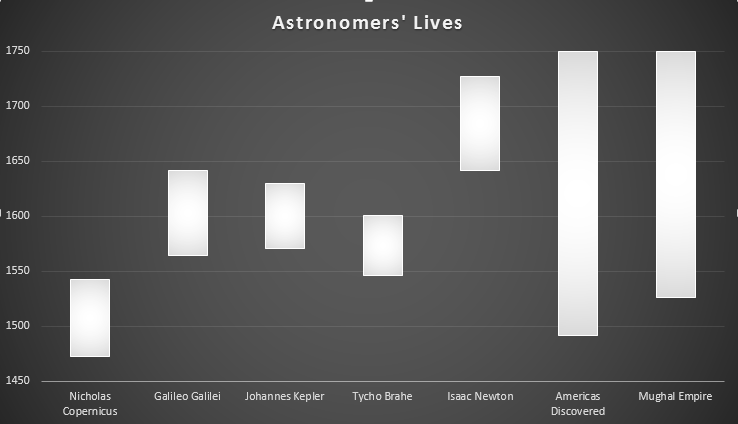
astronomers lives

There are 5 scientists that are recognized as major astronomical figures in Europe:

Of the 5 of these people, 3 of them were alive and active at the same time (Galelio, Kepler and Brahe).

Nicholas Copernicus, in particular contributed a lot to out understanding of the Solar system. It was he who popularized the idea of a Heliocentric model of the solar system. He gave a series of assumptions which explained things such as Sunrise, sunset, star motion, retrograde motion etc. Even though some of his assumptions are incorrect according to modern science, they were still such good approximations that all that was needed was Galileo’s little struggles to put the final nail in geocentric theory’s coffin.

During his time, the world was undergoing some serious changes. The Americas were discovered in 1492, a discovery that literally changed the face of the earth (according to humans, at least). In 1526 King Babur, the great grandson of Tamerlane defeated the Lodhi Dynasty to establish the mighty Mughal Empire in the Indian Subcontinent. His victory marked the first use of cannons in India (that was why he won, mostly). While Copernicus was busy reforming our view of the universe, William Shakespeare (1564-1616) was writing what would become one of the most recognized pieces of literature in the world. He is considered to be the greatest writer in English language and a trendsetter in literature of many other languages as well.

What I found so interesting was how differently I perceived scientific history from political history. Comparing astronomers to Columbus’s voyage makes astronomy seem really old (and the Americas really new). It was also a surprise to realize that the heliocentric model of the solar system was proposed before such a famous Empire was formed. Now the Taj Mahal seems like it was built yesterday.


Posted in Historical | Tagged , , , | Comments Off on Famous Astronomers and other Stuff

Historical Astronomers in Context

Sir Isaac Newton was an important figure in the history of astronomy because he came up with the theory of gravity.  By understanding the physics of gravity here on Earth, scientists now understand many of the laws that govern the rest of the Universe, and this can be helpful in making new astronomical breakthroughs and discoveries.

During Newton’s lifetime, some notable historic events occurred–the Peace of Westphalia and the discovery of cells.

In Europe in 1648, the Thirty Years War ended as a result of the Peace of Westphalia.  The Peace of Westphalia was a series of treaties that established, as the name implies, peace in Western Europe.  This was significant because it set up the new system of Europe that we still see today with independent countries that have sovereignty.

In 1663, the British scientist Robert Hooke discovered cells.  While examining a cork slice underneath a compound microscope, he observed what we now know as cell walls.  The word cell is also attributed to Hooke.  This was a major breakthrough in biology, and science in general, at the time.

One famous historical figure who lived during Newton’s lifetime was Oliver Cromwell.  Born in 1599 and died in 1658, Oliver Cromwell was the ruler of England in a period called the Interregnum.  Cromwell ruled England from 1653 to 1658 between the reign of Charles I and Charles II.  After Charles I was overthrown, military leader Cromwell came to power and had a profound influence over England.  He was seen as a liberal figure among the turmoil of England at the time.

Learning about these events that took place during Newton’s life really helped me place him in time.  Even though Oliver Cromwell probably did not have a direct influence on Newton himself, learning that Newton grew up during the Interregnum made me realize just how recent the discovery of gravity really is.  Additionally, learning that it occurred around the same time as the discovery of cells put things into perspective as well.  It is not often that you compare the timelines of two different disciplines of science, and I found it very interesting.


Posted in Historical | Tagged , , | Comments Off on Historical Astronomers in Context

Historical Astronomers in Context

Isaac Newton (1/4/1643 – 3/31/1727)

Isaac Newton Bio

1)   During Newtons lifetime

  1. In 1648, the treaty of Westphalia was signed. This treaty ended the thirty years war which took place in Germany.
  2. In 1701, The UK of Great Britain was formed. This was when England, Scotland, and Wales all entered the Parliamentary Act of Union.                                                    History 

-

Benjamin Franklin (1706-1790) was alive during Newton’s Lifetime. One of his largest achievements was being one of the founding fathers of the United States as well as being a very decelerated inventor.

B. Franklin Biography

This context was very interesting because it was a time full of invention, creation, and the foundation of America, as we know it. It is hard to believe how many extremely important American figures were alive at the same time.


Posted in Historical | Tagged , , | Comments Off on Historical Astronomers in Context

Sir Isaac Newton

Biography

Year of Birth: 1642

Year of Death: 1727

Historical Events Occurring During the Life of Isaac Newton

  • Great Fire of London.  This five day fire during September of 1666 is one of the most famous disasters in the history of London.  During the fire, much of London was destroyed and 100,000 people became homeless.
  • Invention of the Piano.  The actual date for the invention of the piano is unknown, but one appeared in 1709 in Florence.  Unlike the harpsichord, which plucked different strings to create the range of pitches, the piano has hammers that strike the strings, allowing pianists to vary the volume of a particular pitch.

Famous Historical Figure Who Lived During the Life of Isaac Newton

René Descartes

Famous for his statement “I think, therefore I am,” (Latin: cogito ergo sum) Descartes made a lasting mark on the world through mathematics.  His discoveries allow for the existence of analytic geometry, and the Cartesian plane is name after Descartes.  Descartes is also well known for his work in philosophy and metaphysics and his contributions continue to influence our world today.

Reflection

I remember one day in my high school physics class, my teacher brought in a book of the most influential people of history.  Topping the list was Muhammad, and numbers 3, 4, and 5 were Jesus, Buddha, and Confucius.  Isaac Newton came in at number 2.  The fact that Newton is the lone scientist in the top 5 (top 6, as the apostle Paul was #6) shows just how important Newton’s ideas were.  He tried to describe how the universe works—and to a large extent, succeeded.  Interestingly, we now know many of Newton’s ideas to be false.  For example, his theory of gravity fails to account for the gravitational attraction of photons, massless particles, to objects.  Newton’s work covers numerous fields of science and mathematics, and the contributions he made are extremely impressive, but it is also important to remember Newton did not accomplish this by himself.  Had it not been for the vital work of others like Kepler and Galileo, Newton might not have been able to achieve as much as he did.

As Newton once said, “If I have seen farther than others, it is because I have stood on the shoulders of giants.”


Posted in Historical | Tagged , , | Comments Off on Sir Isaac Newton

Historical Astronomers in Context

Galileo Galilei is one of the most important figures in the history of astronomy. He was born February 15, 1564 in Italy, and lived until January 8, 1642. Galileo has the remarkable distinction to be considered the first human to use a telescope to study planets and stars. With this new equipment, Galileo was able to see things that shook the foundation of astronomy at the time. He noticed Venus had phases like the moon, the heavens had many imperfections, and Jupiter had its own moons orbiting around it. These discoveries supported the Copernican theory that the Earth and other planets revolved around the Sun, challenging the Catholic Church and thousands of years of astronomy doctrine. Because of this, Galileo was sent before the Roman Inquisition and was forced to spend the rest of his life under house arrest.

Contemporary Events:

  • English settle at Jamestown, Virginia
  • King James VI translates Christian Bible according to the Church of England

Contemporary Person:

William Shakespeare, the great playwriter and poet, was actually born the very same year as Galileo. Shakespeare lived from April 23, 1564 to April 23, 1616. During this time, Shakespeare became a prominent figure in English literary history. He acted, wrote plays, and even created new words which are still being used today!

Reflection:

It is important to realize that life still goes on during the time of these great astronomers. I feel like many times we tend to focus on a single event or person in history, and forget
that there was a lot more happening (politics, religious movements, and works of art) during that time period. As an example, I never knew that Galileo and Shakespeare basically grew up together and possibly even admired each other’s work. I’ve studied both men but was never forced to look at the context of their life, and the world outside them at the time. The world was buzzing during Galileo’s life. New worlds to explore, the Renaissance was spreading across Europe, and great works of art were being created. But thankfully, even with all this, Galileo kept his eyes fixed on the stars and added yet another milestone to our rich history.


Posted in Class, Historical | Tagged , , | Comments Off on Historical Astronomers in Context