Historical Astronomers in Context

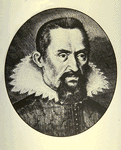
Nicholas Copernicus (19 February 1473-24 May 1543) was one of the three main people involved in the Copernican revolution. He was attempting to create more accurate predictions of planetary positions, when he stumbled upon Aristarchus’s heliocentric model. He was able to provide mathematical details that would make the model more convincing and ended up discovering simple geometric relationships to calculate the orbital period of the each planet, and its distance from the sun relative to the Earth-Sun distance.

Contemporary Events:

In 1492 Christopher Columbus began his first voyage to the new world and discovered the Americas by landing on what is now the Bahamas.

In 1521 Cuahtemoc surrendered to Hernan Cortes after 2 years of fighting marking the end of the Aztec Empire.

Contemporary Person:

Leonardo da Vinci (15 April 1452- 2 May 1519) was not only an artist with works such as the Mona Lisa, but he also excelled in many other subject areas including engineering and architecture making him a true renaissance man.

Reflection:

I did not realize how much progress was made in astronomy in such a short period of time. Before Copernicus, the widely accepted model was a geocentric model with planets that did loops while orbiting. Less than 100 years later, Brahe, Kepler, and Galileo created a model that is very similar to what is used today. Very shortly after that, Newton developed the laws of motion that are still used today.


Posted in Historical | Tagged , , | Comments Off on Historical Astronomers in Context

Historical Astronomers in Context

Image

Isaac Newton

25 December 1642 – 20 March 1726 Pic Source

Isaac Newton invented calculus and formulated the theory of universal gravity. His work in the fields of mathematics and physics revolutionized science and allowed astronomers to understand the motions of heavenly bodies and the forces that interact between them.

CONTEMPORARY EVENTS

The Great Plague of London occurred in 1665 while Newton was attending Cambridge. It was the last major epidemic of the bubonic plague to occur in the Kingdom of England.

The Acts of Union in 1707 united England and Scotland into one kingdom. Parliaments of both nations passed separate acts. The Acts joined England and Scotland into one nation, named “Great Britain”.

CONTEMPORARY PERSON

Gottfried Wilhem Leibniz was a German mathematician who shares with Newton the credit for the development of integrated differential calculus. The two developed different methods of integration independently, however, after some dispute Leibniz’s notation was adopted.

REVIEW

Learning of the context that surrounded Newton’s life and work really helped me to better understand how quickly events occur and how interrelated they all are. This is especially true with the work of Brahe, Galileo and Kepler. These three each made progress that would aid the other two and be used together to further the scientific community as a whole as well as set the stage for the work of Newton.  Without every event occurring as it did, including the Great Plague, who knows what our world would be like today?


Posted in Historical | Tagged , , | Comments Off on Historical Astronomers in Context

Historical Astronomers in Context

Isaac Newton (25 December 1642 – 20 March 1726) is a milestone in the scientific history. He studied laws of physics and mathematics, invented calculus as a means to calculate the orbits of celestial objects. He summarized three laws of motion, and came up with the explanation of the gravity, the reason why we stand on the Earth, why planets in solar system orbit the Sun. All these discoveries are landmarks for science history.

Newton’s lifetime corresponds to the Age of Enlightenment. This movement emphasizes reason and science over religion, and the influence of Catholic Church diminished during this period.

Newton also lived in the Baroque period in music. During Baroque period, music form was revolutionized. Music was not only composed for the church, but for the diversion of the aristocratic. The music was more emotive than that in the Mediaeval.

John Locke (29 August 1632 – 28 October 1704) lived at about the same time as Newton. John Locke is known as a pioneer of Enlightenment, a philosopher and politic ideologist. His work influenced a large number of later revolutionists such as Voltaire.

As I research about Newton, I discovered that some defines the year 1687 that he published his Principia Mathematica as the beginning of the Enlightenment. I realized that the science advanced while the music liberated at that time as well. These movements are clearly related to the confessionalization in the Europe. Protestants brought new idea to the Church, thus the whole society became more progressive, new ideas sprouted from this liberation. People were no longer confined by the absolute authority of the Church. Science, as a branch of knowledge, which is previously controlled by the Church, also gained freedom to be explored by common people.

I realize that behind all these historic incidents, the kernel of science is the freedom to think outside of the circle. Scientists have to try their best to remain neutral, not biased by their previous education and understanding.


Posted in Class, Historical | Tagged , , | Comments Off on Historical Astronomers in Context

Historical Astronomers in Context

Johannes Kepler was born on December 27, 1571 and died on November 15 1630. After Tycho Brahe died, Kepler inherited and analyzed his data regarding planetary motion. Kepler is responsible for discovering the three laws of planetary motion: that planets have an elliptical orbit around the Sun, that planets sweep out equal areas in equal times, and that planets farther from the Sun orbit at a lower speed than planets closer to the Sun, according to a specific mathematical formula . These revelations helped support the Copernican model of a sun-centered solar system and also helped to explain why planets appear to move the way that they do.

In 1607, which was during Kepler’s lifetime, the Virginia Company settled Jamestown, Virginia. This event was significant because it was the first permanent English settlement in what would grow to become the United States. Kepler was also alive for the beginning of the Thirty Years’ War, which started in 1618. This war, which started out as a war between Catholics and Protestants, ended up redefining some of the political and religious systems in Europe.

Kepler was alive for most of the lifetime of William Shakespeare, which was from around April 23, 1564 until April 23, 1616. Shakespeare is an extremely well-known writer, having written numerous plays such as Romeo and Juliet, Hamlet, and The Taming of the Shrew. Today, his brilliant work is a staple in many secondary and post-secondary English literature courses.

This investigation really helped me to put into perspective the lifetimes of key historical figures. I have always lumped the lifetimes of people like Copernicus, Kepler, Newton, Galileo, Brahe, and Shakespeare into the broad category of “a long time ago.” When looking back at all of history, a hundred years does not seem that long, but when I actually thought about how long my lifetime of only twenty years seems, I realized that some of these people, like Copernicus and Newton, lived in completely different eras. I had also never compared the lifetimes of people who specialized in different subjects before. For some reason, I always thought that Shakespeare wrote his plays long before these astronomical figures were making their discoveries, but in fact, they happened at the same time.


Posted in Historical | Tagged , , | Comments Off on Historical Astronomers in Context

Kepler & Shakespeare: Historical Astronomers in Context


Image

Johannes Kepler: December 27, 1571 – November 15, 1630

Kelper worked with Tycho to explain the motions of planets. By studying Tycho’s observation of Mars’ orbit, Kepler found that planets orbit in eclipses, not circles.  Kepler solidified his findings into three key laws, known as Keplers laws of planetary motion.

More Kelper

Soo, what else happened between 1571-1630? And who lived?

  • 1616: Blood circulation was discovered: Physician William Harvey observed the heart in animals and found that the heart was the organ responsible for circulating blood. Before his work, the lungs were thought to be responsible for blood circulation
  • 1618-1648: Thirty Years War: The Thirty Years war was a series of wars in Europe trigged over several causes: religion, politics and land. The Thirty Years war helped establish modern geographic and political barriers of Europe.
  • Shakespeare (1564-1616) was one of the greatest poet and playwrights of all time. His works have shaped the course of modern literature and language.

I have studied Shakespeare thoroughly in my middle school, high school and college English courses, so it is very interesting to place Kepler within this same historical context. Being relatively unfamiliar with the history of astronomy, it’s interesting to think that in the same time that Shakespeare was writing some of my favorite works of writing, Kepler was studying Mar’s orbit. Though Shakespeare’s writing stands untouched and unsurpassed to this day, both the discoveries in anatomy and astronomy have advanced substantially. This highlights the dynamic, accumulative and innovative nature of science. In particular, the discovery of blood circulation helps show how much science has progressed since Kepler’s lifetime. It seems that we knew as little about the human body in 1616 as we knew about the solar system. It is interesting to compare these various fields (English, anatomy and astronomy) then and now to observe changes and advancements achieved since Kepler’s lifetime. It begs the question, how much will change in the next few centuries?


Posted in Class, Historical | Tagged , | Comments Off on Kepler & Shakespeare: Historical Astronomers in Context

Historical Figures In Context

  1. Newton (December 25, 1642-March 20, 1726) was important to astronomy because he was probably the most influential physicist ever. Newton’s laws of physics help explain why planets orbit stars and why moons orbit planets, for example. While many others just made observations, Newton was able to describe why these occurrences were happening through his discovery of gravity. Link to source
  2. Historical Events During Newton’s Lifetime
    1. 1688- The Glorious Revolution in England, in which James II fled and William of Orange and Mary come to power with permission of Parliament. Link to source
    2. 1697- The last Mayan states fall to the Spanish Empire, ending an empire that had existed for around 3000 years. Link to source
  3. That there were Mayas still around when Newton was alive is pretty astounding. It awes me how ahead of his time he was.

Posted in Historical | Tagged , , | Comments Off on Historical Figures In Context

Historical Figures in Context

Johannes Kepler (1571-1630)

Thirty Years War: The Thirty Years War occurred during Johannes Kepler’s life, taking place from 1618-1648. It was a war fought for a variety of reasons (religious, territorial, economic) by many different countries in Europe (Austria, England, France, Germany, Italy, and others). This was a complicated and long war that plagued Europe for thirty years, overlapping Kepler’s life.

Counter Reform: The Counter Reformation began with the Council of Trent and ended with the Thirty Years War. It occurred during Kepler’s life and was also known as the Catholic reformation. It formed a time of strict religious conformity as a response to Martin Luther’s opposition to the Church.

William Shakespeare: William Shakespeare lived in the time of Kepler’s life, from 1564-1616. He was a famous writer and to this day is still taught in schools. He brought emotion and drama to the stage and was extremely successful. His work only got more famous after he died.

It is interesting to remember that while all of these extraordinary astronomical discoveries were being made, so many other things were happening. It is easy to see how many of these discoveries could be swept under the table, especially if it doesn’t match with the past beliefs. People were living in a time of war and religious reform, it is even more impressive that Kepler was able to make such breakthroughs and get people to care while so much other change was happening around him. Generally when this much chaos and change goes on, people want things to stay constant. That means Kepler’s work and data is stronger than I originally even knew.


Posted in Class, Historical | Tagged , , | Comments Off on Historical Figures in Context

Historical Astronomers in Context

For my chosen astronomer, I chose Isaac Newton. He was a physicist, astronomer, and mathematician and his contributions can be found everywhere. Among his findings in astronomy, he is best known for his theory of universal gravitation, which produced an equation that became one of the staples in future astronomical findings.

During his lifetime (he lived for 84 years), a lot of important events had occurred, and here are a few:

– When Newton was basically just born, a huge scientific event that had happened was that the barometer was invented. The barometer is a device that measures atmospheric pressure and is used in chemistry and can be utilized to predict weather changes.

– Then, in 1700, the Great Northern War had begun. It was fought between Sweden’s Charles XII and Russia’s Peter the Great, and had lasted for 21 years. By the end, Sweden lost it’s reign while Russia became a world superpower.

– In 1706, Benjamin Franklin (1/17/1706 –  4/17/1790) was born. He had major contributions in science and politics, ultimately becoming one of the founding fathers of Ameriac. He can be seen on the $100 U.S. dollar bill.

While reflecting on what I have just previously found out, I realized that all of these events had occurred not too long ago. To think that Newton and Benjamin Franklin were alive only 300 years ago, that’s really only 4 generations. So much has been accomplished in these past 10 years in regards to technology and health services, let alone the past 300 years. It makes me wonder what other kinds of historical findings during our current lifetime will impact the world in the next 300 years.


Posted in Historical | Tagged , , | Comments Off on Historical Astronomers in Context

Historical Astronomers in Context – Kepler

This post will focus on the historical context of the life of Johannes Kepler.  The following astronomers lived during the time periods below:

– Nicholas Copernicus:  19 February 1473 – 24 May 1543

– Galileo Galilei:  February 15, 1564 – January 8, 1642

Johannes Kepler:  December 27, 1571 – November 15, 1630

– Isaac Newton:  25 December 1642 – 20 March 1727

– Tycho Brahe:  December 14, 1546 – October 24, 1601

Kepler’s biggest contribution to modern astronomy was the creation of his three laws of planetary motion.  These laws are:  planetary orbits are ellipses, with the star at one focus; planets sweep out equal areas in equal time periods during their orbits; and there is a precise mathematical relationship between the speed at which a planet orbits a star and the distance of that planet from the star, which can be expressed as a ratio of the square of the orbital period to the cube of the average distance of the planet from the star.  Kepler was the first astronomer to abandon the idea that orbits are perfectly circular, and his laws are still important to our understanding of planetary motion today.

Two major events that occurred prior to Kepler’s publishing of his laws of planetary motion in 1609 were the 1605 publishing of the first part of Miguel de Cervantes Saavedra’s Don Quixote de la Mancha, which is widely regarded as the first modern fictional novel, and the implementation of the modern, Gregorian calendar in 1582.

One other famous figure that lived during Kepler’s life was William Shakespeare, 1564-1616, arguably the most influential writer and poet in the history of the English language.

I enjoyed learning about the historical context of Johannes Kepler’s life because it added to my understanding of the literary, scientific, and exploratory times in which he lived.  For example, the fact that the first permanent colony in what is now the United States, Jamestown, was being settled during Kepler’s lifetime, before a complete understanding of the techniques of astronomical navigation, is tremendous.  This helped put into context for me how great of a feat it was for such explorers to navigate the globe without a complete understanding of planetary motion.


Posted in Class, Historical | Tagged , , | Comments Off on Historical Astronomers in Context – Kepler

Historical Astronomers in Context

The historical figure that I chose was noted astronomer Johannes Kepler (1571-1630).  During his lifetime, the following events were happening:

–       The Thirty Years’ War (1618-1648) was an era of warfare in Central Europe.  It is believed to have been caused mainly by continuous conflict between Catholics and Protestants in Europe, however, more causes are also suspected.  The Thirty Years’ War was occurring in Kepler’s home country of Germany during the last years of his life.

–       The Jamestown Settlement in The British colony of Virginia was founded in 1607.  This massive step in expansion of the western world was a pivotal event in world history, and happened during a time of incredible scientific expansion as well.

Galileo Galilei was another incredibly important scientific figure at the time of Kepler.  His discoveries helped change the way the entire world saw Earth’s role in our solar system.

I was most interested to learn just how hard all of these historical figures worked to develop and prove their individual theories and discoveries, in a time where technology was such a limiting factor.  The accuracy of their measurements and scale of their discoveries is incredible when considering the time period in which they accomplished these feats.


Posted in Historical | Tagged , , | Comments Off on Historical Astronomers in Context