The Sound of the Solar System!!

Screen Shot 2013-03-18 at 4.42.52 PM

Recently I have started a new habit before bed, I try to watch one TED talk a night. I’ve really enjoyed this experience, and I have learned a lot about things I otherwise would never come across. I really love the variation in the talks, and it reminds me how much knowledge is out there! A few weeks ago I watched a TED talk called “A History of the Universe in Sound”, which I think adds a really unique perspective to our understanding of the solar system. Honor Harger narrates the talk and provides audio clips of various solar bodies including the Sun, Jupiter and the rings of Saturn. To accomplish this, Harger uses radio waves from celestial objects and turns them into sound. She concludes her talk by telling the story of the origin of the universe through sound. The video is about 11 minutes long– I highly reccomend listening all the way through. The last minute is the oldest known sound in our universe. In the words of Harger, I hope you enjoy “listening to the weird and wonderful noises emitted by the magnificent celestial objects that make up our universe”!


Posted in Class, SolarSystem, Sun, Universe | Tagged , , , , , , | Comments Off on The Sound of the Solar System!!

God Particle

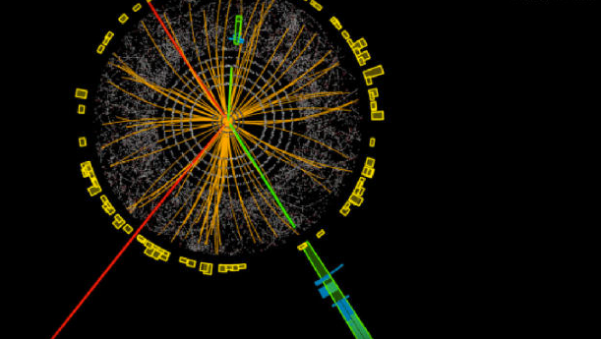
ImageThere has been new findings regarding the origin of the universe and what caused the big bang. This research, $10 billion dollars later, confirms that the way physicists and other scientists viewed particle physics was actually correct. Had this not been proven, scientists would have completely had to reconsider their theories on the origination of the universe and quantum physics. This could have changed the way technology is made- such as MRI’s and PET scans. Basically, the God Particle, also known as the Higgs boson, gives everything in the universe its mass. This is a huge discovery for the science community, and something scientists around the world are celebrating. It also came just in time for Einstein’s birthday, and Pi day!

SourceSource


Posted in Physics | Tagged , , , , | Comments Off on God Particle

Life On Titan?

We may not have to look very far from our solar system for habitable worlds that can sustain life. We already know that Mars had conditions suitable for life in its early years and there is a possibility that Venus might have been the same way. But scientists are now excited about the possibility that Saturn’s moon Titan might have life in some form because there are organic compounds in liquid from beneath and even on Titan’s surface!

Scientists guessed that Titan is rich in organic compounds much like our Earth for quite a while but it was NASA’s Cassini-Huygens spacecraft that provided crucial evidence. Specifically, the Huygens probe landed on Titan’s surface after separating from the Cassini orbiter and started collecting data. It found that Titan actually has hydrocarbon lakes (mostly made of methane and ethane) on its surface with the possibility of even more so beneath its surface! Titan is the only known world besides our own planet to have clear evidence of having substances in liquid form on its surface.

Therefore, exploring Titan more and seeing if it can support life in any way is crucial if we are to understand how life started in our own world. Who knows? Maybe Titan will grow to be a paradise for life just like Earth is now millions of years in the future


Posted in Moons | Tagged , , , , | Comments Off on Life On Titan?

Venus

Venus is a unique planet among the terrestrial worlds and possesses  many features that make it an interesting planet to study.  Often called a sister planet of Earth because of the two planet’s similar sizes and compositions, Venus is, in some ways, a very different planet from Earth.  To start, Venus is completely inhospitable to life, with surface temperatures reaching over 880 degrees Fahrenheit, the highest of any planet in our solar system.  Venus’s extreme temperature is due to its atmosphere, composed of mostly CO2 and N2, which traps the heat.  Unlike Mercury, the Moon, and Mars, Venus has a thick atmosphere, producing a surface pressure of about 90 times that of Earth’s.  Venus’s atmosphere also moves incredibly quickly, with top wind speeds travelling at around 224 miles per hour.

Another feature that makes Venus unique is its rotation.  It orbits the Sun once every 225 days, but it completes one rotation on its axis every 117 days.  This means that a Venusian year lasts about 2 Venusian days! This very slow rotation means that, unlike Earth, Venus does not have a magnetosphere, despite the two planets’ similar cores.  Another interesting fact about Venus’s rotation is it rotates backwards compared to the rest of the planets.  Most of the planets spin counterclockwise at an angle to the ecliptic (plane of the solar system), but Venus spins clockwise.

Because Venus is a terrestrial world, we might expect to see cratering like Mercury, the Moon, and Mars, but Venus has relatively few craters.  Venus does have some large craters, but most of its craters have been destroyed by processes such as volcanism.  We might also expect to find evidence of erosion on Venus because of its atmosphere.  However, due to its very slow rotation, Venus does not have strong surface wind.  Venus is also too hot for erosion by water to occur.  Note that the slow surface winds are different from the high velocity wind in the atmosphere.  The third geological process absent from Venus is plate tectonics.  Plate tectonics may have been an important piece of Venus’s past, but several hundred million years ago, many of Venus’s geological features were erased by volcano’s, the most active geological process on the planet.

Venus is a very interesting planet, but unfortunately its extremely high surface temperature means that it would be virtually impossible for astronauts to go there, and even space probes we have sent have not lasted more than few hours in the brutal conditions.

Source


Posted in SolarSystem, Terrestrials | Tagged , , , | Comments Off on Venus

The Little Solar System that Could

Pluto and its moons

Pluto and its 5 moons, as seen by the Hubble Space Telescope. Space.com

Pluto may no longer be a planet, but it sure is proving to be one of the most interesting objects in our solar system.  We’ve kicked it out of the planet club, but Pluto seems to have plenty of friends of its own, with scientists thinking the little dwarf planet could have 10 more moons to keep it company.

It’s not even the biggest dwarf planet – that would be Eris – but Pluto has a surprisingly large number of moons. It’s less massive than the Earth (with 1 moon) and Mars (with 2), but Pluto already has 5 discovered moons, 2 of which have yet to be named. The newest moon, called P5 for now, was only discovered last year, and it was this discovery that has NASA scientists worried. The NASA mission New Horizons is set to get up close and personal with Pluto in 2015, but scientists are worried they may need to modify its path to avoid these newly-discovered moons or any other tiny moons lurking in the area.

Scientists think that the tiny moons exist because of computer simulations involving the formation of Pluto. Evidently a dust cloud once surrounded the dwarf planet, potentially following a collision of Charon with Pluto. This dust and debris gradually clumped together in much the same way the planets formed, only on a smaller scale.  The collisions that would have built the moons are hard for researchers to implement, so the correct number of additional moons could be anywhere from 1 to 10. These moons would be too small to be seen from Earth due to Pluto’s relative brightness, and the Hubble Space Telescope would barely be able to see them. Either way, that’s a lot of moons for such a tiny planet.  I think it’s great that just because Pluto isn’t a planet anymore doesn’t mean it isn’t still full of things for astronomers to discover.


Posted in Moons | Tagged , , , , | Comments Off on The Little Solar System that Could

The Magic of Scattering

Ever wondered why the sky looks blue? Or red during sunsets? No, it has nothing to do with light reflecting from the oceans (think about it, why would the sky look blue over inland areas then?). The real reason is the phenomenon called scattering. Scattering occurs when light rays are deflected from their original path by the molecules of the substance they are passing through. The amount of scattering depends on the wavelength of the light. The particles in our atmosphere are better at scattering light of shorter wavelengths and thus, blue light from the sun is scattered the most compared to the other colors and it makes the sky look blue. Particle size also matters in determining light of which wavelength is scattered the most.

What makes the sky look red during sunsets then? It is not that the atmosphere changes or anything but the sunlight has to travel through many more layers of atmosphere when the sun is near the horizon. By the time the light reaches us, light of shorter wavelengths has already been scattered and the light that reaches us is of longer wavelengths like red. This is also the reason why “stop” is signified by red light in traffic signs as the color red can be seen from far off (as it is scattered the least!) This type of selective scattering where particles of a certain size are more effective at scattering a particular wavelength of light is called Rayleigh scattering.

The other type of scattering is called Mie scattering and it is responsible for the white appearance of clouds. Cloud droplets have the size appropriate to scatter all wavelengths of light and thus, they appear white!


Posted in Class | Tagged , , , , | Comments Off on The Magic of Scattering

Everyday is SUNday

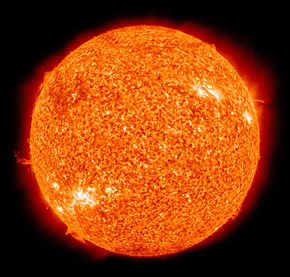
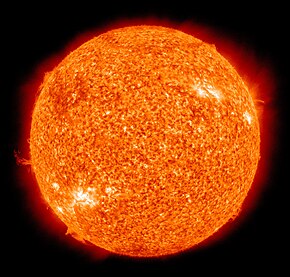
The Sun is the single most important object in our solar system. It makes up over 99% of the mass of the solar system, exerts gravitational force over the whole solar system, and even helps sustain life on Earth.

One of the most remarkable aspects of the Sun is the self-regulation of thermonuclear fusion. It has a “pre-set thermostat” that maintains the rate of fusion to be relatively constant. This mechanism is very common in living organisms, such as when hormones are released and they gradually build up and eventually inhibit the organ that released the hormone. The Sun follows that pattern as a result of gravitational equilibrium and fusion. Gravity causes the mass to contract to the center of the Sun but the pressure of hydrogen atoms causes the core to expand. These opposing forces eventually find an equilibrium position and prevent the Sun from collapsing or expanding uncontrollably. The regulation of this equilibrium is actually quite clever. If the temperature of the core rises, then fusion increases, and the core expands. However, the larger core ends up cooling down, and the pressure drops and gravity contracts the core. If the temperature of the core decreases, then fusion decreases, and core shrinks due to lower pressure. However, the shrinking of the core causes the core to heat up and restoring the original fusion rate. Gravity and nuclear fusion keep each other in check.

The Sun will keep fusing hydrogen in equilibrium as long as there is hydrogen to fuse, but what happens when it runs out? The Sun will have grown into a red giant before it has exhausted its hydrogen supply, and once it has, an explosive helium flash will occur. The Sun will start fusing helium in the same way that it fuses hydrogen. Eventually, the Sun will shed its outer layers and become a white dwarf.

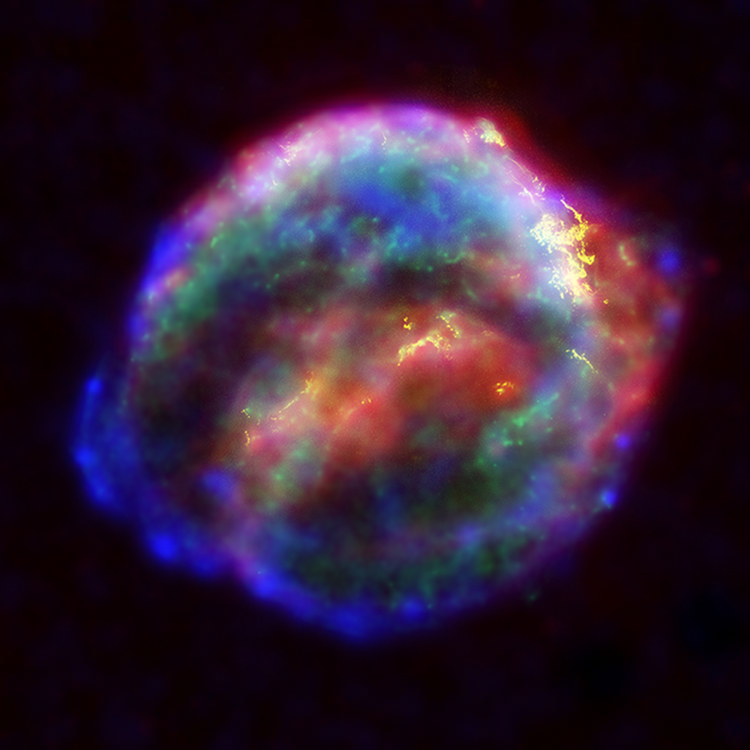
A more exciting outcome occurs with much larger stars. When they run out of hydrogen, they begin to fuse helium. When they run out of helium, they fuse heavier elements such as carbon or silicon. However, the limit is reached when stars attempt to fuse iron. Fusing iron requires more energy than it releases when fused, and the equilibrium between fusion and gravity shifts. Gravity now overcomes the outward force of fusion and the star violently collapses and explodes in a supernova explosion.


Posted in Stars, Sun | Tagged , , , , , | Comments Off on Everyday is SUNday

Mass Conversion of Energy

Albert Einstein’s most commonly known contribution to science, E=mc2, relates energy to mass. The energy conservation law preached to high school physics students states that energy can neither be created nor destroyed. As a result, mass can be seen as a “type” of energy (but acts more like a massive store of energy). The conversion of mass into energy is how the Sun produces energy through thermonuclear fusion.

How much energy does mass store exactly? Einstein’s equation gives us the answer. The amount of energy stored in the mass of an object is equal to the mass times the speed of light squared. The speed of light is about 300,000,000 m/s (as investigated thoroughly in my first blog post), which is a very big number! The square of the speed of light is even bigger: 90,000,000,000,000,000 m2/s2. If you multiply this number by even a very small mass, you will still get massive amounts of energy.

You decide you want to see for yourself whether Einstein was right about the amount of energy that mass holds. You start small…you decide to use the mass of an electron – 9.12×10⁻³¹ kg. You put that electron into your mass converter (which unfortunately does not exist in real life yet) and it gives you a disappointing 8.2×10⁻¹⁴ joules of energy. Which means nothing actually happened.

You’re frustrated, so you decide to use something bigger. You don’t want to blow yourself up, so you decide to test a single human cell. You pop that cell (about 1×10-12  kg) into your converter, and out comes 90,000 J of energy. 90,000 J is not a lot of energy. A 100W lightbulb uses 100 joules of energy per second, so leaving that lightbulb on for 900 seconds (15 minutes, or about half the length of your favorite TV show) would consume the same amount of power.

You now decide to use objects you can actually see without the help of a microscope. You look around outside, and you throw a grain of sand (mass 3.5×10⁻¹⁰ kg) into the converter. The energy you receive from this grain of sand gives you enough energy to power your 100W lightbulb for over 3 days (31,500,000 J of energy).

The thrill of these explosions causes you to keep finding bigger objects. You snatch a mosquito flying around your house and discover that its mass (2.5×10⁻⁶ kg) gives you 2.25×10¹¹ J. This amount of energy, if released all at once, is the equivalent to an explosion of 50 tons of TNT. Alternatively, if pumped into our 100W lightbulb, would light it for over 71 years.

You discover your invincibility after surviving the release of energy from the mosquito, and you go decide to really invest in this project. You put a dollar bill into the converter. The dollar bill is 1×10⁻³ kg (1 gram) and is worth much more than a dollar if converted into energy. The energy released in this conversion is 9×10¹³ J, which is more than the energy released in the atomic bomb that was dropped over Nagasaki. Instead of destruction however, this energy can be used to power the 100W lightbulb for 28538 years.

At this point, you are throwing everything in the converter. Selling the energy you are producing is worth more than what the object is worth.You convert your 2 kg laptop into 1.8×10¹⁷ J of energy which is about 50 megatons of TNT, or equal to the energy released by the Tsar Bomba, the largest nuclear weapon ever detonated. Using this energy, the lightbulb stays lit for over 57 million years.


Somehow, after surviving blasts of energy equal to the most formidable nuclear weapon ever tested, you drag your piano into the converter. This 400 kg piano yields 3.6×10¹⁹ J of energy, enough energy to power the electricity needs of the United States for over two years.

Turns out, the rest of the world isn’t invincible. Instead of patenting your converter and receiving a Nobel Prize, you obliterated everything. Except your 100W lightbulb. The piano’s energy will allow it to shine on for another 1.1 billion years.


Sources: Approximate masses of objects

Approximate energy equivalents

TNT comparisons


Posted in Physics | Tagged , , , | Comments Off on Mass Conversion of Energy

By Chance…

I set out without a real direction for this blog post. (I suppose that makes sense since some of the more interesting discoveries you can come across on the web pop up when you jump from page-to-page.) During my search for a new and interesting article on some aspect of astronomy, I came across a Scientific American article called “Spacecraft Sees Comet, Earth and Mercury Together.” The article talks about how just two days ago a spacecraft—which NASA launched to study the Sun—caught an image of a comet (called Comet Pan-STARRS) with Mercury and Earth in the same field of vision.

Comet with Earth (right) and Mercury (left)Source:

Comet Pan-STARRS with Earth (right) and Mercury (left)
Source: “Spacecraft Sees Comet, Earth and Mercury Together”

Now what the spacecraft actually caught was this video (the picture above is just a still-frame from this video):

Source: Space.com

A couple of things initially truck me about this story. First of all, I had to take a second to realize that this comet will be roughly 110,000 years older after it finishes this orbit around the Sun (after it finishes its journey through our inner solar system, as is seen in the video). Additionally, from this simple video, scientists plan to take a more in-depth look at the tail of this comet to analyze how it moves as well as the wealth of additional data that the spacecraft was able to collect about it’s approach and interaction with the space it is currently traveling through.

Thinking about the fact that this comet will soon be caught in orbit around the Sun (the physics major in me took a slight detour thinking about escape velocities that would be needed for the comet to break free of the Sun’s gravitational pull and instead simply slingshot around the Sun) reminded me that the spacecraft taking this video was not sent into space to observe this, or any comet. Instead Stereo-B (the name of the spacecraft) was placed in space to observe phenomena of solar wind. Actually, if you look closely at the video you can see the solar wind stream as a stream of material in the upper left hand corner. But that’s besides the point. After thinking about the data that this simple spacecraft was able to collect about an object which it wasn’t even truly equipped to study, I began to wonder how many other spacecrafts catch random astronomical phenomena by chance and are able to give us—well, scientists—valuable data to further study. Is a decent amount of what we know about our universe based solely on the fact that we happen to be looking in the right place at the right time? Sounds like the topic for another blog post. Stay tuned.

Also, if anyone is interested, we can actually see this comet right now—because we are in the Northern Hemisphere—if we look “low on the western horizon just after the sun has gone down.”

Source for this article: “Spacecraft Sees Comet, Earth and Mercury Together”


Posted in Small SS Objects | Tagged , , , , | Comments Off on By Chance…

Magellan to the New World

In class we recently discussed the four primary types of robotic missions that we can send into space:

  1. flyby
  2. orbiter
  3. lander or probe
  4. sample return mission
MAGELLAN

Magellan orbiter at the Kennedy Space Center
Source: Magellan Images

In general the concept of sending physical objects into space so that we can collect data about plates, stars, or anything really that we can’t directly observe here on Earth (or rather that we can directly observe better from space) is a pretty amazing concept. It took me a little bit (and by a little bit I mean I am still trying) to wrap my mind around the fact that this is even possible considering how vast and complicated the “world” of space is.

But, if you can push through the initial magnitude of the data that such missions can illuminate, it is easy to get caught up looking into specific missions. One mission in particular really caught my eye: Magellan—the 1990 NASA orbiter-mission sent to observe Venus. This mission was so monumental because, even though it came early in NASA’s history, it was able to revolutionize what scientists then knew about Venus.
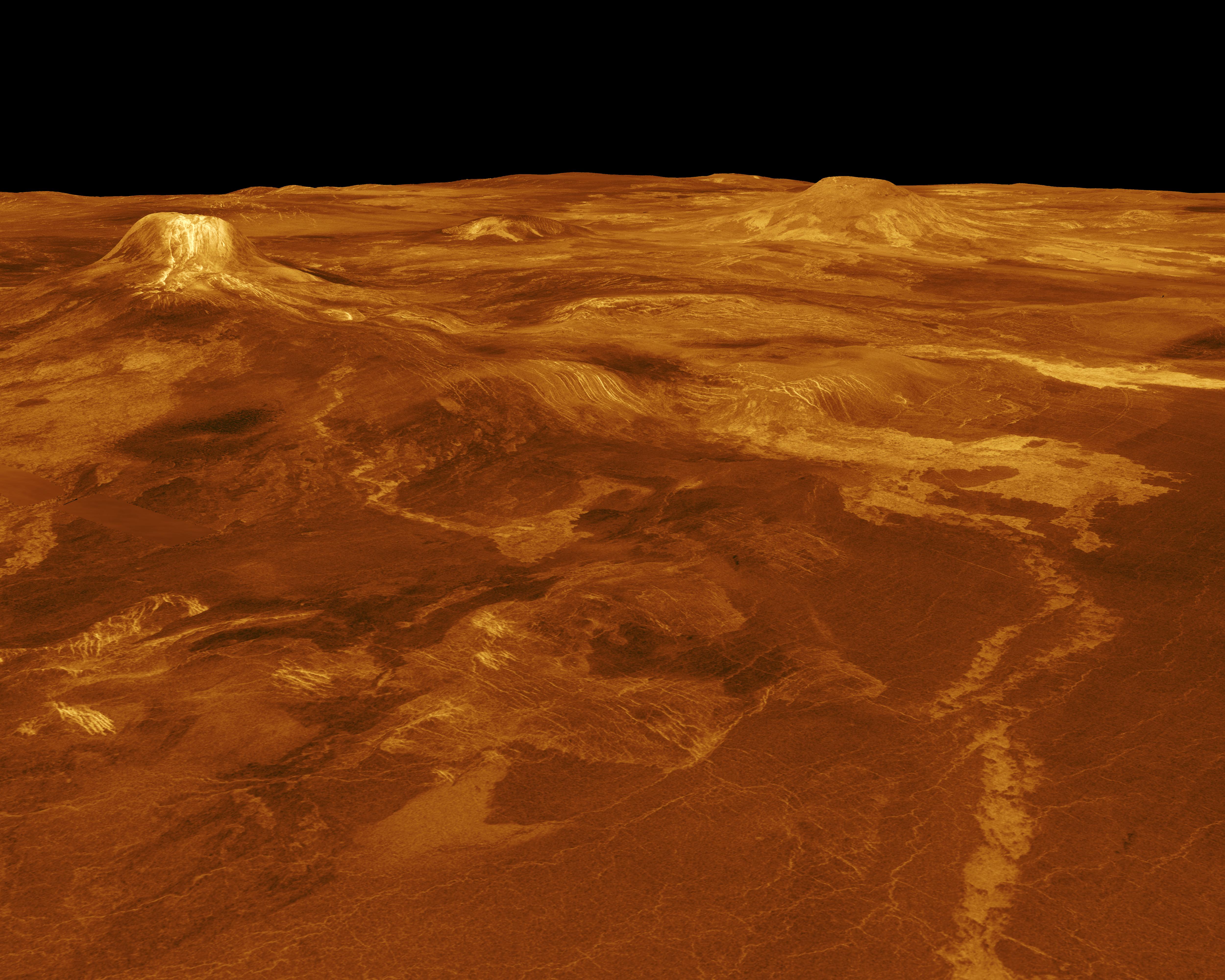
Among some of the more impressive discovers were:

  1. Venus’ surface appeared relatively young. They were able to conclude this because of the radar images of Venus’ surface revealed relatively few craters for the expected age of the planet. This suggested that volcanism had smoothed out some of the initial craters in the past 500 million years.
  2. Magellan showed no signs of water ever on Venus. Because of the maps that Magellan was able to construct, scientists were able to conclude that there were no surface features that pointed to the presence of water in Venus’ past—such as shorelines, ocean basins, or erosion by water.
  3. Venus doesn’t have plate tectonics, contrary to prior belief. Because the Magellan orbiter showed no geological proof for plate tectonics, scientists began to suspect that the interior of Venus was vastly different from Earth (even though their sizes are roughly the same).
Picture of Pancake Domes on Venus taken from the Magellan mission.Source: Magellan Images

Picture of Pancake Domes on Venus taken from the Magellan mission.
Source: Magellan Images

These three discoveries, which would not have been possible without Magellan, allowed scientist to better understand Earth’s sister planet. It also allowed scientists to get more insight into the fundamental elements of a terrestrial planet that serve as determining factors in that planet’s history. Orbiter or not, this is one of the cooler NASA missions that I looked into!

Primary Source: Magellan Mission Homepage
More Magellan Pictures: Magellan Mission to Venus


Posted in Instruments | Tagged , , , , | Comments Off on Magellan to the New World