Animated diagram of deuterium (hydrogen-2) and tritium (hydrogen-3) fusing into helium-4, courtesy of Wikipedia.
Nuclear fusion, the process by which two atoms collide to form a single larger atom, has been fueling stars since the beginning of star formation. At most distances apart, two protons will naturally repel each other due to the fact that both are positive charges, and the Electromagnetic force between them pushes them apart; however, all atomic particles will attract one another at extremely close distances (around 1-3 femtometers, or the distance between protons and neutrons in an atomic nucleus) due to the Strong force acting on them. The Strong force can overpower the Electromagnetic repulsion between like-charged particles, but this can only happen at an extremely close distance as the Strong force has a very short range.
What does this mean for nuclear fusion? It means that if you have two separate atoms, it is possible to force them to combine together into a single nucleus provided you can get them close enough for the Strong force to overtake the Electromagnetic one. If the nucleus formed in the reaction is smaller than iron (Fe) or nickel (Ni) then the reaction will produce energy, as the particles can all experience the net attraction from each other particle; for larger nuclei the reaction will consume energy as the produced nucleus will require more energy to overcome the Electromagnetic forces than is supplied by the net attraction of the particles to each other. The only remaining question is, how do the two fusing atoms overcome the Electromagnetic repulsion to begin with? If the two atoms are moving fast enough, their momentum can overcome the repulsion and they will stick once they smash together. Extreme temperatures and pressures can bring atoms such as hydrogen up to speeds fast enough for fusion, making the cores of stars a perfect breeding ground for fusion reactions.
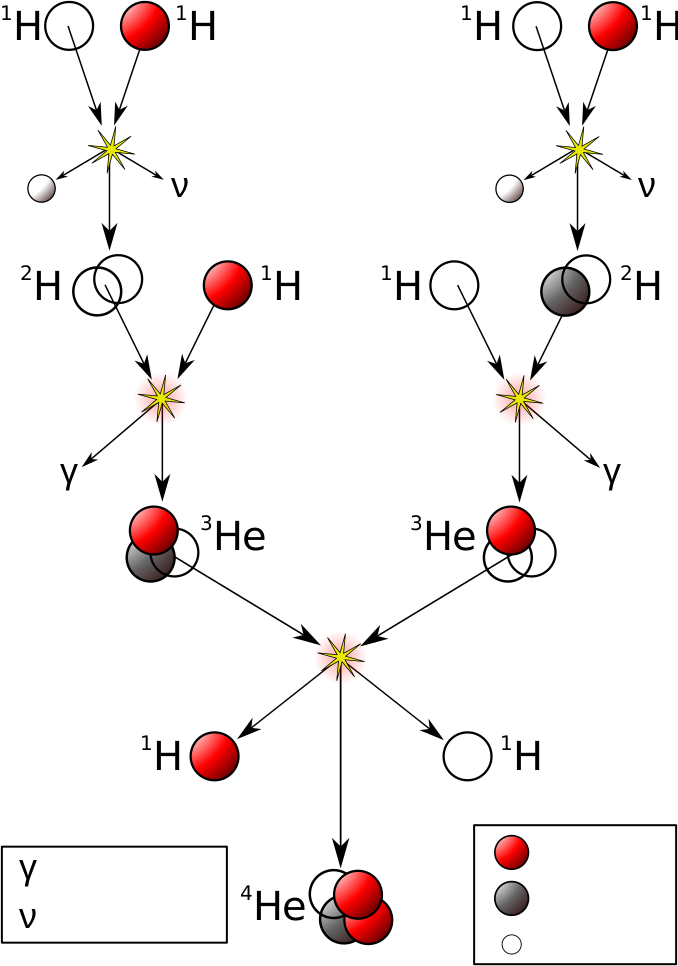
The reaction that takes place within stars is often a proton-proton chain reaction, as is the case with our own sun. This is a multistage fusion reaction which ultimately converts four hydrogen atoms into one helium-4 atom and an excess of energy. At first two hydrogen nuclei smash together and fuse while simultaneously releasing a positron; and a neutrino, which causes one of the protons to become a neutron. This new hydrogen-2 atom then fuses with another hydrogen-1 to produce a helium-3 atom, as well as releasing energy as two gamma rays. This helium-3 collides with another helium-3 formed by the same process to produce a helium-4 atom while at the same time releasing two of the protons as hydrogen-1 atoms. Ultimately, six hydrogen-1 atoms become a heliums-4 atom, two hydrogen-1 atoms, and energy released as gamma rays. A pictorial representation can be seen here.