I know everyone is blogging about this, but how exciting is it that Mars was once suitable for life?!? Of course, Mars will soon be on the other side of the Sun, so NASA will not be able to test for life for about a month. However, it is pretty cool that this was just a test drill to help clean the equipment, and it already returned exciting data. Curiosity was in the area because scientists believed it was a dry lake bed. Under the surface, the dirt was grey, which is what we find on Earth under fresh water. SAM also analyzed the gases in the rock, finding water, carbon dioxide, oxygen, and sulfur.
The forms of sulfur indicate a fresh water environment with plenty of chemical energy for microbes. On Earth, this would have been a great environment for life. Since all we know about life it what happens on Earth, we have to assume that Martian life would need similar conditions.
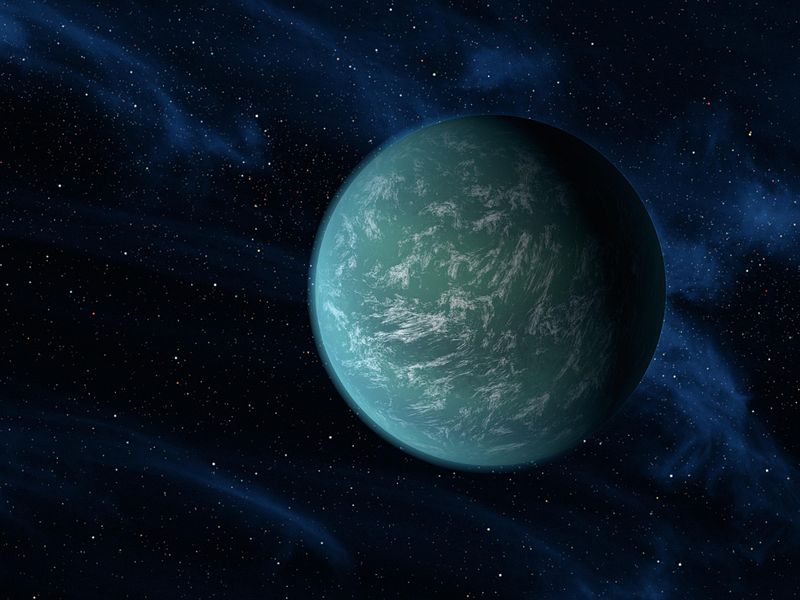
To be classified as a habitable planet, the planet in question must be found in what is known as the habitable zone. The largest requirement for this is that it must be the correct distance from the planet’s star to be able to have liquid water. The distance for the habitable zone varies based on the size of the star that the planet orbits, depending on how much heat the star gives off. Scientists have been searching for these planets, and while there have been many false positives for habitable planets, there have recently been a few that look promising. Kepler 22b (seen below) seems like a promising candidate for a habitable planet though. It, however, may be mostly oceanic, and its orbit may be too irregular and cause the temperature to fluctuate for the planet to actually be habitable. These types of planets are important, however because they would be the possible locations of extraterrestrial life, as well as locations that humans could eventually possibly transfer to in case we use up the resources on Earth or there is some other apocalyptic event that occurs.
Many people hear the word radioactive and immediately think of either radiation from nuclear power plants or bombs, or they think of turning into a superhero. So they generally associate the idea of radiation and humans as an always negative thing. However, what they may not realize is that the human body itself emits radiation. Potassium 40 is the most abundant source of radiation in the human body with around 200,000 disintegrations per minute. While nuclear radiation does have many negative effects on the body, other types of radioactive decay are fairly common in the body. While people generally think of radioactive materials to look like the picture below, there are many types of normal radiation that does not negatively affect your body.
Above: an artist’s conception of the binary system
On the same note of new discoveries, Kevin Luhman, a researcher in Penn State’s Center for Exoplanets and Habitable Worlds, just discovered a pair of stars that constitute the closest star system found in a century, and the third-closest star system we have ever discovered. The binary system consists of two brown dwarfs, which are stars that are not sufficiently massive to ever become hot enough to spark nuclear fusion. Thus, they are very cool and dim; unsurprisingly, Luhman detected this cool system using a data from one of NASA’s infrared satellites. Luhman detected the system using a keen eye and time-lapse images of the sky from this satellite. He immediately recognized how quickly the system moved across the sky, which indicated that it was likely very close to our solar system.
Luhman applied his findings to much older sky surveys and measured the distance using stellar parallax, concluding that it was 6.5 light-years away. Finally, he used the Gemini South telescope in Chile to obtain a spectrum of the system. The sharp images showed that it was not a single object, but a pair of brown dwarfs. Scientists say that close-up views of their system that can be seen with large telescopes will teach them a lot about brown dwarfs, adding to the significance of Luhman’s work. This discovery left me marveling at the vast emptiness of space; it took until now to discover the third-closest star system to our own, and it has been just outside of our solar system the entire time. I can’t help but wonder what other surprises the universe may have in store for us in the near future.
Recently, we’ve been emphasizing comparative planetology in our work. This has prompted studies of each planet in our solar system, which made it clear that many of our questions remain unanswered. We know that Mars had a warmer, wetter period billions of years ago, and have much evidence indicative of abundant liquid water flows in the planet’s past. This leads to a very significant question: could Mars have been home to microscopic life at some point in its earlier history?
Luckily, we’ve recently seen great advancements in robotic spacecraft technology, and our horizons for gathering planetary data are broadening rapidly. A quick search for new data regarding Mars produced important findings from early this week; Curiosity, NASA’s Mars rover, has seen evidence of water-bearing minerals on the surface of Mars first-hand. Additionally, the rover’s science team announced last week that analysis of a rock sample collected by the rover was highly indicative of past environmental conditions that could support microbial life. Michael Meyer, the head scientist for NASA’s Mars Exploration Program, brought up the question of whether Mars could have supported an environment that was habitable for life. His confident answer: “From what we know now, the answer is yes.” It is amazing to see how quickly new technology can fundamentally alter our understanding of the solar system, outdating textbooks in a matter of months or years.
The greatest barrier to human exploration of space is undoubtedly the vast distances and time lengths required to travel from one stellar body to the next. This post will outline some potential modes of interstellar propulsion:
As described by NASA, MPD thrusters are the most powerful form of electromagnetic propulsion. They use charged particles from ionized gas as fuel (xenon, lithium, neon), feed them into an acceleration chamber and out a nozzle to produce thrusts of up to 200,000 MPH. Unfortunately, these thrusters require hundreds of kilowatts to generate acceleration, requiring power generation on the scale of nuclear power plants.
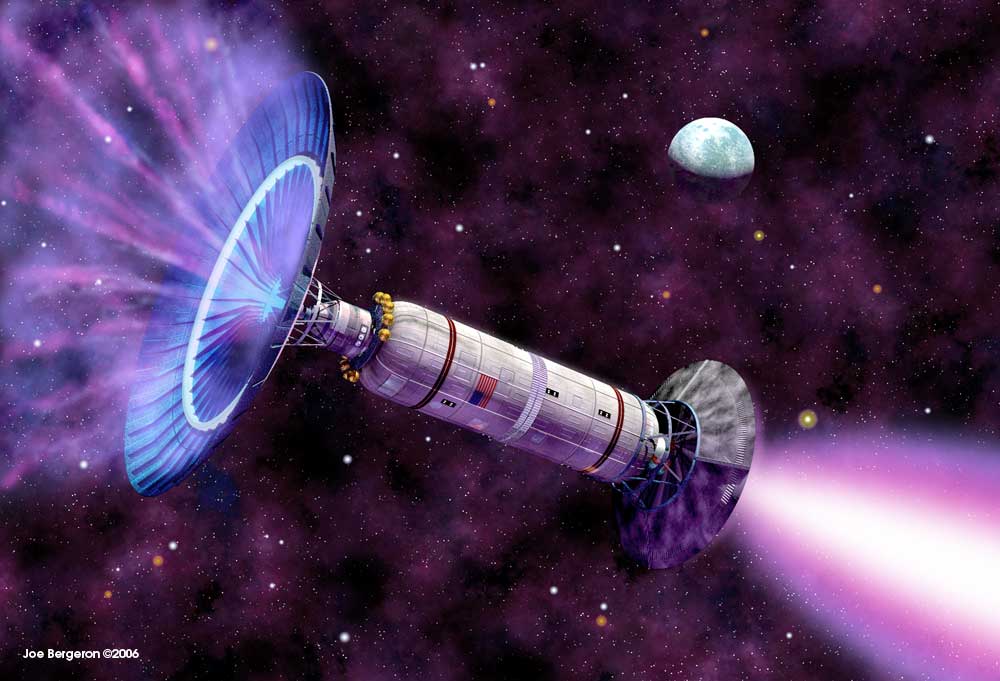
The Bussard Interstellar Ramjet propulsion system draws its fuel from space itself. Developed in 1960 by Dr. Robert Bussard, this “ramjet” uses an electromagnetic field to collect interstellar hydrogen, which is compressed in the craft’s cylinder shaped body and expelled as propellant for a fusion rocket. The speed of the craft is mostly dependent on the density of hydrogen in front of the vacuum-like Bussard Collector. Some estimate that the Bussard Ramjet could move at 77% the speed of light. (The Enterprise–D has two “Bussard Collectors” that were used as emergency fuel sources for the warp drive).
This technology is true to its name and very real. Solar sails use solar photons to push a hair-thin reflective carbon-fiber fabric in a fashion similar to using wind against sails to move across water. This technology has been successfully created by NASA and put to use by the Japanese. IKAROS, a Japanese solar sail, traveled to Venus in 2010, proving the technology for intrasolar missions. Solar sails to not need fuel, but are propelled via solar pressure or self-generated lasers. Because of its sail mechanics, this craft takes years to build up speed, but can reach velocities of 100,000 MPH and more. – Latest solar sail project from my hometown!
The US National Snow and Ice Data Center (NSIDC) based in Boulder, Colorado, has been taking images of our planet for 34 years, documenting climate changes and ice levels across the planet. Data from the past five years show ice levels to be lower than any previously document years. Changes in climate and ice levels for the year 2012 entirely surpassed expectations and thoroughly shocked many scientists and climatologists.
On August 26th, 2012, the NSIDC recorded record-breaking ice-melt levels. The ice had dropped to 4.1 million square kilometers in the Arctic. This ice covered 70,000 square kilometers less and occurred two weeks earlier than the previous record low in 2007. According to a report released by the NSIDC on September 9th, that figure dropped by another 14% to around 3.52 million square kilometers, evidence of a rapidly increasing melt rate. Some scientists agree that the observed drop in sea-ice coverage suggests that the Arctic could be seasonally ice-free as early as 2030 [1].
For scientists, Arctic ice is a fundamental indicator of climate change because of its sensitivity to warmth and the key role it plays in amplifying climate change. Water under the ice pack (known as the halocline) could be warming due to climate warming and ice melt. The warming could, in turn, melt sea-ice and the carbon-rich permafrost beneath costal waters, releasing large amounts of greenhouse gases into the atmosphere [2]. The release of long-stored greenhouse gases would likely contribute to a cascading effect of global warmth, trapping more heat from the sun, melting more ice, and thickening the atmosphere.
This scenario of melting ice and increasing warmth is frighteningly similar to the runaway greenhouse effect responsible for Venus’s (Earth’s “sister” planet) climate. On Earth, large amounts of carbon are trapped in ice, water, in the oceans and in materials such as surface minerals. On Venus, there is no water to dissolve and trap carbon, so it exists gaseously free in an atmosphere made up of 96% carbon dioxide. Climate warmth on Earth could potentially release a lot of its trapped carbon into gaseous carbon dioxide, contributing heavily to the greenhouse effect on Earth. In essence, climate warmth and ice melt will bring us closer to the atmospheric composition of Venus, which is often equated to hell.
– How will the little kids of the future ever believe in the wonder of Christmas, Santa Clause or claymation without an ice-covered North or South Pole?… & what about Mr. Snow Miser?
Twin NASA probes orbiting the moon for the Gravity Recovery and Interior Labority (GRAIL) mission have created the most highly detailed gravity field map of any celestial body. Pictured above, this map reveals an abundance of features including tectonic structures, volcanic landforms, basin … Continue reading →
A visual description of what happens during a solar flare, and the projected effects of another flare with the magnitude of Carrington’s. As seen on 2012 Apocalypse Theories. As a side note, none of their theories turned out to be true.
Imagine that it’s 1am and you’re lying in your bed, when suddenly it begins to get lighter out–as if the sun is already rising. Birds are chirping, men are waking up confused, and aurorae can be seen in skies across the entire world. This phenomenon is what people around the world experienced on the morning of September 2, 1859, during the solar storm of 1859 also known as the Carrington Event. Telegraph machines across the world sparked and failed, and some printing machines caught fire. The event was named for astronomer Richard Carrington, who observed the solar events that day and later conducted further research on solar activity.
What was witnessed that day was the strongest coronal mass ejection (or CME) in recorded history. CMEs are believed to happen when magnetic fields within a star realign through magnetic reconnection in such a way that a massive burst of energy is released. With this energy burst a plasma of electrons and protons is released (along with helium, oxygen, and trace amounts of heavier elements), creating a sizable wave of charged particles. When one of these waves of plasma approaches Earth, the charged particles can create a geometric storm capable of interfering with magnetic and electrical equipment.
It is widely believed that another CME on the scale of Carrington’s Event is due to happen, and if it did it would be much more destructive this time around. The only widespread electronics harmed by Carrington’s Event in 1859 were the telegraph machines, which were for the most part quickly repaired. Electronics are much more prevalent today–in fact, almost everything from our cell phones to our coffee makers to our pacemakers have electronic components controlling them. In the event of a strong enough CME, the electromagnetic pulse (or EMP) generated could potentially fry any unshielded electronic devices. In extreme cases an EMP can even damage sensitive equipment that is not operating at the time, as a moving magnetic field can induce a current in an otherwise inert electrical conductor. It is possible to shield equipment from the effects of an EMP, and in many cases these precautions are taken with electronic equipment considered to be vital. While another Carrington Event certainly wouldn’t be Earth-ending, it would potentially mean you would have to go without your iPhone or laptop for a while.
Check out this video from NASA of the Sun over a 24-hour period of time! The video frames are measuring output in extreme ultraviolet. According to this article, viewing the Sun in this wavelength allows us to view the plasma in its atmosphere (called Corona). But what is interesting is that the same magnetic field we have been talking about in class that is generated by the molten cores of planets, is what is keeping the plasma we see in this video in place. Go to the time stamp 1:55 especially. It shows a really cool time elapse of a solar flare, which goes to show that these flares actually occur over hours at a time (I thought it would be faster). When I think of this, I imagine water boiling and the surface bubbling. Those bubbles rise and burst in manners of seconds and so if we compare that time and scale to the solar flares on the Sun that occur over hours of a time, it’s just unbelievable how MASSIVE those things really must be compared to us here at Earth.