
September 2026 S M T W T F S 1 2 3 4 5 6 7 8 9 10 11 12 13 14 15 16 17 18 19 20 21 22 23 24 25 26 27 28 29 30 Archives
- December 2024
- November 2024
- October 2024
- September 2024
- August 2024
- April 2024
- March 2024
- February 2024
- January 2024
- May 2023
- April 2023
- March 2023
- February 2023
- January 2023
- May 2022
- April 2022
- March 2022
- February 2022
- January 2022
- May 2021
- April 2021
- March 2021
- February 2021
- January 2021
- April 2020
- March 2020
- February 2020
- January 2020
- May 2019
- April 2019
- March 2019
- February 2019
- January 2019
- May 2018
- April 2018
- March 2018
- February 2018
- January 2018
- July 2017
- May 2017
- April 2017
- March 2017
- February 2017
- January 2017
- May 2016
- April 2016
- March 2016
- February 2016
- January 2016
- April 2015
- March 2015
- February 2015
- January 2015
- April 2014
- March 2014
- February 2014
- January 2014
- May 2013
- April 2013
- March 2013
- February 2013
- January 2013
- April 2012
- March 2012
- February 2012
Currently Used Categories
Tag Cloud
- astro201
- astro2110
- astrobiology
- astronomy
- blog1
- blog2
- blog3
- blog4
- blog5
- blog6
- blog7
- blog8
- blog9
- blog10
- brahe
- Class
- Comets
- Copernicus
- earth
- Europa
- extremophiles
- galilei
- galileo
- gravity
- history
- HW2
- HW6
- jupiter
- Kepler
- life
- Mars
- me
- Moon
- NASA
- Newton
- planets
- pluto
- saturn
- Solar System
- space
- technology
- telescopes
- tides
- Time
- Uncategorized
Building the Launch Pad of the Future
NASA’s Ground Systems Development and Operations (GSDO) Program is currently upgrading and modifying Launch Pad 39B (pictured above) at the Kennedy Space Center. The Space Launch System, with the Orion spacecraft atop it, will release from this launch pad to send humans … Continue reading
Posted in Space Travel
Tagged astro201, blog5, NASA, News, spacecraft, technology
Comments Off on Building the Launch Pad of the Future
Possible Proof of Extra-Terrestrial Life
A meteorite found in Sri Lanka has been reported to contain fossilized algae. If this discovery is true, it could act as proof to the existence of extra-terrestrial life. The meteorite is said to contain “microscopic fossilized diatoms” as illustrated below.

Unfortunately, many scientists have already started proposing theories as to why the finding is inaccurate. The scientist Phil Plait stated, “the chemical analysis presented does not prove it’s a carbonaceous chondrite, let alone a meteorite.” And another scientist, Patrick Kociolek, has said that there is no evidence of diatoms, but the species rather represented a case of contamination of fresh water. We do not know the final answer sure, but regardless this outcome, we are getting closer and closer to discovering extra-terrestrial life.


SpaceX’s Merlin 1D engine

SpaceX is a space transportation company founded in California by the same guy who founded Tesla Motors and Paypal etc. They have designed a new boost engine that has the potential revolutionize space travel. It has the capability to loose two engines and still ensure safe travel and the reason it is so amazing is that it is the first of its kind to be a potential candidate for a reusable space engine. It has improved manufacturability where it is much cheaper to produce than the engines NASA has been using to date and it has a simplified design which reduces labor costs and part requirements. Wouldn’t it be amazing to see the manufacturing of space craft and space engines turn into something similar to the aircraft industry, where space travel becomes much more common and affordable. Here is a link to an article about the engine.


Posted in Space Travel
Tagged astro201, blog6, spacetravel
Comments Off on SpaceX’s Merlin 1D engine
Things You can Do with a WMD
If your knowledge is lacking, historically…
A WMD stands for a Weapon of Mass Destruction. Commonly they refer to nuclear weapons: fission based and fusion based. Fusion based weapons are more powerful. I will talk about fusion based weapons. Because they make a bigger bang. I like big bangs.
Remember Hiroshima and Nagasaki?
Exactly. But fusion reactions are three to four times more energetic than fission. Therefore their destructive output is significantly larger. Add this to the fact that unlike fission that requires a critical reactant mass to happen, fusion can happen for an indefinite time, given that the right conditions are present. Therefore a fusion based weapon can lead to a potentially cataclysmic, near-apocalypse outcome.
But Lets think positively: Infinite Energy
That was an overstatement. But for humans, there is no difference. Fission (usually) requires Uranium-235. That isotope is only 0.72% abundant. On earth, there are an estimated 5.5 million tonnes of Uranium, which means about 36,000 tones of fissile Uranium. Compared to this we have about 4.68 trillion tonnes of oil reserves. Fusion, however, requires hydrogen atoms. Most of the hydrogen atoms on earth are tried up in water in the oceans. Compared to these two, we have 15 million trillion tonnes of hydrogen in the oceans. How’s that for unlimited?
…and Exploring the Ends of our Galaxy
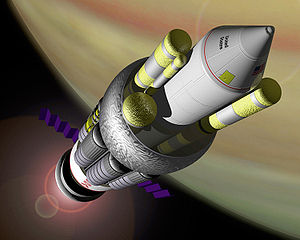
Another overstatement. Poetic licence, you see. Anyways, NASA came up with a proposal about explosion propelled space ships.

Project Orion
They would have a thick metal shield at the back. At set intervals a nuclear explosion would be set off and the shock waves would accelerate the space ship. With each explosion, the mass of the ship would decrease and it would accelerate even more , eventually reaching relativistic speeds. That would technically allow us to access the stellar neighborhood, if not the entire galaxy.
Alas! Fusion’s too Good for our Technology…
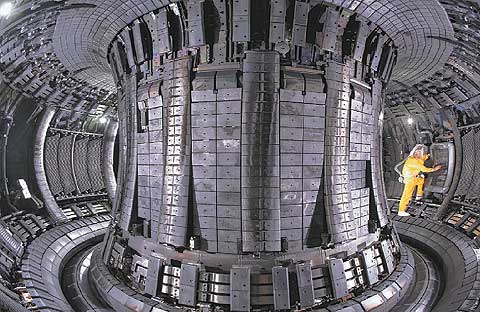
Fusion requires extremely high temperatures (millions of Kelvin) to occur. And no material known to man can withstand the heat. Scientists are still experimenting with magnetic and inertial confinement. In magnetic confinement, the hydrogen plasma is confined within a solenoid so that it does not touch the surface or the container. In inertial confinement, beams of lasers heat up the particles in suspension to cause fusion. you can read more about these two methods here.

Fusion Reactor
In the end, we’ll have to just wait for and see,
For a Genius of a Man to Solve the Mystery.
But if you really think that you are Worthy,
Step forth, Champion, and Tame the WMD!
Last semester, I took some poetry,
It seems some of it rubbed off on me.
I will stop now.


Posted in Space Travel
Tagged astro201, blog5, energy, fusion, Speculation, technology, WMD
Comments Off on Things You can Do with a WMD
NASA Pinpoints Cause of 2011 Arctic Ozone Hole
The causes of ozone depletion are ozone destroying chemical reactions (CFCs), frigid temperatures, and sunlight. Both poles undergo ozone depletion during the winter months, but the Arctic’s ozone typically experiences less depletion than the Antarctic’s ozone. The reason for this is that frigid temperatures and sunlight are typically not present at the same time in the Arctic. However, this year ozone concentrations in the Arctic atmosphere were 20 percent lower than usual.
NASA has discovered that the cause of this extreme ozone depletion is from unusually cold and persistent temperatures and uncommon atmospheric conditions that blocked wind coming from the tropics that usually resupplies ozone levels. These unusual conditions are both perplexing and frightening to scientists studying global climate change.


We are all star stuff
Although our bodies are made mainly of oxygen, carbon, hydrogen, this composition is not consistent with our solar system. The most significant elements of our solar system are hydrogen, which is about 74% of all elements, and helium, 24%. The rest 2% of the solar system is heavier elements from the explosion of massive stars that died before our solar nebula. These niche 2% of elements, however, are amazingly important to us. We live on terrestrial planet Earth, whose composition is mainly rocks and metals from that 2%. Without the past dead stars, there is no possibility for us to exist. Primordial oxygen and water on Earth was brought by comets crushed to Earth in the first several millions of years of our young Earth.

solar system abundances


The Birth of Solar System
It is so amazing that we live in such an organized solar system. Most planets rotate in the same direction as the Sun’s rotation, and of all planets are very close to the same plane. A theory of solar system formation must explain all these characteristics. The nebular theory seems to explain these phenomena neatly.
According to the nebular theory, the solar system was from an interstellar cloud of gas, we call it solar nebula. At the very beginning, the gas particles were so far apart and of so low density, that gravity alone cannot start the formation. Many hypothesize that the collapse of the solar nebula was triggered by the impact of a shock wave from the explosion of a nearby star.
Once the collapse is triggered, the gravity began to play a major role. Particles are pulled together by gravity in all directions, which results in the disk shape of the solar system. As particles were getting closer and closer, the inverse square law of gravitational force makes the strength of gravity got even larger.
As the solar nebula was collapsing, three important processes took place. First, the solar nebula got hotter as particles transferred their gravitational potential energy to kinetic energy. As they came together, the kinetic energy became the thermal energy of the system. This process obeys conservation of energy. Second, conservation of angular momentum made the nebula rotate in an ever-increasing speed. As it shrank in its radius, it also rotated faster and faster. Third, collisions between particles average out random directions and speeds of these particles. The nebula got more orderly and flattened.
To take a visual tour of this amazing process, please look at this video:
Stephen Hawking – Formation of the Solar System


Posted in Class, SolarSystem
Tagged astro201, birth, blog5
Comments Off on The Birth of Solar System
Quantum What?

The Sun is really hot, yeah we all know that. We also know that all of this heat is produced by the fusion of hydrogen into helium in the core. However, did you know that the temperature required to produce fusion here on Earth (100 million K) is much greater than the temperatures present in the sun’s core? So what gives? Well the atoms in the sun experience a little thing called quantum tunneling, which basically means that particles in the sun can “tunnel” through the energy barrier to fusion. For fusion to occur, atoms must attain speeds great enough to overcome electromagnetic repulsion, but since the position of particles cannot be known if their speed it (Heisenberg Uncertainty Principle) there is a very small chance that those particles will collide by sheer chance. So how does quantum tunneling help power the sun in the chance of it happening is so small? Because the sun is HUGE! There are so many Hydrogen atoms in the sun, that despite the rarity of tunneling, it happens constantly. Quantum physics is confusing…but check out this video, it makes this all much easier to wrap your head around.


Kepler 37b
The smallest exoplanet that has been discovered is Kepler 37b. It is very small, being about the size of the moon, and is also believed to be terrestrial. Scientists speculate that Kepler 37b is very much like Mercury, being hot, barren, and geologically inactive. Also, like Mercury, it is orbits very close to its parent star, Kepler 37, which is 215 light years away.
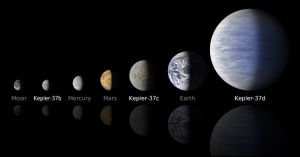
This discovery shows that other solar systems can sustain planets that are even smaller than those found in our solar system. This is a great discovery because it broadens our theoretical understanding of solar system formation. Planets as small as the Moon are able to form in the planet-building process. It also serves as a testament to our ever-improving planet-finding technology. Being able to find a moon-shaped planet 215 light years away is quite an accomplishment!


Posted in Exoplanets
Tagged astro201, blog6, Kepler 37b, Solar System Formation
Comments Off on Kepler 37b
How much did the Apollo Missions Cost?
Recently, due to Budgetary Concerns, the Government has made cuts to NASA programs and has eliminated the Space Shuttle Program. As a result many scientists and space enthusiasts have complained that NASA expenses are minuscule compared to the many other articles of government expenses on the budget. In addition, according to our book, many people have wanted to reincarnate the Apollo program, sending shuttles to the moon.
So the question is: how expensive were the Apollo programs? Would it be budgetarily feasible to send more manned spacecraft to the moon? According to Discovery Channel, the Apollo program in total (includes all missions) cost $25 billion dollars over the span of its lifetime. In current dollars, this would cost at least $100 billion. That is a tremendous sum of money, but it is less than 1% of our current 16 trillion dollar deficit.
The LA Times says that the proposed 2011 capsule that would return astronauts to the moon twice would cost $38 billion. Once again, this is less than .3% of our total deficit. However, the U.S. government is in a time of spending cuts, trying desperately to balance the budget while keeping critical programs intact. According to most Congressmen, landing a capsule on the moon is less critical than other programs. Thus, a new mission to the moon probably will not happen in the near future.


Posted in Space Travel
Tagged astro201, blog5, NASA, spacecraft
Comments Off on How much did the Apollo Missions Cost?