A Black Hole’s Diet

Source

Incredible! While studying a distant galaxy, astronomers noticed a bright flare of X-rays coming from another galaxy that happened to be in their field of view. Upon closer look, they discovered that it was actually a black hole ‘eating up’ what they believe to be either an extremely large planet or a smaller brown dwarf. Fortunately for the object, it only lost about 10% of its mass and was able to move past the black hole before it was completely sucked in. What is so amazing is that this is the first time anything like this has been observed.  It is also noteworthy to recognize that this must be one huge planet/star for it not to be captured by a black hole. You can see this in action in the video that I included above. You can also continue reading about this discovery in the article where I found this information here!


Posted in Physics, Space Travel, Stars | Tagged , , , , , , , , | Comments Off on A Black Hole’s Diet

Saturn’s Rings

     I think I speak for a lot of people (or maybe I don’t) but I honestly thought Saturn’s rings were legit rings, made up of a solid material that didn’t break and rotated around Saturn.   It is amazing how pure ice is what makes up the rings.  Although it’s not surprising that it hasn’t melted because of how cold the temperatures are, it’s amazing that it remains pure and not dirty, allowing us to see it due to the Sun.  The ice forms very tiny layers that individually orbit around Saturn, meaning that there are probably over millions of layers of ice making up the large and grand rings that we are able to see from Earth!  A really interesting point I learned from this video is that the ice is constantly forming and breaking apart with the surrounding pieces of ice in the orbit.  As it is in an orbit, I assumed the ice would stay at the same distance from the other ice pieces and not gain or lose speed.  This is interesting as the rings are continually being shaped by these collisions and encounters. 

How did the ice come to surround Saturn?  Was it an occurrence due to the formation or what it excess material from another planet?  Or is it extra material in the Oort Cloud that was caught by Saturn’s gravity.  Although the rest of the giant planets have rings, why is it only Saturn that has very prominent and distinct rings that we are able to view from Earth?  Is it due to the pure ice?  Or is it due to its location?  Regardless, the rings of Saturn are a spectacular sight that I hope to someday see with an intense telescope.


Posted in SolarSystem | Tagged , , , | Comments Off on Saturn’s Rings

Triton: The Unexpected Volcanic World

http://www.youtube.com/watch?v=7eXac1DGcjM

When we think of volcanic activity, we expect molten lava to come out.  However, this video from the Science Channel explains that instead of lava, Triton actually produces nitrogen gas to the atmospheric as well as “moon dust.”   As Triton is the coldest world in the solar system, this is an incredible sighting that despite its freezing temperatures and numerous craters on the surface, it still have geological activity, such as nitrogen volcanoes.   It’s amazing how researchers are able to deduct by scientific reasoning what the black smugges meant by observing the direction that they traveling.  Personally, I didn’t know cold volcanoes existed, but as this video shows, they do as the volcanoes on Triton erupt at 400 degrees below zero!  According to Wikipedia, moon dust is “the physical properties of lunar soil are primarily the result of mechanical disintegration of basaltic and anorthositic rock, caused by continuous meteoric impact and bombardment by interstellar charged atomic particles over billions of years.”  It is much lighter and has no organic content, unlike terrestrial soil.  Due to the moon dust, we were able to know about the volcanoes as it is much lighter and able to be carried by the extremely weak winds on the planet.  I thought this video gave a great visual representation of what Trition would look like and it’s size and proximity to Neptune.  The visuals really planted in my mind how to view a world that is so drastically different that the world we live on.


Posted in SolarSystem | Tagged , , , | Comments Off on Triton: The Unexpected Volcanic World

Why is Europa so Awesome?

A lot of the science community is excited about the possibility of life of Mars.  But, as we know, the vast majority of Mars’s atmosphere is composed of carbon dioxide and what water it does have is frozen in its polar ice caps.  An arguably much more exciting destination in our own Solar System is Jupiter’s moon Europa.

Several factors place Europa high on the list of potential candidates for extraterrestrial life.  The first is the presence of liquid water.  Europa’s surface is made entirely of ice, but underneath that ice is an ocean that covers the entire moon.  The Galileo probe found a magnetic signature around Europa that could only exist if Europa had something that could conduct electricity, like saltwater.  Another attribute that makes Europa fascinating is its atmosphere.  The atmosphere is very tenuous, producing a surface pressure around 10^-11 times that of Earth.  However, its atmosphere is composed mostly of oxygen, as in the stuff we need to breathe.  Scientists have proposed that the oxygen comes from the breaking apart of water molecules.  The molecular hydrogen, being lighter, would escape from the moon, and Europa would be left with an oxygen atmosphere. As Europa resides about 485 million miles from the Sun, you might expect it to be extremely cold, but the tidal forces on Europa due to Io and Ganymede keep Europa’s ocean much warmer than expected.

So, what might live in Europa’s subsurface ocean? We don’t know.  As awesome as it is to image massive aquatic creatures swimming around underneath the icy crust, that isn’t very likely.  However, we know of organisms on Earth that survive in extremely harsh conditions, and might do very well on Europa.  The European Space Agency does have a mission planned to launch in 2022 that will visit the Jupiter system to look at Ganymede, Callisto, and Europa.  Currently, there are no plans for a mission to land on and explore Europa, though some interesting ideas have been put forth.  One idea is to send a probe that would melt its way through the ice and then go swimming in the ocean, but no serious steps have been made to implement it.

Sources: 1, 2, 3, 4


Posted in Jovians, Moons | Tagged , , , , , , | Comments Off on Why is Europa so Awesome?

Exoplanets

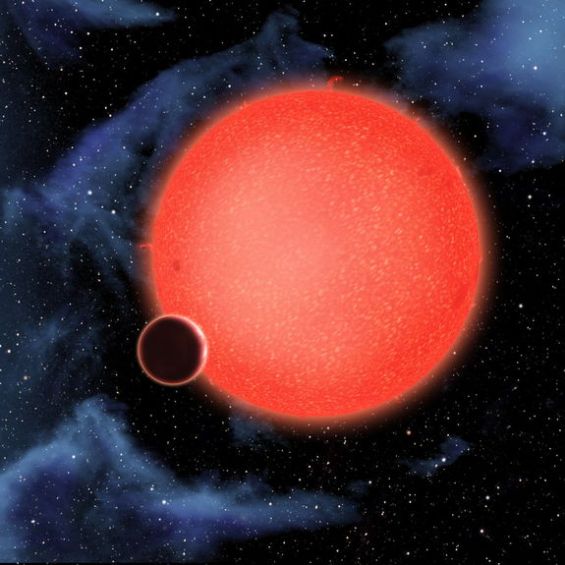
Image

Our lecture on exoplanets in class today reminded me of an article that I saw a few months ago about the discovery of new exoplanets. After looking deeper into it, I realized that just a month ago scientists discovered 2,700 objects that could potentially be considered planets. Not only is this a possibility, but around 90% of these discovered objects are likely to be verified as exoplanets: objects that orbit a star other than our sun. The Kepler telescope discovered these exoplanets. These findings are exciting for reasons other than just their existence: many of these exoplanets are not only different than anything in our solar system, but also something who’s existence scientists thought to be impossible. For example, a gas giant that is 3 times the size of Jupiter or one smaller than the moon.

Of course, the big question people are always asking is whether life exists outside our earth. There are certain conditions that must be satisfied for this to even be possible, such as temperatures where liquid water can exist. Between 40 and 50 of these exoplanets exist in such conditions, and therefore give scientists hope of discovering life. This discovery has not only broadened our knowledge of the Universe, proving that there are thousands more planets that until now we were not even aware existed. Hopefully scientists continue searching and eventually find life on one of these exoplanets.

Source: telegraph


Posted in Class, Exoplanets, Universe | Tagged , , | Comments Off on Exoplanets

Dark Matter Discovered?

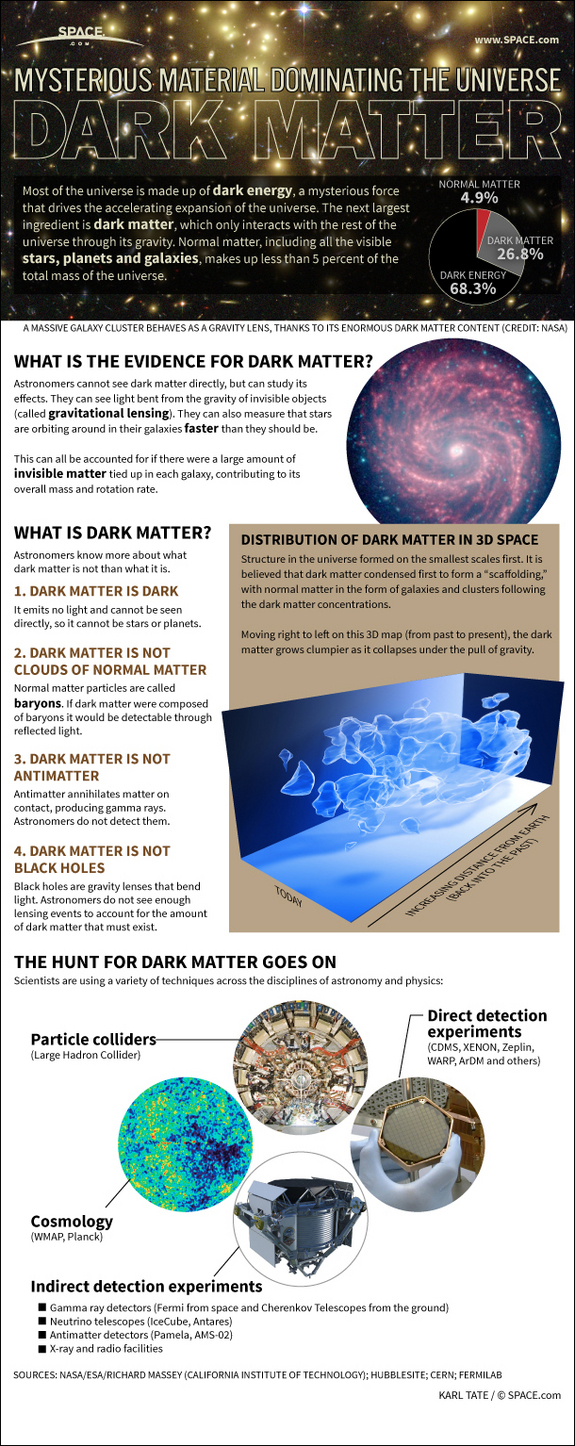
dark-matter-what-is-it-130403c-02

Dark Matter infographic from Space.com

Scientists announced today that they may have finally found dark matter. Dark matter is the invisible matter making up most of the universe, but scientists can’t see it because it emits no light.  Scientists only know it exists because dark matter’s gravity bends light – gravitational lensing – and because stars are orbiting in galaxies faster than expected.

So how have they finally found this mysterious substance? It’s all thanks to the International Space Station (ISS).  2 years ago, Endeavor delivered a $2 billion present to the ISS – the Alpha Magnetic Spectrometer (AMS).  The AMS measures cosmic-ray particles,  among which the most important (in terms of dark matter) are positrons. Positrons are also called antielectrons because they are literally the antimatter version of electrons. This means that if you ram a positron and electron at each other, they will be annihilated. The AMS found 400,000 of these particles, and their energy leads scientists to believe that they were created when dark matter particles collided. These dark matter particles destroyed each other when they met, which physicists suggest happens because dark matter particles are their own antimatter.

This is some crazy intense particle physics, but it just makes dark matter seem that much cooler. I mean,  how insane is it that 80% of our universe is made up of stuff we can’t see or easily detect? Not only that, but dark matter particles destroy each other when they collide. That seems weird to me because it’s the majority of the stuff in the universe, but if it comes into contact with itself, it gets destroyed. It seems like it would no longer be 80% of the universe. Maybe there was once more dark matter in the universe and it just destroys itself over time? I have no idea how often dark matter particles collide though, so this could be a really stupid idea.

Even with this positron discovery, scientists may have not actually found dark matter. Pulsars, for example, could have created the positrons. Scientists won’t know for certain until a ground-based detector picks up on dark matter particles.

Source.


Posted in Instruments, Universe | Tagged , , , , | Comments Off on Dark Matter Discovered?

New Saturn Discoveries

Image

As we’ve learned in class, Saturn is an interesting planet mostly for its “rings” made of many small rocks and particles.  Because Saturn is a Jovian planet and so far away, we are still trying to learn as much as we can about it. In fact, scientists have discovered new information about Saturn’s rings and moons just the other day. Thanks to the Cassini spacecraft that has been orbiting Saturn, NASA has learned about the timing and origin of the rings and moons around Saturn. They believe that both of these objects formed around the same time as the sun- meaning they are over 4 billion years old. They came from the same gas and dust from which the rest of the solar system planets originated. This helps us relate the moons and rings, instead of looking at them as individual objects we can now view them as related and interconnected.

In fact, they may be so interconnected that some of Saturn’s moons may have come from the rings themselves. Due to a reddish color on a moon in an area where most other moons are white, scientists hypothesize that this moon may have come from the rings that contain a similar red color. They suggest that particles from the rings may have combined to form moons.

All of this information is exciting, leading us to more information about a planet so far away and so foreign to us. It is proof that we are still (to the day) learning more and more about this Jovian planet.

Source: space.comyahoo.com


Posted in Class, Jovians, Universe | Tagged , , , | Comments Off on New Saturn Discoveries

Almost Interstellar

So, has humanity become Earth’s first interstellar species?  It all depends on whether the Voyager 1 spacecraft has left our solar system or not.

Voyager

features3

NASA

First, some history.  The Voyager program actually consisted of two space probes, Voyager 1 and 2, launched September 5, 1977 and August 20, 1977, respectively.  The probes were launched in 1977 to take advantage of a once-every-177 year alignment of worlds in the outer solar system which would allow them to swing from planet to planet with minimal fuel.  Voyager 1 itself made it out to the Jupiterian and Saturnian systems, providing up close photographs of things like Jupiter’s Great Red Spot, the Galilean moons, Saturn’s rings, and Titan’s (Saturn’s major moon) atmosphere.  After last close fly-by of Titan, Voyager was directed on a course away from the Sun, to explore where the solar system officially ends.  Voyager 1 is now the most distant man-made object from Earth, approximately 18 billion kilometers away, traveling at a speed of 17.26 km/s.  Even though its original mission is long over, it has continued to send data back to scientists on Earth, and its nuclear power source is in fact estimated to last until 2025, meaning we’ll still be hearing from this intrepid spacefarer for years to come.

redspot_voyager1_3072 saturn2

NASA                                                                                         NASA

The current Voyager controversy, however, is whether or not it has actually left the solar system.  False alarms have been raised before, the most recent case being by NASA last October, so the debate isn’t new.  The answer, though, comes down mostly to semantics.  Voyager’s sensors have detected a drop in radiation and an increase in cosmic rays.  This is an indicator that it may have passed outside our solar system, because the area outside the solar system would also be outside the Sun’s heliosphere (the Sun’s protective magnetic bubble), and there would be an increase in the cosmic rays that are normally absorbed the the magnetic sphere.  However, until a dramatic change in magnetic field intensity is detected, NASA scientists believe the probe is in a transition zone within the outer part of the heliosphere.  Additionally, the Sun’s gravitational reach is distant, and the Oort cloud of comets 7.5 trillion km from the Sun should still be gravitationally bound to the star.  If that is considered the real edge of the solar system, Voyager still has a long way to go.

Here’s a video by NASA describing Voyager’s final journey.


Posted in Class | Tagged , , , | Comments Off on Almost Interstellar

Galileo’s Moons

To me, moons are fascinating.  Many planets in our solar system have them, with the majority belonging to the gas giants in the outer solar system.  For me, the most interesting of all the moons is not Earth’s, but rather the Galilean ones, so named because Galileo Galilei was the first to discover them orbiting around Jupiter with his new high-powered telescopes.  We now know that Jupiter’s gigantic gravity field  has captured many moons, actually about 60, but the Galilean ones are the four most important and interesting: Io, Europa, Ganymede, Callisto.  These are their stories.

Io
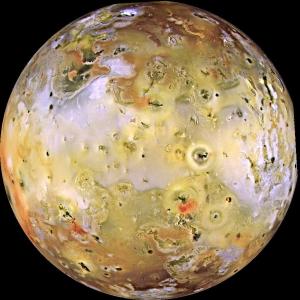
io970321_gal_big

NASA

Io is the most geologically active world in our solar system, with over 400 active volcanoes.  In fact, every one of the dots in the picture above is a volcano.  Because of this rampant volcanism, Io’s surface is also one of the youngest looking in the solar system, since almost all of its impact craters have been filled in by lava.  Surprisingly enough, the cause of  all this constant activity is actually Jupiter.  Io orbits Jupiter in synchronous rotation, and the force required to keep that rotation causes tidal bulges on Io.  This constant change in size and orientation causes friction that creates the internal heat required for volcanic eruptions.  Finally, even with all that volcanic activity causing outgassing, Io still only has an extremely thin atmosphere, made up mostly of sulfur dioxide.  Most expelled gases are nabbed by Jupiter’s gravity and put into orbit in the Io torus, which is a doughnut-shaped ring of gas surrounding Jupiter.

Europa
PIA00502

NASA

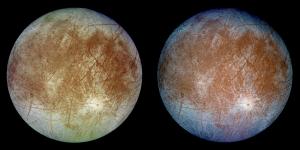
Europa shares many characteristics with Io.  Just like Io, it has a metallic core and rocky mantle.  Also like Io, Europa has no impact craters, meaning it is still tectonically active and that its surface may only be a few million years old.  The differences between the two however, are great.  Rather than volcanoes, Europa’s surface (and crust) is covered by a layer of ice approximately 100 km thick.  What is most exciting about Europa, though, is that it is a prime candidate for the finding of extraterrestrial life.  It is theorized that liquid water exists under a thin shell of ice, because tidal friction caused by Jupiter should provide enough heat to make sure the ocean remains liquid and also drive geological activity (tidal flexing is also what causes the cracks on Europa’s surface).  Scientists hope that primitive life may exist then underwater, near hydrothermal vents, just as on Earth.  One last interesting note about Europa is that its atmosphere, though tenuous, is composed mostly of oxygen, a gas important at least to life on Earth.

Ganymede
Ganymede_Collage

NASA

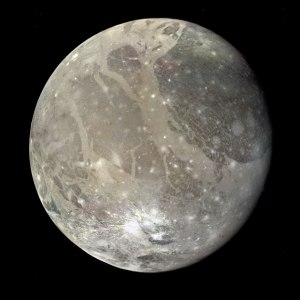
Ganymede is the largest moon in our solar system, at 5262 km across.  It also has a geography similar to Europa’s, in that its surface is composed of water ice, and a saltwater ocean is thought to exist 200 km below its surface, sandwiched between layers of ice.  Unlike Europa, however, its surface shows signs of age, along with visible craters on the surface, meaning it is no longer as geologically active as in the past.  What’s also interesting is that a strong magnetic field (perhaps even a magnetosphere) has been detected around the moon, leading to speculation that it still contains a liquid iron core, heated by radioactive decay and tidal heating.  Finally, Ganymede has a tenuous atmosphere, composed mostly of oxygen and ozone.

Callisto
inset-jup_callisto-large

NASA

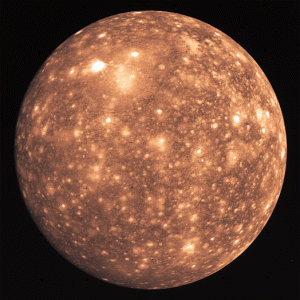
Callisto is the second largest of the Galilean satellites, and has a geography similar to Ganymede’s (mostly rock and ice), but with even more cratering, indicatingan even cooler interior.  Callisto is considered “boring” by some, since it seems to be a dead world, but it does still have some interesting features.  First of all, it has a very thin atmosphere composed mostly of carbon dioxide.  Second, it has an induced magnetic field, which may be evidence of a salty liquid ocean beneath its surface.  Lastly, it has a 3000 km wide impact crater in the shape of a bulls-eye, named the Valhalla Basin, which was produced about 4 billion years ago.  Upon impact, the foreign object exploded, heating the subsurface ice to above the melting point and producing shock waves in a ripple pattern away from the impact site, giving it its distinctive look.  What’s cool too about Callisto is that it is considered the most suitable place for a base for future human exploration of the Jupiter system, since it is furthest from the intense radiation of Jupiter.

There you have it, the four Galilean moons.  With such a diversity of worlds, I think it’s pretty clear why I find these moons to be so interesting.  Sorry, Earth’s Moon, but in the end, you just can’t compete with these guys.


Posted in Class | Tagged , , , , , , | Comments Off on Galileo’s Moons

Greenhouse Gases

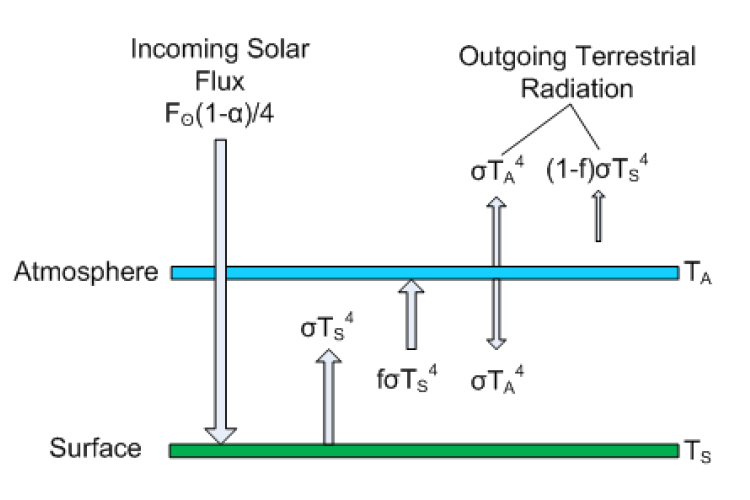
As noted in the textbook, the Earth is hotter than it would be without it’s atmosphere.  According to the EES 201 notes, just based on incoming solar radiation and 30% reflected back to space, the Earth is 255 K.   However, using the math in the diagram, we get very close to the actual surface temperature, which is closer to 288 K.

Since the Earth's temperature remains constant, energy in equals energy out

Greenhouse gases on Venus are much stronger, warming it from 232 K to 730 K!  The simple diagram below does not account for that thick of an atmosphere, which requires two layers of reflection.  Looking at the models used for greenhouse gases helps us see that this effect is real.  In fact, looking at how the molecules can vibrate, which wavelengths of light they absorb, and how prevalent they are, shows why some gases are greenhouse gases and others are not.

Posted in Class | Tagged , , | Comments Off on Greenhouse Gases