With the constant discovery of more and more objects in space, it is difficult to keep track of the planets, moons, asteroids, comets, and exosolar planets that we already know and love. Therefore I am using this blog as an opportunity to discuss the four largest moons of Jupiter: Io, Europa, Ganymede, and Castillo.
Let’s start with Io. Io is the fourth largest moon in the solar system, the innermost moon to Jupiter, and is known for its volcanic activity. This volcanic activity is primarily due to tidal heating. The volcanic activity is the reason for different colorings and the surface changes on Io, and it’s material also creates Io’s thin atmosphere. Most importantly, it is key to remember that Io is the most geologically active object in the Solar System. Must be entertaining to see
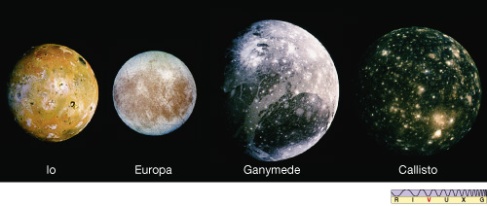
After Io we have Europa, what is potentially the best current option for a viable life form in addition to Earth. From the diagram above, it is easy to see that Europa is the smallest of the four Galilean Moons, yet it is still a large moon in comparison to others within the solar system. Europa’s atmosphere contains abundant oxygen, which is one of it’s most intriguing characteristics when thinking about other life forms. There is the potential of water on Europa as the fly-by mission of 1989 showed a young surface, but there is no solidified evidence. Unfortunately, although Europa seems to have the most hope for life, there are no future missions in the next few years scheduled to check it out.
Moving along we get to Ganymede. When I think Ganymede, I think great. That is because Ganymede is the largest moon in the Solar System! The surface of Ganymede has both old and young features, with the potential of an ocean deep within. One cool thing about Ganymede is that is has a magnetosphere due to the convection process. You are probably wondering what this giant moon is made of: silicate rock and water ice. Now that’s a combination for ya.
The last Galilean Moon is Callisto. Callisto is unique because it does not have orbital resonance that is attributable to the other three Galilean Moons and therefore Callisto does not experience tidal heating. In class we learned that Callisto represented cratering. This cratering is due to the fact that Callisto’s surface is very old, and there is no geological activity such as volcanism or plate tectonics to cover the craters. One fun fact about Callisto- its surface is asymmetric causing the trailing hemisphere to be lighter than the leading one.
In all, I hope this blog helped outline the main points to remember about the four Galilean Moons of Jupiter. Although a lot of information, remember simple techniques like Callisto-Cratering or Great Ganymede can help you to remember the moon’s characteristics!
Overview Io Europa Ganymede Callisto