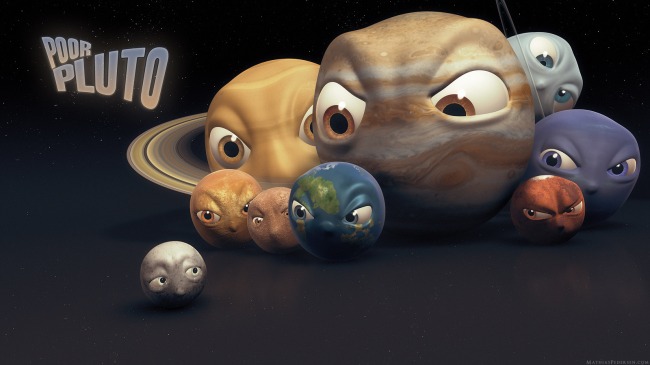
The Planet Formerly Known as Pluto

I remember that growing up, I was always told that there were 9 planets in our Solar System. I always found Pluto very interesting, and even more so now that it has been demoted from its planet status.  This article provides many entertaining facts about the famous dwarf planet, a few of which I found extremely interesting.

I learned that while most cold, dead, terrestrial worlds similar to Pluto lack an atmosphere, Pluto actually has a pretty active one.  In fact, when Pluto’s orbit carries it further from the Sun, its atmosphere of gases freezes.  It then warms and expands as Pluto travels towards the Sun the next time.

I was also surprised to learn just how tiny (astronomically speaking) two of Pluto’s moons are.  Nix and Hydra are only about half of a football field in length, smaller than several large asteroids in our Solar System!


Posted in Dwarf Planets | Tagged , , , | Comments Off on The Planet Formerly Known as Pluto

Comets

Near Earth Experience

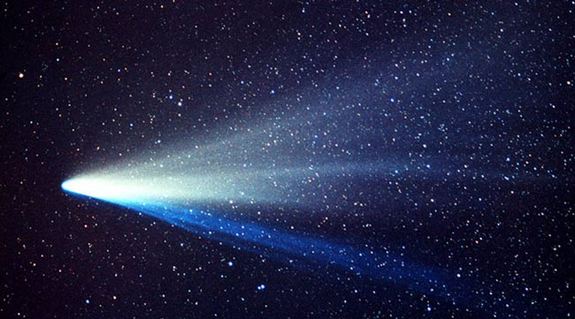
The snowballs of the universe, comets are amazing bodies of ice and rock orbiting a star from a great distance. In our own solar system, these balls of ice mostly inhabit an area known as the Oort Cloud. This outer region surrounds our solar system from all different directions. Because the cloud surrounds us as such, the orbits of the objects in the Oort cloud do not lay on the same plane as the rest of our solar system.

With all this disarray, some comets orbit through the plane of our solar system. Therefore, much attention has been put forth to monitor and track these massive objects, as an impact with Earth would be devastating. With our eyes on the comets, we have seen incredible view as the objects produce a unique streak known as the comet tail. This tail is visible when a comet passes close to the Sun, reflecting the light off dust and other materials that have been vaporized by the solar radiation. While comets are generally hard to see, if you do get the chance to see one while it is producing its coma, the sight is truly unforgettable.


Posted in Class | Tagged , , , , | Comments Off on Comets

The Planet Pluto

The little planet that could…

Although I am only 22 years old, the world has changed a lot since I grew up. No longer are the days of hearing the obnoxious but familiar sound of dial-up internet, listening to music with a walkman in your hand instead of an ipod in your pocket, and above all else, living in a solar system with 9 planets. With no thought to public opinion or the impact this would have on young lives, those in power made a hasty decision to rip the beloved Pluto from its’ rightful place as the 9th and final planet.

In 2006, the International Astronomical Union met and voted to establish a new definition for planets. This need for a new definition was developed as astronomers began to discover more and more object in the Kuiper Belt that are similar to Pluto’s size. In 2005, a team discovered Eris, which was further out than Pluto yet larger and more massive, making reclassification necessary.

While this new definition reclassified Pluto as a “dwarf planet”, it will always remain special to those who grew up loving the 9th planet. Maybe some day, if not but for pure nostalgia, the planets will be redefined once again, allowing own favorite cold, blue planet to take back its spot on ever-growing list of planets in this amazing galaxy.


Posted in Class | Tagged , , , | Comments Off on The Planet Pluto

Oxygen on Europa?

Europa global views in natural and enhanced colors (NASA / JPL / University of Arizona)

Europa, which is one of the four largest moons orbiting Jupiter, is currently one of the top candidates for potential life. Europa’s surface is made of ice, but beneath all this ice, is an ocean of water. This water is likely due to tidal heating caused by Jupiter and is evidenced by the magnetic field found around the moon. Few moons even have magnetic fields, and Europa’s changes as Jupiter rotates, suggesting that a liquid is responsible for the electrical conduction. As far as we know, life requires chemicals like water, carbon, and nitrogen.

Recently, scientists discovered that Europa has abundant peroxide. Peroxide (H2O2) is thought to be important in creating energy that would be essential for life to exist in oceans. When mixed with water, hydrogen peroxide can produce oxygen (O2), which is the gas that life on Earth uses to create energy but is not known to be abundant on other worlds. Interestingly, the highest concentration of peroxide is found on the side of Europa that, due to synchronous rotation, is always facing Jupiter.  It is still not known if the peroxide is mixed with the ocean, but if it is, this discovery makes the case for life on Europa even stronger. More information on this discovery can be found here.


Posted in Aliens, Moons | Tagged , , , | Comments Off on Oxygen on Europa?

M-theory Might Explain Everything

Have you ever thought about the Big Bang? And what might have happened before it? If you have come to blindly accept the widely accepted theory about how our universe was created, you might have missed the various loopholes the theory presents. For instance, the Big Bang theory states that before the huge explosion took place, there was a point of infinite mass and density called singularity. This infinitesimally small point basically was the universe before everything started. Therefore, the concept of time does not exist before singularity! Then for whatever reason, one fine day, the singularity exploded scattering all the matter in all directions which went on to form galaxies, stars and planets. Therefore, the theory never really explains how that point got there in the first place!

Welcome M-theory. By now, most of you have probably heard of terms like “multiverses” or “string theory” thrown around loosely without really understanding what they all mean. This video does a great job of explaining as simply as possibly how string theory works and leads to an ever more important theory – M-theory. What this theory basically states is that our universe is an infinitely long sheet with finite width – kind of like a rectangular sheet with infinite length. Such a structure is called a membrane and thus, the name M-theory. Membranes are a result of the theory that there are eleven dimensions and not just the three of length, width and breadth we see in our everyday life.

But how does this theory explain the Big Bang you might ask. Well, think of our universe as a slice of bread. To us, it doesn’t seem like we are trapped in object of finite dimensions but looking at this slice of bread from the outside, it does! What scientists think happened to cause the Big Bang is basically that two such membranes (or universes) collided with one another. The resulting ripples caused in the respective membranes caused matter to be dispersed across that membrane or universe and led to all the matter we see in the universe.

Even if we don’t understand how this theory works at all, it still makes more sense than the Big Bang theory! Think about it – M-theory actually proves that there was time before the Big Bang! Whereas the alternative is that time just didn’t exist prior to the Big Bang and the cosmic clock suddenly jump started once the explosion happened. If M-theory is correct, that means our universe is just another book in a whole library full of books where each book represents a parallel universe.


Posted in Class | Tagged , , , , , | Comments Off on M-theory Might Explain Everything

Neutrinos and Other Strange Things in Space

An article on SPACE.com lists the “Top 10 Strangest Things in Space” including antimatter, exoplanets, quasars, and many others. I thought this list gave a very interesting overview (and cool pictures) of these more cutting-edge areas of astronomical research. It also explained why the existence of these things are significant. For example, galactic cannibalism may occur when the Andromeda Galaxy and our own collide in about 3 billion years. The image below shows what this event may look like.

My favorite item on the list is probably neutrinos, which have always fascinated me. Neutrinos are neutral particles with almost no mass. They can be found all around us, and can easily pass through matter, even lead. Neutrinos may come from inside healthy stars or from supernova explosions. I first heard about neutrinos in high school, when my physics class took a field trip to the Soudan Mine in northern Minnesota. The Soudan Mine is an old iron ore mine that is now used to investigate neutrinos and dark matter (both made the top 10 list of strange things in space). Because the mine is so deep, it protects these experiments from interference from cosmic rays. Inside the mine, there are large neutrino detectors (pictured below) that detect neutrinos sent from Fermilab in Chicago. The purpose of this experiment (called MINOS, or Main Injector Neutrino Oscillation Search) is to investigate the oscillations of these neutrinos, which will hopefully help us better understand dark matter.

MINOS crew in front of a detector plate.


Posted in Physics, Universe | Tagged , , , | Comments Off on Neutrinos and Other Strange Things in Space

A Big Snack

The physics major in me has always been incredibly interested in black holes. We haven’t spoken about them much in this course, but there are likely black holes at the center of each galaxy, and thus studying black holes can tell us a lot about galaxies in other parts of the universe.

black-hole-eats-super-jupiter

This is a screenshot of an ESA animation about the interaction between a supermassive black hole and a gas-giant planet or brown dwarf.
Source: Space.com

For the first time ever (on April 9th, 2013 actually), astronomers found proof of a black hole consuming what they believe to be a Jupiter-like planet. In fact, astronomers think that this Jupiter-sized planet (roughly 14 to 30 times the size of Jupiter)—which may also be a brown dwarf—was simply wandering through space and was over time drawn in by the gravitational field of NGC 4845’s supermassive black hole (found at the center of this galaxy which is roughly 47 million light-years away from us).

Observing this interaction using ESA’s SMM-Newton and NASA’s Swift space telescopes, astronomers were able to look at this planet/brown dwarf being consumed by this black hole over a period of roughly a year. By studying the different properties from the outbursts of this black hole, astronomers have been able to extrapolate the size of the star/planet that was ripped apart. Furthermore, they believe that the black hole only ripped off the outer layers of the planet/star and thus a smaller core is likely left orbiting this supermassive black hole today. Unfortunately, 47 million light-years is a pretty decent distance away, so we won’t be able to travel there anytime soon to observe this interaction more closely. (Then again, even if we were able to, the black hole would have consumed this start/planet most likely by the time we finally got there.)

Source for this post: Black Hole Caught Snacking on ‘Super Jupiter’ Planet


Posted in Universe | Tagged , , | Comments Off on A Big Snack

Searching the Sky

In class this week I was curious about how astronomers are able to constantly search for exoplanets. On one hand, I knew that the Kepler Space Telescope had played an integral part in discovering the roughly 2,740 exoplanetary candidates as of January 2013. However, keeping in mind how vast space is and how quickly exoplanets can potentially transit a star, it was difficult for me to imagine how Kepler could have caught so many exoplanets at the exact right moment. When I asked about this during class, the response I got was that there are many telescopes focused on the sky at all times and thus Kepler is able to catch many exoplanets as their transit their star.

Then on April 7, 2013, NASA decided to fund a mission that would launch Transiting Exoplanet Survey Satellite (TESS) into space in 2017. The purpose of this mission would be to focus solely on finding exoplanets in our solar system using the transit method (much like the current Kepler Telescope).

200908311113135517

This is an artist’s depiction of what the TESS satellite could look like. A real drawing has yet to be released to the public for now.
Source: MITnews

What is between Kepler and TESS is that while Kepler could only focus on roughly 0.28% of the sky at a time, TESS will survey the entire sky, helping us greatly in the search for exoplanets. This will also help TESS in its goal “to identify terrestrial planets in the habitable zones of nearby stars.”  In all, the technology on TESS is significantly more advanced and varied than the technology seen on Kepler. This will translate to a rapid increase in the frequency of discovery of exoplanets (from Earth-sized to gas giant sized) transiting their respective stars.

Source for this post: Kepler 2.0


Posted in Exoplanets | Tagged , , , , | Comments Off on Searching the Sky

The toughest animal on the planet

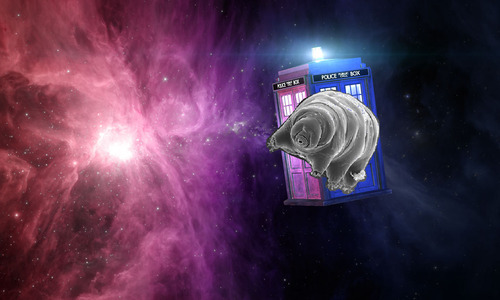
Most creatures require a specific set of conditions to survive: a certain amount of oxygen, temperature, pressure, food, etc.  However, some animals can live in conditions so extreme they kill almost everything else.  These animals are called, fittingly, extremophiles.  One extremophile is the tardigrade, more commonly called water bears or moss piglets.

In general, tardigrades hang around on moss, sucking up water.  However, for some reason, they are able to withstand almost unimaginable conditions.   Temperature-wise, they have survived temperatures of over 304° F (151° C) and down to -423° F (-253° C).  Tardigrades can also survive at extreme pressures.  Some species can survive at pressures 6,000 times that of atmospheric pressure, almost six times the water pressure at the bottom of the Mariana Trench.  Tardigrades have also been shown to survive radiation doses of over 500 times what would kill a human.  The tardigrades accomplish these incredible feats by entering a state of cryptobiosis.  In doing so, they will curl up and dehydrate themselves.  Tardigrades have been known to survive up to ten years in this state.  We don’t know why tardigrades can live in conditions so extreme they aren’t found on Earth, but we are trying to understand them.

Now, as astronomy students, you would probably guess that the most hostile environment in the universe is outer space.  With temperatures of a few degrees above absolute zero and an almost complete vacuum, it seems impossible that anything could survive.  However (as you might have guessed), tardigrades are able to survive in outer space.  In 2007, NASA let a bunch of tardigrades out into the vacuum of space where they were exposed to incredible amounts of solar radiation.  Ten days later they let the tardigrades back in, and when they brought them to Earth, the tardigrades were fine, and some even laid eggs that became perfectly normal baby tardigrades.  This experiment has been repeated multiple times, with the ESA also sending tardigrades into space in a mission they called Tardigrades in Space.  You’re probably thinking the ESA does a terrible job naming things until you learn they shortened the mission name to TARDIS.

So, besides being awesome, why is this information useful? Well, it helps us understand how life might spread throughout the galaxy.  If some tardigrades were ejected from Earth (by, say, a meteorite impact), and somehow they managed to land on another planet, they could bring life to that planet, assuming the planet could sustain life.  This youtube video also does a good job explaining why tardigrades are so awesome.

Sources: 1, 2


Posted in General, Space Travel | Tagged , , , , | Comments Off on The toughest animal on the planet

100,000 Stars

Above is a video of an awesome website, 100,000 Stars. This website is an interactive, 3D map of the closest 100,000 stars to us. The video gives a little taste, but I encourage everyone to go to the site and explore for yourselves. Zooming in on our Solar System, you encounter the Oort Cloud first, and only after zooming in even more can you make out the planets.

This website really gave me an idea of the scale of our Solar System, and how small it is even in comparison with the distance to the nearest stars. We have talked about it many times in class, but actually seeing it on the screen and being able to zoom in and out was very informative to me. Plus it is visually beautiful. Here is the link, check it out.


Posted in Stars | Tagged , , , , , | Comments Off on 100,000 Stars