Orbital Resonance and the Asteroid Belt

Why is it that all of the matter in the inner solar system accreted to form planets, while in between Mars and Jupiter there is still a bunch of stuff floating around?

Conservation of energy is kind of tricky.  As shepherd objects pass by the asteroid belt, they either give or take away orbital energy from the asteroids, pushing them into larger or smaller orbits.  This is the reason for why these asteroids can collide with terrestrial planets.  This resonance also has another effect of destabilizing these orbits so that the would-be accreting material never actually accretes.  Each collision serves only to break up large asteroids into smaller ones.


Posted in Class | Tagged , , | Comments Off on Orbital Resonance and the Asteroid Belt

Cratering, Water, and the Chesapeake Bay

The Chesapeake Bay crater is the largest impact crater in the US.  The meteorite that struck Earth an estimate 35 million years ago cause water and rock to splash all over the entire East Coast, creating a crater larger than Rhode Island and killing all regional marine life.  This impact has helped form the river patterns seen in the area, as well as the Bay itself.


Chesapeake Bay Crater http://tinyurl.com/cgpbqbz

Chesapeake Bay Crater http://tinyurl.com/cgpbqbz

When I first learned that water doesn’t really slow down an asteroid impact, I was surprised.  It turns out that the kinetic energy of larger impacts is so great that most of the water is vaporized instantaneously and has little effect on the velocity of the meteorite.  This makes it so that, particularly in more shallow water, a crater from an impact like the one in the Chesapeake Bay looks very similar to a land impact of similar magnitude.


Posted in Class | Tagged , , | Comments Off on Cratering, Water, and the Chesapeake Bay

Social Astronomy!

I am always interested in new ways that information, ideas and stories can be shared or exchanged online. I love all forms of social media including blogs, tumblr, twitter, google plus, you name it. It always helps me learn a new concept if I have a variety of ways to interact with the subject, like going to a museum when taking an history class. For astronomy, this is a bit more difficult. Due to unfortunately bad weather, I have not yet been able to observe. Therefore, that leaves me to my own devices to find other ways to engage with this material. I turn to social media. For those of you you don’t know, Google Plus is a relatively new social networking platform that allows users to share text, photos, video, etc with whoever they are connected with. The great part about is it is links various platforms in your Google account including mail, Blogger, and games, and let’s you create circles of friends to share certain information with. ‘Hangouts’ are another key feature of Google Plus, and it allows you to participate in video chats with a large number of people. Many astronomers (both expert and lay astronomers) have been using these hangouts to share information on astronomy. Connecting people from all over the world, from Texas to South Africa to New Zealand, these astronomy hangouts are a really powerful and inspring way to share in the excitement of astronomy. People are able to share what they see from their telescopes with a huge audience. Google did a spotlight video on one of these hangouts, which I have shared here. Take a look to see the truly amazing power of these hangouts for this field.
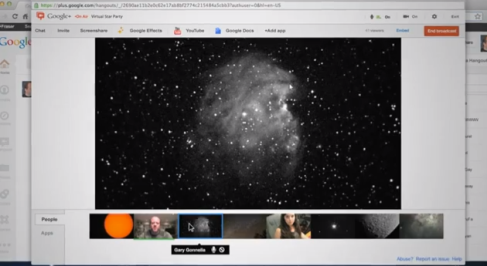
Image

Even NASA has joined the hangout craze. For updates on when the next NASA ‘hangout’ will be, see here!!

A second way that I’ve found to engage with astronomy is through Twitter. Twitter allows people to quickly and easily share articles, breaking news stories, pictures, or facts on astronomy with an incredibly large base of followers. Especially for someone like me who isn’t exposed to astronomy facts on a daily basis, following even one of the hundreds of twitter accounts sharing astronomy news can make a HUGE difference in my ability to understand,  appreciate and stay current the subject. I have shared my top 10 favorite astronomy twitter feeds, feel free to follow!

1)NASA  2) Astronomy Magazine 3) Corey Powell, Editor at Discovery Magazine 4) Daily Galaxy 5) New York Times Science 6) Universe Today 7) NASA Voyager 2 8) Awesome Astronomy 9) TED NASA (my favorite!!!) 10) Virtual Astronomy 

To finish this post, I’ll leave you with a piece of advice I read from one of these twitter feeds: If you wish upon a star, you’re too late because the star is already dead

Posted in Universe | Tagged , , , , , , | Comments Off on Social Astronomy!

A Sea of Metal

Image

Jupiter’s Composition

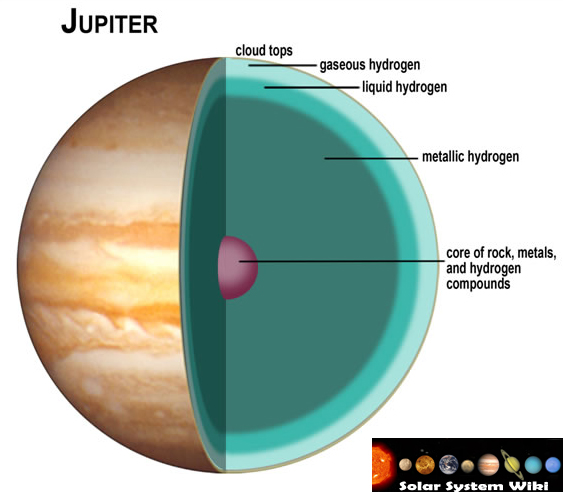
Jupiter freaks me out. It is huge, big enough to greatly affect the path of any smaller body that is unfortunate enough to cross its path, with potentially adversarial results for Earth. Even more so is its composition. Should you be unfortunate enough to find yourself on a ship heading towards where the surface of Jupiter, you’d have to pass through liquid hydrogen and then would hit metallic hydrogen. While this may seem normal enough, these two layers seem so alien to me when compared with the chemical diversity of Earth’s surface. It is quite fascinating to me the huge difference in composition that a relatively small (on a universal scale) difference in distance from the sun can have on the composition of a planet. Even better is that I know how it happened, thanks to the Nebular Formation theory, and still can’t help but marvel at the diversity of planetary composition between the Terrestrial and Jovian planets.


Posted in Class | Tagged , | Comments Off on A Sea of Metal

Kepler 2.0 Looks for Earth 2.0

Within the last week, a new break through has been made in the search for extrasolar planets, or planets orbiting another star other than our Sun. As we’ve know, other stars, or other distant suns, hold the possibility of other solar systems. Ideally, these solar systems may contain another Earth-like planet, which could possibly lead the the discovery of other life! In the search of extrasolar planets, astronomers have come a long way. The first discovery in 1995 found planet 51 Pegasi orbiting a star. Since then, hundreds of other extrasolar planets have been discovered, and now extrasolar planet hunting has become one of the hottest topics in astronomy today. To see a catalogue of all extrasolar planets found so far, check out this website!

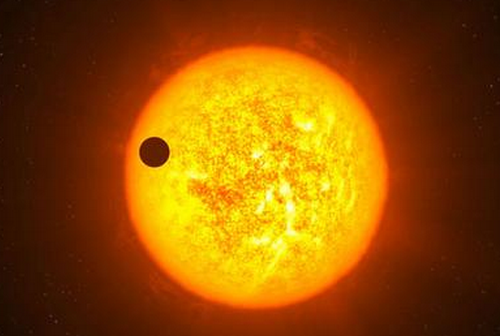
Three days ago on April 7th, Discovery.com announced Kepler 2.0, or the next generation of extrasolar planet hunting. According to the article, NASA has approved a $200 million mission  dedicated to extrasolar planet hunting, set to launch in 2017. Named “TESS” for the Transiting Exoplanet Survey Satellite, this telescope will be looking for a ‘dip’ in starlight which denotes a planet moving in front of the star during it’s orbit. (Otherwise known as the ‘transit’ method). See pic below!

Screen Shot 2013-04-10 at 8.58.16 AM

According to scientist George Ricker, this mission will take extrasolar planet hunting to the next level. He explains, “TESS will carry out the first space-borne all-sky transit survey, covering 400 times as much sky as any previous mission”. Looking ideally for Earth- sized planets in the habitable zones, this is sure to be an exciting new venture for astronomy! With the Nashville eclipse and the launch of TESS, 2017 is sure to be a big year for astronomy.

Screen Shot 2013-04-10 at 9.00.17 AM


Posted in Class, Universe | Tagged , , , , , , | Comments Off on Kepler 2.0 Looks for Earth 2.0

Theories, Theories Everywhere

What the solar system might actually look like with sun’s movement accounted for.

The formation of our own and other planetary systems is, understandably, one of the most interesting topics in astronomy. But what interests me even more than our current formation theory is how subject it is to change. I do not doubt its validity, but it seems funny to me that with each advancement in the technology of finding extrasolar planets, another challenge to the theory arises. This being said, our theory has held up quite well, in my opinion. The basic concept has remained mostly unchanged, but it has been added on to and refined as necessary, in a relatively quick span of time. This is the theory of what happened in our Universe over a course of 13.7 billion years; yet in only a few decades we are able to refine our Nebular Theory to explain these events. The addition of planetary migration, encounters and resonances has once again made our theory once again seem to explain it all, though questions still (and probably always will) remain.

I guess my point is that I am amazed at how quickly the scientific community can act when it comes to the Nebular Formation theory and astronomy in general. Each ounce of advancement leads to a plethora of new questions about the formation of the universe, and the scientific community has been able to provide a reasonable answer which does not contradict our initial theory each time. And quickly too, especially with compared to the Universal time scale or even the time scale of how long astronomy as a science took to develop.What I get from this is that astronomy is very much a working science; a work in progress. New questions and new answers are being addressed everyday by astronomers and various other scientists. This is the exploration period of the Universe, and much like Christopher Columbus’ famous voyage, I am very excited at the possibility of an Earth-shattering (hopefully not literally) discovery just around the corner.


Posted in Class | Tagged , | Comments Off on Theories, Theories Everywhere

A Comet Heads For Mars

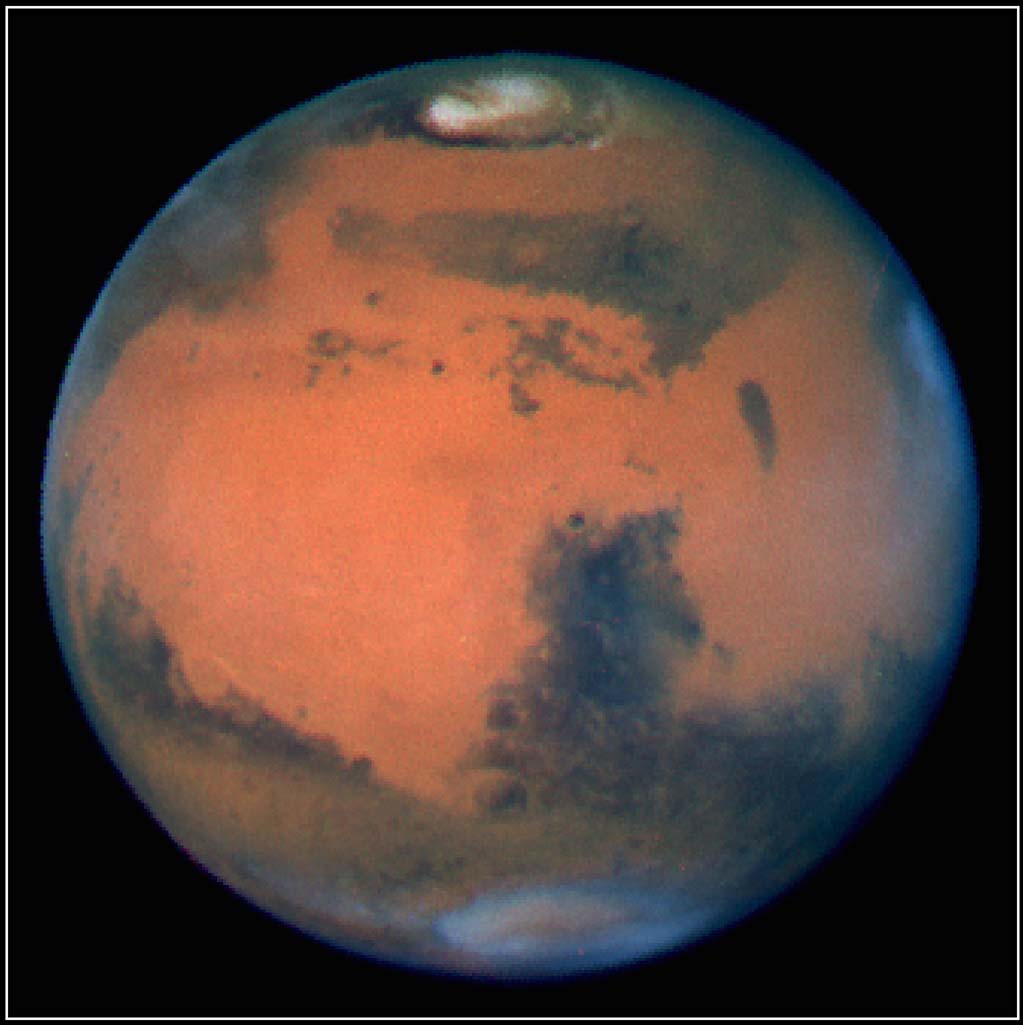
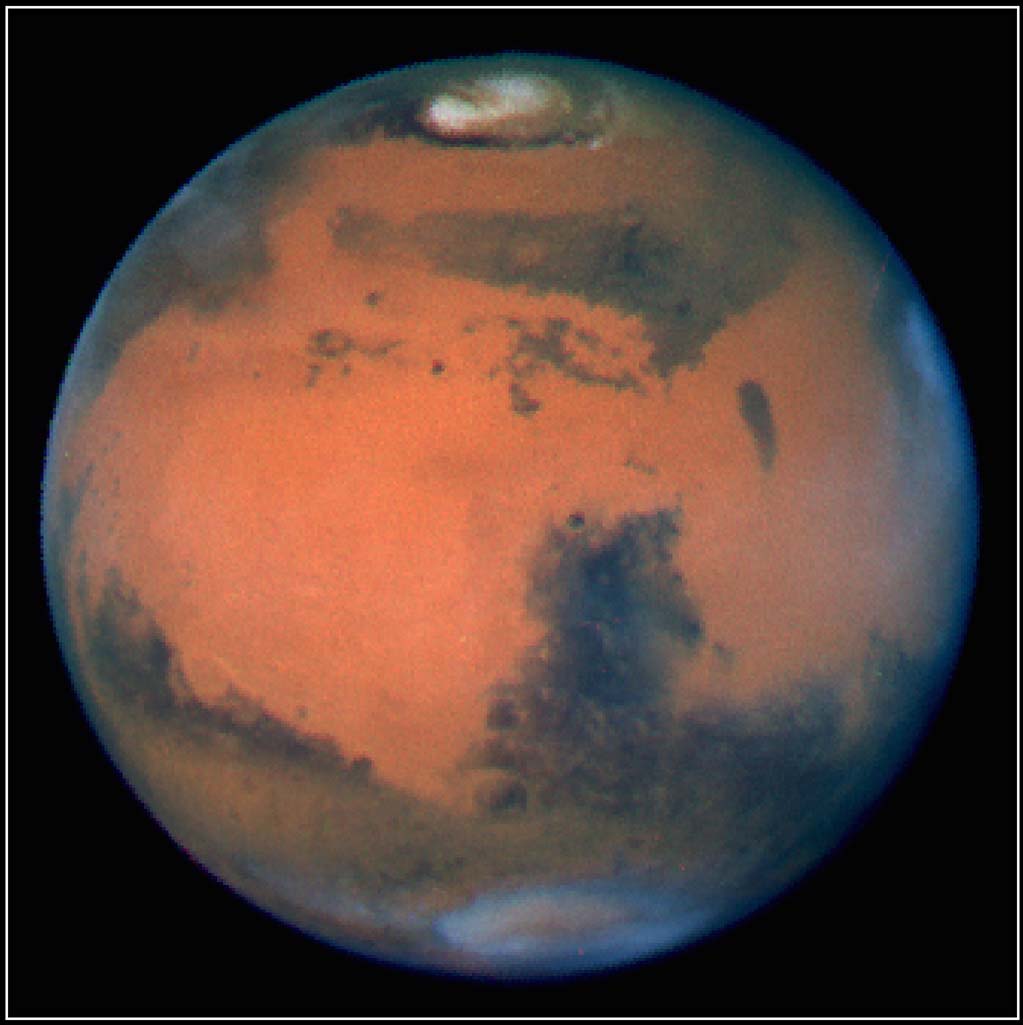
NASA has discovered that there is “small but non-negligible” chance that Comet 2013 A1 will strike Mars in October of 2014. The comet is between 1 to 3 kilometers in diameter, which, according to our textbook, only happens about once every 100 million years! Furthermore, the energy from the impact will be about one third the energy of the impact that destroyed the dinosaurs.

NASA is both concerned and excited for the possible impact. On one hand, the impact will allow scientist to study the impact process and the material that will go flying into the air (just as with SL9 crashing into Jupiter). The impact could change the climate too, making for a “wetter and warmer Mars” that would be interesting for scientists to study. On the other hand, NASA is concerned about some of the equipment they have on Mars. Solar powered Opportunity in particular may not survive if the atmosphere becomes opaque. Most of the other equipment should survive the impact and will continue to be useful studying the “new” Mars.

Comet Striking Mars

Image


Posted in Small SS Objects | Tagged , , , , , | Comments Off on A Comet Heads For Mars

A Breakthrough in Space Travel

There is currently a project underway which aims to send astronauts in a fusion powered spacecraft to Mars and cutting the travel time to just 30 days round trip. Using existing rocket fuels it would take at least 4 years to travel the same round trip and would cost more than $12 billion. Using this new technology, the team hopes to send two astronauts on a 500 day fly by mission of Mars by 2018, taking advantage of its ideal position relative to Earth at this time. Obviously the duration of this mission is a major concern due to the amount of radiation the astronauts would experience, however the Inspiration Mars Foundation suggests using food, liquid and even human waste as protection. This truly seems like a breakthrough that will allow us to begin visiting other planets and possibly even set foot on them too. For more information on the science behind project please refer to this article from pcmag.


Posted in Space Travel | Tagged , , , | Comments Off on A Breakthrough in Space Travel

Drawing Closer to Discovering the Mysteries of Pluto

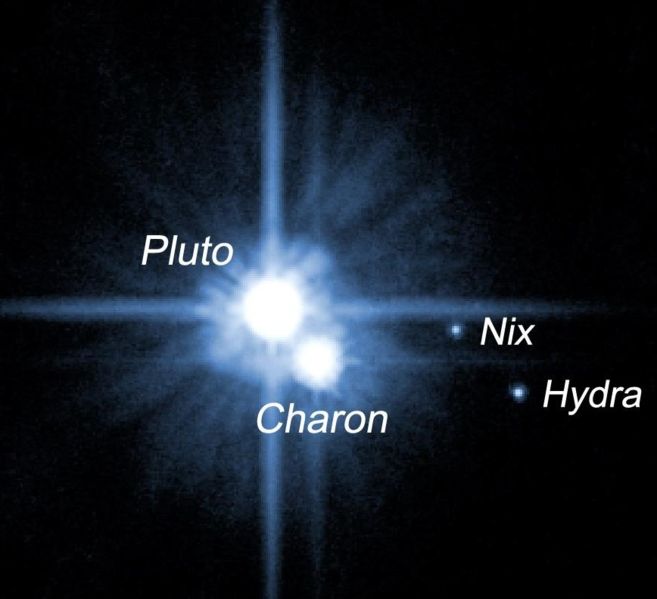
Right now Pluto is a very mysterious planet. No man-made object has flown by it and so there is not a lot of information on its global geology or chemical composition on the surface. In 2 years however, New Horizons will finally reach the dwarf planet and retrieve valuable data that astronomers have seeked for so long. Interestingly enough, Pluto was still classified as a planet when New Horizons launched in January of 2006. This results in a total travel time of 9 years once it reaches Pluto. The spacecraft will also be investigating Pluto’s moon Charon which many consider to be part of a binary planet. It will be very interesting to see what is discovered about Pluto and Charon, and whether or not there is any unique activity happening on either world. Please refer to the Wikipedia page for a lot more information on the New Horizons mission.


Posted in Dwarf Planets | Tagged , , , , | Comments Off on Drawing Closer to Discovering the Mysteries of Pluto

Binary (Double Star) Systems

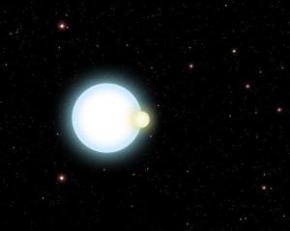
If you’ve ever seen any kind of sci-fi movie, I’m sure you’ve seen an example of a binary star system.  Countless space movies (most notably Star Wars) feature an alien sky with more than one Sun.  While the effect is usually dramatized in film, these binary star systems are in fact very real.

A binary star is defined as “A star system consisting of two stars orbiting around their common center of mass.”  Most often, these systems are classified as “visual binaries” that are close enough in the sky to be considered a binary star.  The brighter star is designated the primary, and the dimmer star is called the secondary.

A rare binary occurrence is described here, where a star and black hole are orbiting each other at an incredible rate of once every 2.4 hours!


Posted in Observables, Physics, Stars | Tagged , , | Comments Off on Binary (Double Star) Systems