Comets and Meteor Showers

An Artistic Interpretation of a Comet

Everybody loves comets. Just think of a flashy ball with a lovely tail crossing the night sky. How beautiful it is! Most people like me have many misconceptions about comets however. The most surprising thing about comets I learned from Astronomy 201 is that meteor showers are actually from comets! How can that be?

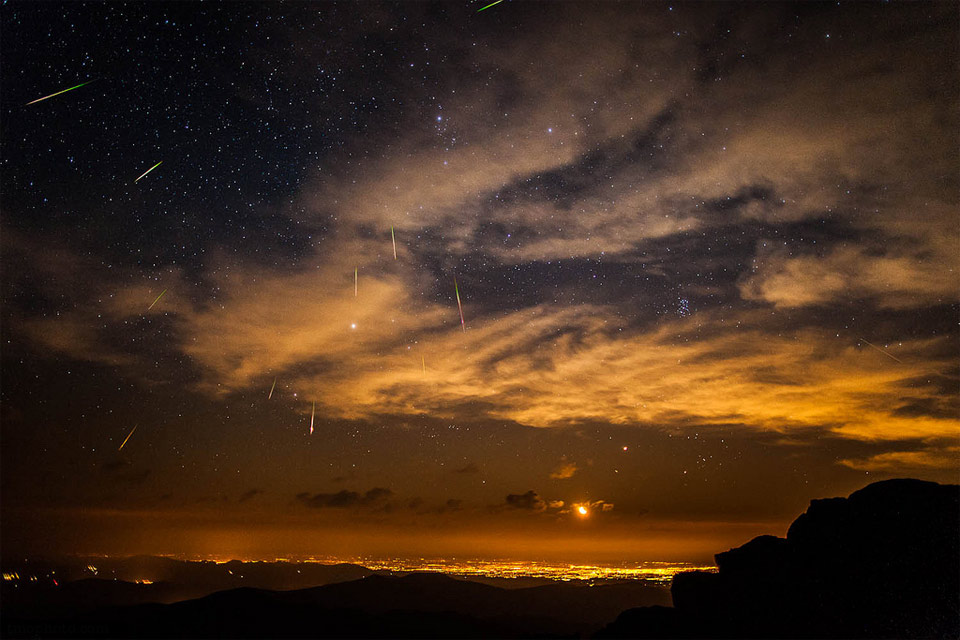
Meteor Shower over Denver, Colorado

The first thing to know is that a comet that passes through inner solar system has three tails. We can see plasma tail (or ion tail) and dust tail, but there is one more invisible tail: rocky tail. This tail is composed of sand- to pebble-size rocky materials when the gas escapes from comet. As these rocky materials are too dense to be affected by either solar wind or sunlight, they simply leave at approximately where they are disposed, i.e. the comet’s orbit.

A close look into a comet

We see a meteor shower when Earth crosses through the comet’s orbit. All those rocks and dusts now enter the atmosphere. They come with a very high speed, and the high frictional heat burns them up. Their surrounding air thus glows. As Earth passes through these certain orbits annually, we can actually see meteor showers by the same comet at about the same day every year. Here is a chart of these annual meteor showers. Never feel upset when you miss a meteor shower – you can always pack up your telescope and wait for no more than a few months to see another!


Posted in Class | Tagged , , , | Comments Off on Comets and Meteor Showers

Gushing With Life

Image

The search for extrasolar planets and potential for alien life is one of the hottest topics in modern science. As such, I thought it would be interesting to discuss the place that some scientists say is most likely to alien host life.

Enceladus seems to be at the top of everyone’s list for alien host planets. This small moon of Saturn is called the most promising bet for life for several reasons. Its surface is icy, but scientists believe there may be water beneath the surface ice. Also, the moon seems to have a boiling core of molten rock, helping to heat the moon to warmer temperatures that can help give rise to life. The most attractive characteristic of Enceladus is the geysers of frozen water spewing from its southern hemisphere. If there is life on Enceladus, these geysers may be continuously gushing life into space, making it easier for scientists to grab potential samples.


Posted in Aliens | Tagged , , | Comments Off on Gushing With Life

Gravitational Slingshots

I always wondered why doesn’t the sun slow space probes down when they are leaving the Earth for outer planets. Isn’t there a risk that the probe might change its trajectory and fall into the sun? There is. You see, the more distant the space probe gets from the Sun, the more potential energy it gains. However, energy must be conserved at all costs. Therefore the probe loses its Kinetic energy (and therefore its speed) in order to get away from the sun. It is the same as when you throw a rock up into the air.

But there comes a point, as with the rock, when the probe loses all of its kinetic energy. At that time it has reached as far away from the sun as it can. Yes, you could add thrusters to make sure the probe continues its journey. But the extra weight and inefficiency of propellants known to us make it an unsuitable alternative.

Enter the Gravitational Slingshot! Nature’s way of compensating us (very marginally) for all the millions of years we’ve been dragged through the mud in the name of evolution. Through this method, space probes go into a partial orbit around a planet and emerge on the other side with a greater velocity. “No!”, some might say, because it is a violation of conservation of energy. Intuitively it seems that way, but it is all a matter of relativity.
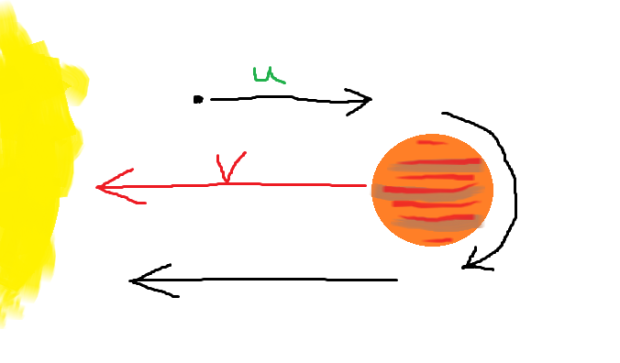
slingshot

Imagine there is a probe approaching a planet with a velocity ‘u’. To an observer on the planet, the apparent velocity of the probe’s approach will be ‘V+u’, where ‘V’ is the planet’s and ‘u’ is the probe’s heliocentric velocity, i.e. velocity relative to the Sun. It will go into orbit at that speed. Now, when it comes out of orbit on the other side, it is still moving with a velocity ‘V+u’ relative to the planet’s surface. But the planet is also moving in the same direction at velocity ‘V’. So the final velocity as the probe leaves orbit will be ‘V+(V+u)’. Of course, some of that velocity will be reduced due to the planet’s potential, but in the end it will still be greater than the probe’s initial velocity.

If you look at what happened overall, ignoring how it happened, the probe approaches a moving planet at a certain velocity and “bounces off” at a higher velocity. It is just like when you throw a ball at the face of a moving train, the ball bounces off at a higher velocity. Now, the ball changes its momentum (first going in one direction, then another) and transfers that change to the train to ensure conservation. But the train is comparatively so massive that we do not notice the minuscule change in its velocity. That’s the same with planets and probes.

The effective increment in the probe’s velocity is due to the orbited body’s velocity relative to the Sun (analogously, the change in velocity of the rebounding ball depends on the train’s relative velocity to the ground). Of course, the Sun’s velocity relative to itself is zero. Therefore ‘V’ will be zero. So there will be no gravitational slingshot from the Sun (towards planets in its orbit) even though it is the most massive body in the solar system; just like there will be no increment in the velocity of the ball when you throw it at the ground.


Posted in Physics, Science | Tagged , , , | Comments Off on Gravitational Slingshots

Stories about Europa

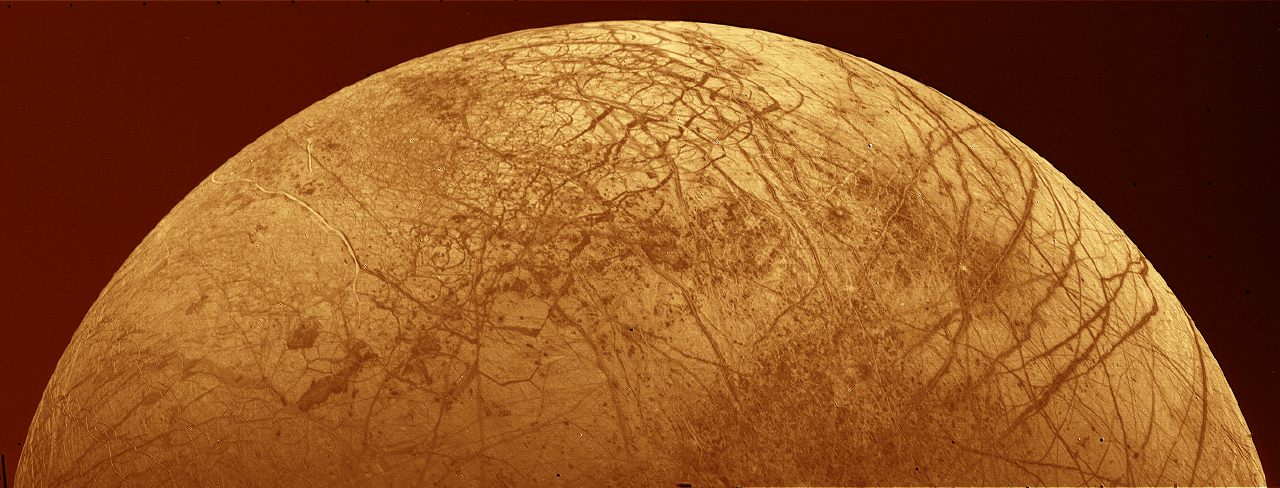
Among four Galilean moons, my favorite one is Europa. Known as the water world, Europa has huge abundance of liquid water beneath its icy surface. Let’s take a closer look of how this extrapolation of liquid water on Europa.

Water is suspected to be the agency that erases Europa’s relatively young surface.

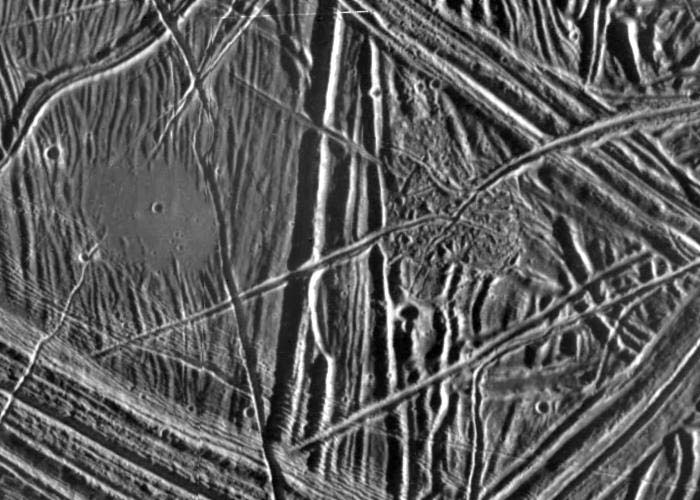
Double-ridges on Europa’s surface


The double-ridges on Europa as shown in this picture are likely to be the evidence that liquid water rise up from the cracks. The cracks may be caused by frictional heating of the surface ice due to tidal forces of Jupiter and other Jupiter moons.

Astronomers have now come up with model of Europa’s interior with metallic core, rocky mantel, water layer and icy surface.

Interior Structure of Europa


The question is: does the water layer exist in the form of liquid water form or warm, convecting ice? Many astronomers support the liquid water layer, as Europa is rare among moons as it has a magnetic field. There are three basic requirements for a global magnetic field: 1) an interior region of electrically conducting fluid; 2) convection in the layer of fluid; 3) moderately rapid rotation. As ice does not conduct electricity, a salty liquid water layer seems to be a more probable explanation for the magnetic field.


Posted in Class | Tagged , , , | Comments Off on Stories about Europa

Transiting Exoplanets: The Search for Terrestrial Worlds

Image

On Monday, NASA announced a new project scheduled to launch in 2017: the Transiting Exoplanet Survey Satellite (TESS).  This project was selected after a three-year competition, and will use surveys covering 400 times as much sky as any past missions to discover transiting exoplanets.  This struck me as particularly significant having just studied methods of indirect detection.  Compared to the astrometric and Doppler techniques, the transit method has one crucial advantage; it can reveal planets far smaller than the other two techniques.  However, study of transits was previously limited because only a very small fraction of planetary systems have orbits oriented edge-on to Earth, which allow for the planets to eclipse their stars with a regular period from our perspective.  It has also been biased toward short orbital periods, because repeated observations are necessary to verify transiting orbits.

Because these three means of indirect detection have all been biased toward massive planets with short orbital distances and periods given past technologies, they have been less useful for detecting and studying Earth-like terrestrial planets than large jovian ones.  This limits the scope of past studies, because terrestrial planets with masses similar to Earth and slightly longer orbital periods and distances are far more likely to be capable of sustaining life.  The TESS Project has a special focus on planets close to Earth’s size, and new technologies should greatly accelerate potential for discoveries.  Hearing this, I can’t help but consider the tremendous implications of the possibility that we may soon find life on another planet.


Posted in Exoplanets, Stars | Tagged , , , | Comments Off on Transiting Exoplanets: The Search for Terrestrial Worlds

Astronomy and its Misconceptions

I was browsing earlier and decided to think back on some of the assumptions I had about our Solar System before beginning this class. I stumbled upon this page and was proud to say that although I was not THAT clueless, I was guilty of some of the common misconceptions about Astronomy. It was interesting to read about some of the common misconceptions and why people though this way. It made me think about the common misconceptions that I’ve read about in the book. One that I had never even thought about was on the Lunar phase names, #25. I would think that a first quarter moon would be 25% lit up. Instead, it’s actually half illuminated by the Sun during the first quarter. Instead, first quarter simply refers to which stage of the cycle the Moon is currently in.

Another one I found interesting was #30, the brightness of the Moon. We can look out on a great night and commonly express how bright the Moon looks. Turns out, the Moon only actually reflects 12% of the Sun’s light; Earth reflects 39%. So, the Moon is not actually very bright and shiny reflective, it just appears that way to us.


Posted in Class | Tagged , , | Comments Off on Astronomy and its Misconceptions

And Then There were 8

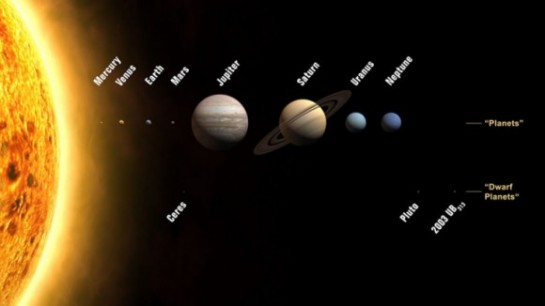
And Then There were 8

Bye pluto :( We all learned the acronym back in elementary school: My Very Educated Mother Just Served Us Nine Pizzas. Now the joke going around is that we have to learn My Very Evil Mother Just Served Us Nothing. Not only is Pluto killing our childhood knowledge, it’s also being mean to moms! So the real question is, why isn’t Pluto a planet anymore?

When the International Astronomical Union met, it decided that Pluto was no longer a planet because it didn’t satisfy the three requirements to be a planet: 1. must orbit the Sun (check) 2. must have enough gravity to pull itself into a ball (check) 3. must clear out all other objects from its orbit (fail). According to these rules, Pluto is only a dwarf planet because it shares space with its neighboring objects (polite). Interestingly enough, you would think that Pluto would be the largest dwarf planet given its downgrade from new conditions. However, it isn’t. Eris is bigger than Pluto, which seems silly because you’d think we would have called Eris a planet at some time too!


Posted in Class | Tagged , , , , | Comments Off on And Then There were 8

TESS: a New Eye in the Sky

NASA has a new project set to launch in 2017 and it’s going to be big. The TESS project will be tasked with the most trendy task in astronomy these days: finding exoplanets. Using a slew of wide-view cameras, TESS will peer tirelessly at the stars looking for “transits,” or dips in brightness when an orbiting exoplanet passes in front of it’s star. This will be an exciting launch because TESS will be able to cover about 400 times the amount of sky that the current Kepler mission can, so we can soon expect the number of exoplanets to increase drastically. This project will be able to work in tandem with the James Webb Space Telescope, whose infrared lenses will be perfect for examining these new planets once they are found.


Posted in Exoplanets, Instruments | Tagged , , | Comments Off on TESS: a New Eye in the Sky

It’s OK, Pluto, You’re Not Alone!

A lot of Pluto fans were really upset with Pluto’s demotion from planet to “dwarf planet” back in 2006. I mean what’s not to love about a tiny iceball on the edge of the Kuiper Belt? There is good news though. Despite Pluto’s lowly new title, at least it has some company. The IAU recognizes four other dwarfs for Pluto to be friends with: Ceres, Eris, Makemake, and Haumea. Ceres inhabits the Main Belt and is the only  dwarf planet to do so, Eris, the most massive dwarf planet orbits at roughly three times the distance to the sun as Pluto, Makemake is possibly the largest object in the Kuiper Belt, and Haumea is the only known elliptical dwarf planet. Additionally, there are estimates that there are hundreds and maybe thousands of other “dwarf planets” out there waiting to be discovered. Bottom line, don’t feel badly for Pluto, it’s not alone out there!


Posted in Dwarf Planets | Tagged , , | Comments Off on It’s OK, Pluto, You’re Not Alone!

Protoplanet Publicity

Image

Scientists have located what they believe to be the first direct observation of a planet forming in its stellar womb of gas and dust. Using ESO’s Very Large Telescope, Sascha Quanz and an international team of scientists has been studying the young star HD 100546 and its surrounding gas. They were surprised when they spotted a protoplanet, about 10 times further out than the Earth is from the sun, still being formed. The discovery is exciting for several reasons. Firstly, the youthful planet and its star are relatively nearby to earth at 335 light-years away. But even more importantly, “if [the] discovery is indeed a forming planet, then for the first time scientists will be able to study the planet formation process and the interaction of a forming planet and its natal environment empirically at a very early stage.” Current understanding of protoplanet formation relies heavily on mathematically based theories and computer models. Scientists note that the results of the study require follow-up observations to confirm the existence of a protoplanet.


Posted in Exoplanets, Physics | Tagged , , , , | Comments Off on Protoplanet Publicity