On the Hunt

During class recently we have been talking a lot about the Drake Equation and extraterrestrial life. Tying all of the various topics that we have discussed together has been this concept of “astrobiology.” Class over the past couple weeks was the first time that I had ever heard the term astrobiology (that could be my own naiveté). The concept at first seemed pretty straightforward, but after reading a couple of articles I realized that I didn’t understand how extensive this study is.

According to a NASA article, NASA has an Astrobiology Program which has four different branches (focused on evolutionary biology, astronomy, planetary exploration, and instrument development). These branches focus on exploring the possibility of life in the vast (and quickly growing) number of NASA solar systems that have been discovered.

As stated in the article, this program is focused on answering three fundamental questions (taken directly from Astrobiology):

  1.  How does life begin and evolve?
  2. Is there life beyond Earth and, if so, how can we detect it?
  3. What is the future of life on Earth and in the universe?

In all, this article gave a good synopsis of NASA’s involvement in the search to find extraterrestrial life. It also gives areas of focus for searching for this life.

PICTURE 1

Image of the ALH84001 Martian meteorite showing carbonate inclusions.
Source: Astrobiology

PICTURE 2

Microscopic image of the same meteorite pictured above.
Source: Astrobiology

One of the interesting focuses of the article was on the ALH84001 meteorite. This meteorite came from Mars and fell onto Allan Hills, Antarctica in 1984 (ALH84001). As scientists began to study this meteorite, they found carbonate inclusions that could be proof that life once existed on Mars (even if it was basic life). The possibility for microscopic life is immensely interesting, and I hope that discoveries like this continue to occur as more research is done in the field of astrobiology.


Source for this post: Astrobiology – NASA Science


Posted in Aliens | Tagged , , | Comments Off on On the Hunt

Blog #10: Accumulation of Astronomy


Starburst Galaxy

Starburst Galaxy

In this article by National Geographic, astronomers have recently discovered a galaxy that is about 13 billion light years away from us that we are now being able to see develop.  This galaxy is very similar to our own Milky Way in terms of size; however, it is drastically different when comparing stars and the amount of matter produced between the two.  The Starburst Galaxy is absolutely incredible in that it is creating stars over a billion years before it’s estimated prediction time.  The stability of this high energy galaxy is shocking to astronomers as it could have a traumatic effect if it was developing unstably.

To me, I find it amazing that such a complex and massive planet is able to form after our own Big Bang. Also, the elements that are present in this galaxy showed up after the explosion of first generation stars in our universe.  The recycling nature of our universe is so awesome in that we can see the travel and reuse of elements, compounds, and other matter in planetary systems.

While this is a very recent topic (the article was written today!) it’s amazing how I am able to read this piece confidently as I can understand the techniques of how they were able to locate and identify the galaxy by using infrared mapping.  Although I am by no means pursuing a degree in astronomy, this class taught me a lot of knowledge about our own solar system and how this applies to our ones so we can examine events like this and hope to find life like on Earth.  While I was researching for my last blog, I was commenting on what this discovery might mean in terms of understanding how other solar systems and galaxies can form and my roommate commented that although I won’t be using this knowledge in my profession, I am able to discuss a topic that many people have no knowledge on whatsoever.  This is interesting because everyone on this entire Earth has a few things in common: we all live in the same universe, in the same planet, on the same Earth revolving around the same Sun.  I think astronomy is a class that should be given more attention especially as we develop more advance technology to discover and research new worlds in the sky.

The study of stars was of the most important activity to partake in back in the ancient period of our world.  It gave direction to travelers and had us question philosophical issues of our existence that we still continue to search for.  The more we examine and study our universe, the more questions, answers, doubts, theories, and laws we will able to determine if we keep exploring into the depths of the unknown.


Posted in Observables | Tagged , , , , | Comments Off on Blog #10: Accumulation of Astronomy

Blog #9: Alien Life?


Last year the Discovery Channel started a new show titled, “Curiosity” which examined what it would be like if advanced life, such as aliens, were to attack our Earth.  In this clip, physicist Dr. Michi Kaku discusses what our interactions would actually be like with distant life and why an encounter with them would either follow one of two ways.  Either a) because Earth is so “primitive” compared to their civilization that has been around for millions of years they do not want to bother with us or b) it would be like “Bambi vs. Godzilla”.  Their technology would be so advanced that we would have no means to protect ourselves from this invasion.

I thought it was interesting on how the producers of “Curiosity” chose to consult Dr. Kaku to keep the integrity of their show as realistic as possible, but also appealing to the interests of their audience.  A physicist gives an interesting perspective because he is able to conclude based on our research and theories of our own planetary systems as well as studying others in our universe what could eventually happen.  While I am not opposed to other life existing, I find it very unrealistic considering we have found no signs of intelligent life, even though we have examined countless planets, some very similar to Earth and others resembling Jupiter.

Lastly, Dr. Kaku’s response on how we are going to to protect ourselves if an invasion like this were to occur was very well thought out.  It’s obvious that we have no technology on Earth that could possibly match that of an alien’s.  Although he points out that we have yet to find any advanced civilization like our own, he is confident that we will eventually find one and will need to prepare ourselves for this day.  A great lesson that we can learn is how he would approach talking to an alien civilization, depending if they are warlike or non-aggressive.  He explains that there would be difficulty in communication but that it is needed and necessary to analyze and understand. Dr. Kaku makes a very interesting point that since these alien civilizations have been around for millions of years longer than our own, they have had time to sort out all of the troubles that we are struggling with today on our own planet in terms of religious, social, political warfare.  I had never really thought that history could occur on other planets as well and they would have the same struggles that we ourselves have on this Earth.

With our advancements in research into space, the possibility of finding another civilization is increasing as we analyze more distant planets and observe life and how it can occur.  While it might not be practical to develop weaponry or begin “alien shelters”, it should be noted in terms of our national and global security how we would address the invasion of such a species and how to conduct civilized and peaceful agreements.


Posted in Aliens, Class | Tagged , , | Comments Off on Blog #9: Alien Life?

Is Cold the New Hot?

Yes.

why_star_trek

A few days back, a friend shared an article with me. It talked of how scientists had managed to achieve temperatures below absolute zero. Does it mean that temperature has to be redefined? Has our understanding of thermodynamics been flawed for the past hundred years. No, it turns out. It is all a matter of semantics.

Absolute Zero. This is the temperature at which a particle has the minimum possible energy. The energy is NOT zero because that would violate the Heisenberg uncertainty principle (that you cannot know the energy and its duration with absolute certainty). However that zero-state energy is a quantum quantity, so for all intents and purposes, the particle itself appears stationary. Classically, it is impossible to go below absolute zero because for all the matter that we know of, it will never have negative energy (because the zero state energy prevents energy from going past zero and into the negative).

Therefore when you talk of temperatures below absolute zero, and you know that there is nothing wrong with absolute zero, then logically there must be something going on with “Temperature”. The layperson will call temperature the hotness of something. Some one more well versed in science will call it the average kinetic energy of the particles. All of these definitions are correct in the same way Newton’s gravity is correct i.e. it works for our observations. But in order to really understand temperature, you need to understand entropy.

Entropy in a sense is the amount of disorder in a system. Imagine making a mound of sand on a table. Now shake the table. The sand particles will spread out as they roll down from the mound. Because the particles are now spread out, the entropy of the system has increased. The farther a particle is from the original position of the mound, the more effectively it has harnessed the energy you gave the system by vibrating the table. If the table was infinitely expansive, the particles would continue spreading out and absorbing the energy you provide and increasing the entropy of the system.

In a system with infinite states, energy and disorder have a positive relationship.

In a system with infinite states, energy and disorder have a positive relationship.

This is temperature, the ratio of energy required to the change in entropy. The greater the energy required for the same increase in entropy, the greater will be the temperature.

But there is a catch: what if you provide more energy to the system but the disorder (entropy) decreases instead. Is it possible to shake the table and make the sand particles more ordered? If it is, then that would mean that the temperature of the system is negative because the change in energy is positive, but the change in entropy is negative, so the ratio (which represents temperature) is negative. Imagine that the table is not infinite. Instead it has little walls on the edges. As you shake the table, the sand particles start to spread out (they gain energy, and increase entropy). The temperature increases. But there comes a point when they reach the edges. Then they start to accumulate again. The more you shake the table, the greater is the particle accumulation on the edges. At that point, an increase in energy of the system is in fact decreasing its disorder. Thus the temperature has become negative.

In a system with finite states, energy and disorder develop a negative relationship.

In a system with finite states, energy and disorder develop a negative relationship.

That is exactly what the scientists mentioned in the article did. They trapped the molecules using lasers and magnetic fields, so that after absorbing certain amount of energy, the barriers created by the magnetic fields and lasers would cause particles to accumulate around the same energies. In the classical sense, the particles were hotter because they had a greater energy, but since the disorder in the system was lessened, their temperature was negative i.e. below absolute zero.


Posted in Physics, Science | Tagged , , , , , , | Comments Off on Is Cold the New Hot?

Asteroids in Orbit?

It looks like we’ll be bringing an asteroid home sometime soon.  NASA wants to identify an asteroid in deep space, figure out a way to capture it, and bring it into our own planetary region, ultimately setting it in orbit around our moon, all by the year 2025.  This proposal was included as a part of the NASA budget rollout for 2014, and an initial $104 million for the project is being provided by President Obama’s broader federal budget.  NASA’s plan for the asteroid is to first capture it, then surround it with a large, flexible covering that will be towed by a space craft with large solar arrays.

asteroid20130410-full

NASA

Although the NASA project is similar to an idea proposed by scientists at the Keck Institute for Space Studies at CalTech, it will cost less than the projected Keck price tag of $2.6 billion, because NASA will look for their target asteroid much closer to earth, and because they will already be spending millions on related rocket technology.

Here’s a video from NASA describing the project.

Some of the goals articulated by the project are:  learning how to identify asteroids heading toward us and to change their course, finding destinations where astronauts can go as they try to learn how to make the longer trip to Mars, and providing opportunities for space investors.  Because asteroids are among the oldest objects in our solar system, bringing one into our neighborhood would give scientists an unprecedented opportunity to see what things were like at the formation of our solar system.  It will also help astronauts practice for the projected mission to Mars further in the future.  Another reason for the increased interest was the meteorite explosion above Chelyabinsk, Russia back in February, which has sparked conversation about “planetary defense”.  Finally, several commercial space companies have expressed interest in mining the asteroid and having a potential space mining site so close would spur those company’s development.

At the very least, we can finally dispel asteroid misconceptions passed on to us by films like this, and this.  Also, this.  Terrible, I know.


Posted in Class | Tagged , , , , | Comments Off on Asteroids in Orbit?

Terrific Titan

thumbnail_big

NASA

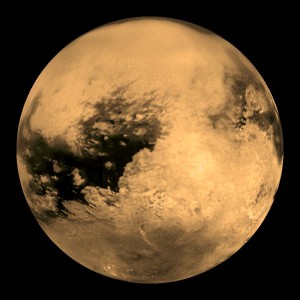
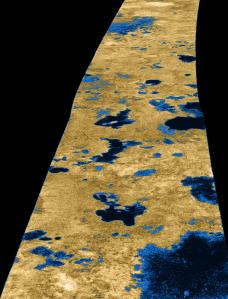
Titan, Saturn’s largest moon (and second largest in the solar system), is a really cool world.  Like Earth, it has a thick atmosphere, making it the only moon in our solar system to have one.  Also, like Earth, Titan’s atmosphere is mostly composed of nitrogen, and has a presence of organic molecules that contain carbon and hydrogen.  This has led many scientists to speculate that current conditions on Titan are like those during the early years of Earth.  One major difference, however, is that because Titan is so cold,-290 F or -179 C, water is frozen as solid as a rock, but methane and ethane can be found in liquid form.  In fact, similar to Earth’s water cycle, Titan has the phenomenon of a hydrocarbon cycle, in which liquid methane and ethane fall to the surface.  In 2005, the Huygens probe was released by the Cassini spacecraft down to Titan’s surface, and pictures taken during the descent show that Titan’s polar region even has lakes and rivers filled with liquid methane.

What’s great about Titan is that it’s still making headlines.  One new discovery has to do with the moon’s atmosphere.  Back in 2009, Cassini spotted a glow emanating from Titan’s atmosphere.  The emission comes from a mysterious gas and is strongest at an infrared wavelength of 3.28 micrometers, near one where emissions from methane are also very strong, one reason why these mystery emissions were previously obscured.  The glow only appears on the moon’s daytime side, at altitudes between 600 and 1250 km, with the largest intensity occurring around 950 km.  Normally, this light, known as airglow, is generated when atmospheric molecules are excited by sunlight or electrically charged particles.  Therefore, scientists expected to see a glow in the high atmosphere because there, charged particles from the Sun and Saturn’s magnetic field strip away electrons from molecules in Titan’s atmosphere.  The deeper glow (below 700 km), however, has puzzled researchers, because it originates too far down to be caused by the excitation of atmospheric molecules by charged particles.  Perhaps  the glow is produced by deep-penetrating cosmic rays or by light emitted by a chemical reaction deep in Titan’s atmosphere.  Unfortunately, we still don’t know the glow’s cause, nor the chemical composition of the gas, for sure.

sn-titan

Science

The second bit of news regarding Titan concerns its methane lakes.  Apparently, we probably wouldn’t want to sail the Titanic through those waters either, because there may be chunks of hydrocarbon ice floating in them.  Scientists first believed that methane ice on these seas would not be possible, as solid methane is denser than the liquid form.  However, after a model investigating how Titan’s seas interact with its nitrogen-rich atmosphere (which creates pockets of varying composition and temperature) was created, scientists determined that hydrocarbon ice should indeed float in the moon’s seas, so long as the temperature is just below methane’s freezing point (-297 degrees F or -183 degrees C) and the ice is at least 5 percent “air”.  That ice may only last a short time, however, as even a small drop in temperature would cause the ice to sink.  The research team will be able to test out their model soon, as Titan’s northern spring is underway, warming up the lakes and seas there and allowing ice to rise to the surface.  This in turn will create a surface that appears “brighter”, or more reflective, to Cassini and as the temperature increases further, the ice will melt, leaving an entirely liquid surface that will appear “darker”, or less reflective.  As one researcher put it, the discovery that ice could form is important because “…the formation of floating hydrocarbon ice will provide an opportunity for interesting chemistry along the boundary between liquid and solid, a boundary that may have been important in the origin of terrestrial life.”
166569main_image_feature_732_jw_full

NASA

Hopefully, we’ll make even more discoveries about this fascinating world in the years to come, and hey, who knows, maybe one day we’ll even get to swim in those methane lakes ourselves.


Posted in Class | Tagged , , , , , , , | Comments Off on Terrific Titan

Spacecraft of the Future

Image Source After the end of the Space Shuttle program, many alternative spacecraft designs have begun to surface. Most of these designs are spaceplanes, much like the Space Shuttle, which means that they can glide through Earth’s atmosphere and land … Continue reading
Posted in Space Travel | Tagged , , , , | Comments Off on Spacecraft of the Future

New Way to Study Asteroids

NASA and the White House just announced the space agency’s budget for the 2014 fiscal year. Included in that budget is a $100 million dollar project to retrieve and research an asteroid. A small, unmanned spacecraft will attach itself to a small asteroid and then steer the asteroid to the Earth-moon liberation point. At this point, a manned spacecraft will meet the asteroid and the members of the team will perform scientific experiments on the asteroid. This landmark new method of conducting research on hard to reach parts of the solar system should reduce risk and minimize costs. However, until the mission (called the Asteroid Retrieval and Utilization Mission) is carried out, we will not know the true success of this method.

PictureImage


Posted in Small SS Objects | Tagged , , , | Comments Off on New Way to Study Asteroids

The K-Pg Event, or: How I Learned to Stop Worrying and Exterminate the Dinosaurs

An artist’s interpretation of the impact, as seen on Wikipedia.

Also known as the K-T Event, its name is derived from the German words for Cretaceous and Paleogene.

It has been a long-held belief by scientists that it was an impact by a large comet or asteroid that killed off the dinosaurs. Fossil records indicate that 66 million years ago, almost 75% of life on the planet ceased to exist. Several species of mammals, reptiles, plants, and even water species like fish and plankton went extinct (relatively) shortly after the impact. It is believed that the crater from this massive impact was located on (now buried beneath) the end of the Yucatán Peninsula, centered near what is now the town of Chicxulub. Although the impact happened in one single place, the mass extinction was global. Dust particles clouded the sky, killing off many photosynthesis-based plants. As there food sources dwindled the herbivores began to die off as well, as did their predators later on. The interesting part is that the extinction while massive was also selective; birds and mammals were greatly affected while the land dinosaurs were killed off completely, but some species like alligators, turtles, and salamanders were almost completely unaffected.  Those that were not affected began to flourish as they evolved to fill environmental niches left by the species which were eliminated.

Fossil records from around the globe indicate that the majority of species living at the time were exterminated within a thousand years or less of the impact; the appearance of this rapid-but-still-gradual dying off may be due to the Signor-Lipps effect, which represents a type of bias in the data presented. The idea is that because neither the first nor last fossil of a species is guaranteed to be preserved, there is always a measure of inaccuracy in determining the beginning or end of a species’ existence. A perfect example of this effect is the coelacanth. The last fossil discovered of one was dated around 66 million years ago and they were believed to be extinct, that is until someone caught a live one in South Africa in 1938.


Posted in Class | Tagged , , , , , , | Comments Off on The K-Pg Event, or: How I Learned to Stop Worrying and Exterminate the Dinosaurs

The Galilean Moons

The Galilean moons of Jupiter, from top to bottom are Io, Europa, Ganymede, and Callisto.

The Galilean moons of Jupiter are in order of distance Io, Europa, Ganymede, and Callisto. They are the four largest and most prominent of the 67 moons orbiting Jupiter, these four moons are some of the largest moons in the solar system–Callisto and Ganymede are even larger than Mercury, while Io and Europa are smaller but of comparable size. They are called the Galilean moons because it was Galileo himself who discovered them through his telescope, between the years 1609 and 1610.

The innermost moon, Io, has a diameter of 3,642 km (compare this to Mercury’s diameter of 4,879 km) and has many active volcanoes. The tidal forces between Jupiter, Io, and the other moons have an astounding effect on Io and allows for its intense volcanic activity. The altitude of the surface on Io can change by as much as 100m due to the pull of the tidal forces it experiences. Its surface and atmosphere are mostly composed of sulfur, sulfur dioxide, and other sulfur compounds as a result of the moon’s volcanic activity. It has a sparse and spotty atmosphere of sulfur dioxide centered mostly around the volcanoes which are spewing it.

The next innermost moon is Europa, the smallest Galilean moon with a diameter of 3,121 km (approximately the size of Earth’s moon). Its surface is almost completely composed of water-based ice, and it is believed for a few reasons that there exists a world-wide ocean beneath the thick ice layer. One such reason is that Europa has an inducted magnetic field caused by Jupiter’s magnetic field; in order for this to occur, Europa would need a layer of conductive material such as salt water below the surface. Another clue is the almost complete lack of large craters on the surface. This would be most likely explained by the cracking or melting–and later refreezing–of impacted ice on the surface, something which would not happen if there were not liquid water below. Europa also has several large linear cracks running along the surface, believed to be caused by Jupiter’s tidal forces deforming the surface and stressing it to the point of cracking. Many researchers believe that Europa’s water ocean would be a likely candidate for finding extraterrestrial live in our solar system.

After Europa comes Ganymede, the biggest moon in our solar system with a diameter of 5,268 km–larger even than Mercury. It is believed to be about equal mass of rocky material and water-based ice, divided into geological layers similar to the way that Earth’s surface has layers. It hosts its own magnetosphere, most likely caused by a rotating core of molten iron; this would of course suggest that Ganymede probably has an active interior, likely due to tidal forces. It is unsure if Ganymede’s magnetosphere is strong enough to deflect higher-energy solar radiation. It also has its own atmosphere, a very thin layer of oxygen (including O, O2 and O3) and hydrogen.

Finally there is Callisto, a moon as large as Mercury (having a diameter of 4,821 km) but much less massive. This is attributed to the fact that Callisto is believed to be made of of equal parts rock and ices, while Mercury is pure rock and metal. It has a small rocky core, and potentially a water ocean somewhere below 100 km under the surface. Its surface is littered with very old impact craters, which suggests that it has neither plate tectonics nor volcanism to cover over them. It has a thins atmosphere of carbon dioxide and oxygen. The presence of water and the overall lack of radiation on the world means that life could potentially exist there, although Europa is the most favorable of Jupiter’s moons to play host to life.


Posted in Class, Moons | Tagged , , , , , , | Comments Off on The Galilean Moons