A Message From Earth

A Message From Earth. A foolhardy attempt from humans to try and reach alien life forms, it was sent on October 9, 2008. This message was sent towards the planet Gliese 581 c, a large terrestrial planet orbiting around the star Gliese 581 that is believed to have the possibility of life. The message was sent using Ukraine’s National Space Agency’s RT-70 Radar Telescope (pictured below), and is supposed to reach the planet in early 2029.

Image

There were 501 messages sent in the form of text, pictures and drawings. The messages submitted contained different content, from the individuals own life to world peace, and many of the images were of famous places or people. It was done with the hope of generating interest in space and astronomy in the youth population. This transmission, however, was foolhardy. First off, the likelihood that there is life on this planet is still very low. Secondly, if the planet does happen to contain life, the life is likely either not advanced enough to receive the information, or advanced enough that it could be a possible danger to us for the planet’s civilization to know that we exist. The odds that there is a civilization that arose on that planet that uses the same forms of communication that we do is extremely low, and to find one that is at a similar form of development that humans currently are at would be extremely unlikely. That means that if there is an alien civilization that is capable of receiving such messages it is likely that they would not only be able to travel to Earth, but that they would then be able to destroy us using much advanced weaponry. This makes attempts at contacting other worlds foolish.


Posted in Universe | Tagged , , | Comments Off on A Message From Earth

The Final Frontier

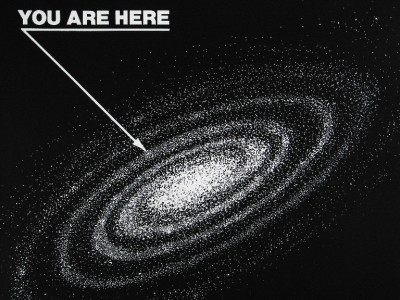
In case you are ever lost in the galaxy, this is where our sun is. You should be able to find your way home from there. Source

We live quite cozily on our happy little planet we call Earth. Our own solar system has 8 planets including Earth, and 613,152 confirmed minor planets. Our best estimates say that the Milky Way galaxy has anywhere from 100 to 400 billion other stars in it, most of which have planets around them. To put that into perspective, for every person alive on Earth there are anywhere from 14 to 57 solar systems in the Milky Way. We’ve observed 170 billion other galaxies, some of which are orders of magnitude larger than our own.

If there’s one thing this class has taught me, it is respect for the scale of the universe. There is a star, NML Cygni, with a radius of 7.67 a.u.–so large it would extend well beyond the orbit of Jupiter–and it is as bright as 300,000 of our own suns. Black holes can have masses one billion times the mass of our own sun in a space only about a dozen Earth-radii wide, and have gravity so strong it pulls in even light itself.

The most amazing part of it all: the entire universe is one big collection of living things. I’m not necessarily talking about extraterrestrial life, but the actual stars themselves. Right now, at this very moment we can simultaneously watch one star end its life cycle in a brilliant supernova just as another star is forming elsewhere. Some regions of the universe are finally dying, while others are just now beginning to experience life. They are born, they grow, and eventually they die. We believe the universe itself is even constantly expanding, but into what? Is our universe the only one? (wouldn’t be much of a universe if there were more, but I wouldn’t rule out the possibility)

Astronomy raises more questions than I believe humanity will be able to answer across our collective lifetime. After all, we’re just one species living on one little dust speck, orbiting one little star, in the middle of one little galaxy, somewhere in a great big universe.


Posted in Class | Tagged , , , , , | Comments Off on The Final Frontier

A Semester in Review

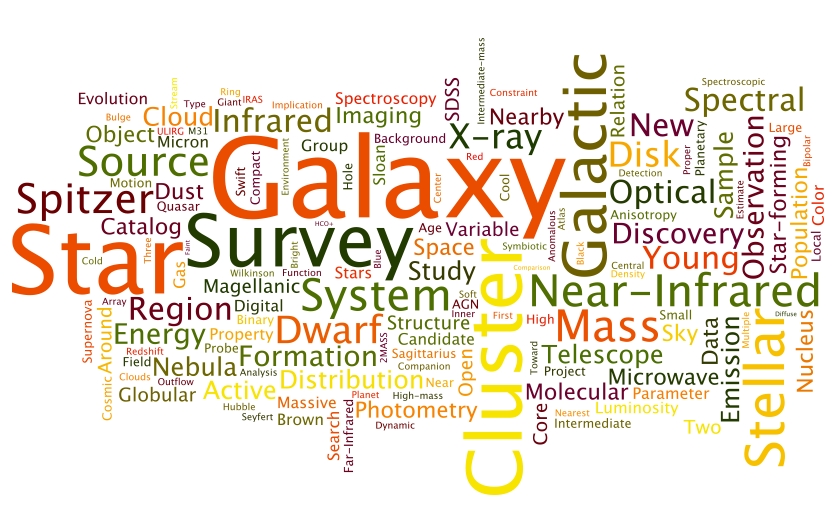
wordle_apr10

My interest in astronomy stems from the pleasure I get just looking out at the stars, trying to find constellations and contemplating the vastness of the universe. Throughout this semester, however, I have learned that astronomy is so much more than just looking at stars. There are so many factors to consider in astronomy, from atmospheric composition to geological activity to Doppler shifting. Astronomy also brings together many fields of scientific knowledge, including the chemistry that goes into nuclear fusion and chemical composition, the biology that goes into the theory of evolution and the possibility of life elsewhere in the universe, and the physics that goes into determining velocities and gravitational forces.

Since astronomy encompasses so many other sciences, this semester has really helped to reinforce scientific principles I have learned in other courses and it has shown me new applications for those principles. Also, I think it is important for people to have a basic understanding of the universe simply because we live in it, and I have definitely gained that understanding through this course. For example, I learned many of the general qualities of each of the planets in our solar system almost by accident because we discussed them so much. These are the things I will remember for a long time and that will help me in the future, whenever I happen to be reading a scientific article about exoplanets or casually discussing the Sun’s light with a colleague.

Although the study of astronomy does not exactly have a tangible result (i.e. it does not have a direct, obvious benefit for humanity), it does lead to the development of extremely complex technology and it helps us to understand where humans come from and our role in the universe. In the future, it could even potentially even help prevent us from overpopulating the globe by allowing us to inhabit other worlds. But overall, I think most people are at least somewhat intrigued by the immensity of the universe and what could be out there.


Posted in Class | Tagged , , , | Comments Off on A Semester in Review

A Humbling Experience

The picture that I have attached above aptly describes what my time in the class has made me feel.  Prior to Astro 201, I had very little knowledge about the workings of our Universe.  And while I’m not saying that a single 200-level course has made me anything even resembling an expert, I feel that I now have enough of a background to sound mildly competent in an astronomy-related conversation.  While this amateur-level understanding is definitely something that I appreciate, I really enjoy how humbling this class has been.  I’ve always known that we (Earth, that is) are tiny.  Insignificant is a word that sounds a bit harsh, but compared to the grand scheme of the universe that we and so unfathomably many other worlds inhabit, it does a pretty good job of putting Earth in perspective.  If nothing else, Astro 201 has really made me appreciate just how little anything we do here on Earth affects the rest of the universe.  Learning about all of the amazing things that happen in our universe is something that everyone should have the privilege of experiencing, because it goes a long way in making a person appreciate the time they are given here on Earth, and how infinitely short that time really is.  This is all a bit deep, but Astro 201 really has given me a much more enhanced perspective on my place here, as well as a newfound appreciation for just what that place means.


Posted in Class, General, Universe | Tagged , , , | Comments Off on A Humbling Experience

The Golden Record

Voyager-records-631

In the early 1970s, plaques containing information about humans and Earth were sent out on plaques on the Pioneer spacecraft. By the late 1970s, these plaques were upgraded to golden records on the Voyager probes. These phonographic records, designed to inform aliens who might discover the probes about humans, included 115 images, greetings in 55 languages, 12 minutes of recorded sounds from Earth, and 90 minutes of music. It took about 10 months and a team of several individuals to compile this media, and a lot of consideration obviously went into it.

As far as pictures go, there were pictures clearly documenting human anatomy and birth, although they were censored. To help the extraterrestrials understand humans, photos of DNA and eating were also included. There were pictures of houses and architecture (including the Taj Mahal and the Golden Gate bridge), too.

The greetings were in almost every language I could imagine, from English to ancient Greek to Burmese to four different Chinese dialects.

The “sounds of Earth” section contained some of the most interesting content, in my opinion. There were sounds of kissing, whale greetings, human brain waves (so that advanced civilizations could hopefully understand our thoughts), and several different other animals.

The music section also included music from all over the world. One of the most controversial choices on the record was Chuck Berry’s “Johnny B. Goode.”

Overall, I thought the selections included on the record were very representative of humanity. Although some of the choices were a bit comical and controversial, I think that they were fitting considering the application of this record: we are sending it as a message to extraterrestrials, which may never find it, and may not understand it even if they do. It’s also interesting to consider what we might include today if we were to send a similar device into space. Particularly, which music selections would we choose? Considering the advancement of technology since the 1970s, we would probably also be able to include a lot more content on such a device, but I wonder which categories we would add this content to. Would we include more pictures, or even a video? Would there be competitions or a price people could pay to get something of their own put on the recording? It’s interesting to consider how much popular culture can affect the message we send out to possible inhabitants of other worlds.

For more information on the content of the golden record, go here or here.


Posted in Aliens | Tagged , , , | Comments Off on The Golden Record

In Conclusion…

The-Sky-is-Not-the-Limit_www.FullHDWpp.com_


astronomy-for-kids

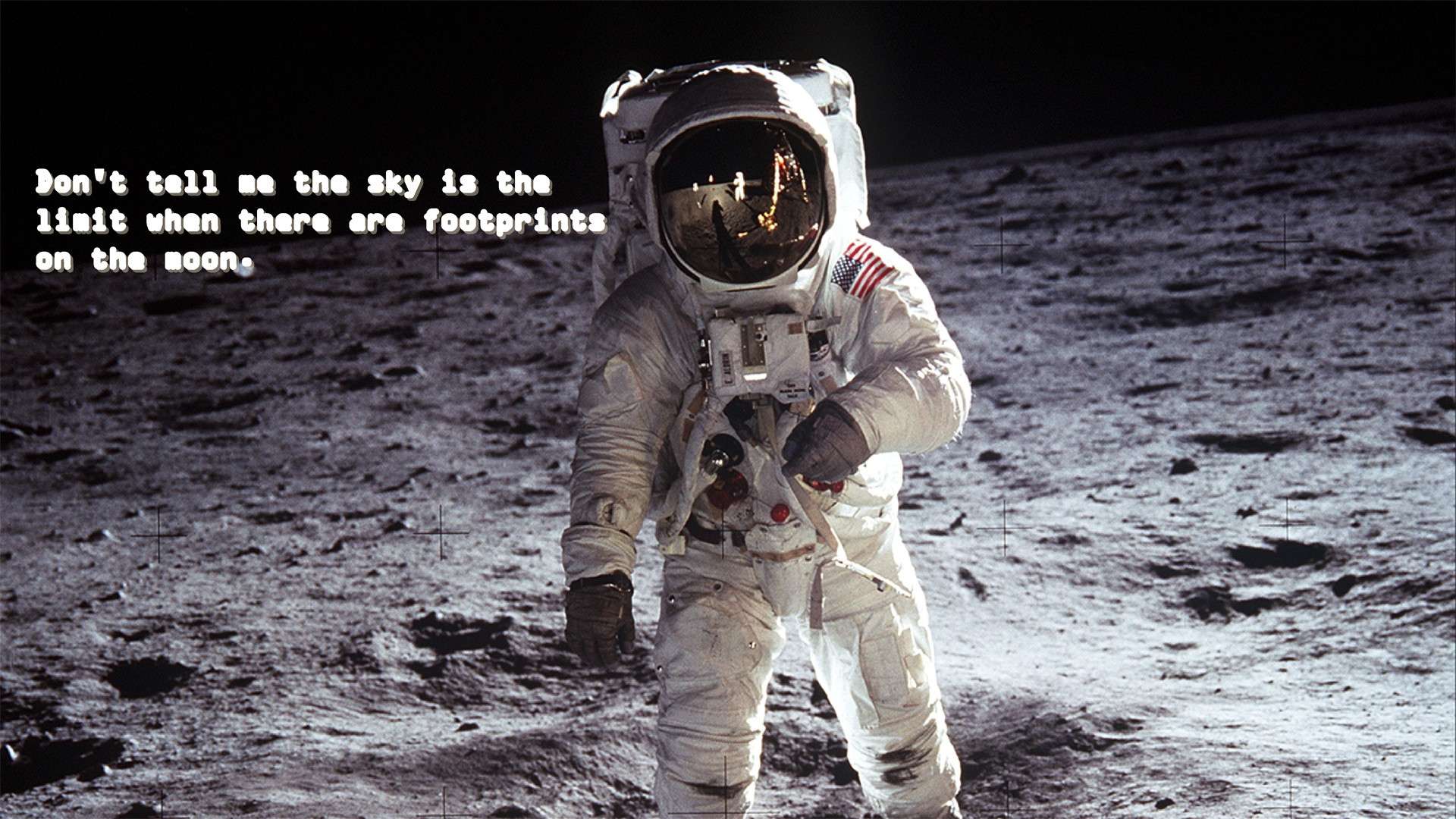
As the semester comes to a close and my first semester taking an astronomy class ends on Monday, I can say that I was not expecting to learn half of the topics we read about. I’m just completed confounded by all the information that we learned about our Universe and our solar system. From the science of gravity, to different kinds of light and energy, to solar flares and the sun, to the outer planets and two tailed comets, and lastly, to whatever else lies outside of our own unique solar system. I’ve never taken a course similar to this, as there is so much information that one can read and learn about. The saying “the sky is the limit” really doesn’t hold anymore for me, because as we’ve learned in class, there is much more out there past our sky. I am now more informed about our universe and can confidently say that if asked about how something came to be or why something looks the way it does in our solar system, I have a repertoire of knowledge to accurately a multitude of questions. This class has given me the opportunity to expand my understanding of our universe and for that, I am highly grateful.

One of our more recent topics that we’ve been studying has been the existence of planets and life in other galaxies and solar systems. I have recently found a NYTimes site that shows the large quantity of planets that the US spacecraft Kepler has found. It’s basically a tally of all the planets that Kepler 62 has found orbiting other stars, and from our recent education, finding these planets is hard enough. Finding hundreds of them is even more miraculous. It illustrates the orbits of many planets traveling around their stars, and does so in a relative size to our Sun and Earth. You can easily see the size of other planets, stars, and orbits. It’s an extremely interesting illustration, as the planets are moving and also has how hot the central star is.

As I was looking at all the different planets that Kepler had discovered, it just further supported the fact of how much information that we’ve learned throughout this semester. Finding all these planets out there would not have been possible without the inventions and discoveries by all the astronomers that we’ve learned, such as Copernicus and Galilei and Kepler, and the fact that everything in our universe follows the same physical laws that we here on Earth experience. I just think it’s amazing at all the information that we’ve discovered in the past 20 years. Nonetheless, the future looks bright and I can’t wait for new astronomy-related discoveries (now that I can finally understand what the researchers are talking about).


Posted in Universe | Tagged , , , , , | Comments Off on In Conclusion…

The Meaning of the Drake Equation

A comic pertaining to our search for extraterrestrial life, courtesy of xkcd. It brings up a fair point about our methods of listening for interstellar communication.

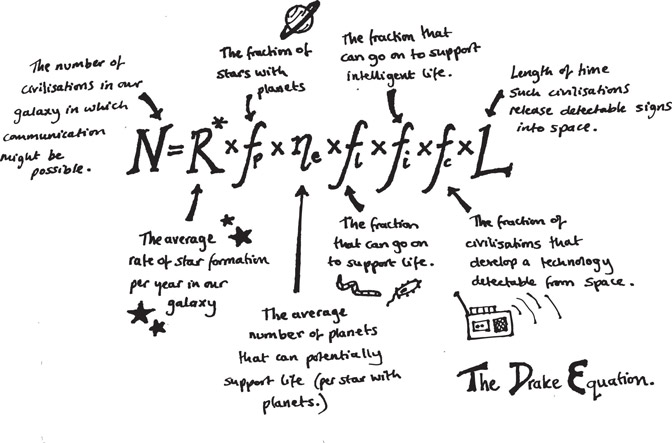
The Drake equation was originally created by (and is named after) astronomer Frank Drake. Given the values of a number of variables, his equation may be used to estimate the number of species in the galaxy capable of interstellar communication. Drake’s proposed equation is as follows:

N = R * fp * ne * fl * fi * fc * L

N will be the number of species we could possibly communicate with in the galaxy
R is the number of new stars forming in our galaxy per year, on average
fp is the fraction of those stars which have planets
ne is the average number of planets per star which could potentially develop life
fl is the fraction of these planets that actually will develop life
fi is the fraction of these life-hosting planets that will eventually have intelligent life
fc is the fraction of these intelligent species that will eventually have the technology for interstellar communication
L is the amount of time for which this civilization will be detectible from the outside

By multiplying these variables together, it is possible to come up with an estimate for the number of communicable species within our galaxy. In 1961, Drake estimated using his own equation and a range of reasonable values that there are likely somewhere between 1,000 and 100,000,000 communicable species in our own galaxy–assuming of course that only one inhabits a planet; if two or more intelligent species share a planet, the number would be higher. The lowest defensible estimates according to the Rare Earth hypothesis suggest we are alone in the galaxy, offering a value of 8×10^-20 communicable species. Contrast that with the more liberal proposed estimate of 36.4 million species, and it is easy to see why some may consider this equation scientifically untrustworthy.

The current most plausible estimate based on what we know so far is as follows:

R = about 7, according to NASA

fp = almost 1, as the vast majority of stars seem to have at least one orbital planet

ne = 0.34 +/- 0.14, according to survey data of ~150,000 stars by the Kepler mission. For this calculation, we’ll go with the maximum and minimum values.

fl = 0.13, according to extensive study (geological, etc.) done by the Australian Centre for Astrobiology.

fi = There are two schools of thought on this one, some favoring a value almost 1, while others believe it to be almost zero. We’ll use 0.99 and 0.01 for our range.

fc = almost 1, as if species develop radio-based technology it is bound to escape the planet at some point and become detectible. Whether or not species will intentionally communicate is another debate entirely. That is likely to be determined by social beliefs, etc.

L = 420, according to a survey of about 60 human civilizations throughout our history. This would likely change based on the species, and is largely connected to the idea that intelligent species may be doomed to destroy themselves–this assumes that all intelligent species are, like humans, war-like in nature.

The final result for N is a range from as few as 0.7644 (rounded up to one, since humans are confirmed to exist) to as many as 182 intelligent, communicable species alive right now.

Very few of these variables are known–or can even be guessed with any measure of accuracy–so it is inadvisable to take the numbers produced at face value; instead, the purpose of this equation is to provoke discussion about the possibility of the existence of life beyond Earth. If a world has life, how likely is it to ever become intelligent? How do we define “intelligence”–is mere sentience enough, must they exhibit problem-solving abilities, or do they even need social capacities?

This also leads to the idea of the Fermi paradox which observes that even if there is evidence suggesting the existence of intelligent extraterrestrial life, we still have neither seen nor heard anything from another communicating species. Possible explanations for this paradox could be that there simply are no other civilizations (Rare Earth hypothesis); that they once existed but destroyed themselves through war, overpopulation, pollution, etc.; that we lack the technology or ingenuity to detect their communication methods; or that for a variety of reasons they have chosen not to communicate with us at all. Other less-likely explanations have also been offered, such as the possibility that communication actually has been received but the information is being withheld by our governments, or even that extraterrestrials are currently on Earth undetected.


Posted in Class | Tagged , , , , , , | Comments Off on The Meaning of the Drake Equation

The Drake Equation – A Scientific Shot in the Dark

The Drake Equation is an incredibly interesting topic of discussion.  Obviously, determining the number of communicating civilizations in our galaxy is a monumental task.  Because of the sheer size of the problem, the fact that a simple equation can bring us anywhere close to a reasonable guess is in itself very impressive.  As impressive as the idea behind the Drake equation is, however, it comes with a few obvious inherent problems.  The conclusion of this blog post describes the Drake equation and its uncertainties in a rather humorous way, but it also illustrates what I believe is one of the most interesting aspects of the formula: As much as we have come to know about our universe and our place in it, the Drake equation shows us that so far there is no such thing as certainty when it comes to life elsewhere in the galaxy.  We still have a lot to learn about each of the factors involved in the Drake equation, and maybe someday we will have discovered enough about them to make a much more accurate “SWAG-y” prediction.


Posted in Aliens, Science | Tagged , , | Comments Off on The Drake Equation – A Scientific Shot in the Dark

The NASA Warp Drive

In class last week, Dr. Grundstrom mentioned that NASA may be developing a warp-drive.  I’ve done a little research and here’s what I’ve found.

Last September, NASA engineer Harold White spoke briefly at a conference in Houston about the possibility of creating and using a Warp Drive, which would allow faster-than-light travel.  He made a brief case for the physics of such a project, defending his proposal against Einstein’s Theories of Relativity, which say such travel is impossible.

White uses the model of Alcubierre Bubbles, developed by physicist Miguel Alcubierre in 1994, to create the physical possibility of traveling at warp speed.  An Alcubierre bubble is a distortion of space time.  Space-time contracts in front of the bubble and expands behind the bubble, creating a wave-like contortion in space-time.  Both Alcubierre and White argue that Einstein’s theory of the universal speed limit hold only when traveling within space-time, but not necessarily when distorting it.

88 MPH

Both White and Alcubierre shared general concepts for the design of the warp drive.  In order to make this happen, engineers need to develop a form of matter called “negative energy”, which pushes apart space time, therefore demonstrating gravitational repulsion.  As outlandish as this sounds, the article provides that it could probably be created in a lab, and White thinks he won’t need much in order to create the technology for the warp drive.

If this is possible, it will redefine space travel, and, as White predicts, could cut the time to get to Alpha Centauri from 75,000 years to just 2 weeks.

Miguel Alcubierre, the man responsible for the physics behind the Warp Drive.

Miguel Alcubierre, the man responsible for the physics behind the Warp Drive.


Posted in Space Travel | Tagged , , | Comments Off on The NASA Warp Drive

Optimistic Astronomy

Image

I have always been interested in Astronomy and the concept that Earth is only a very small part of the rest of the Universe. After learning all of the in depth detail about planet formation, moon cycles, the physics behind it all, and the rest of the topics we covered in class- I have gotten only more optimistic about the future of astronomy. I was pleased that the class ended talking about the possibility of life on other planets, because it was something I always believed in but never knew how to back up. Though some may take a pessimistic approach, the information I got from this class has only made me more confident in my initial theory. The likelihood of life someone else in this universe is high, both looking at the Drake Equation, and the life here on earth. Whether it be extremophiles or the amount of other earth like planets that are being discovered as I type this, the chances of life in the Universe seems to be constantly increasing. Whatever is out there may not be human, but I am so excited and hopeful that we will find other forms of life and hopefully one day be able to communicate with these “aliens.”


Posted in Aliens, Class, Universe | Tagged , , | Comments Off on Optimistic Astronomy