Astronomy201: Reflection and Take Away

The best part about this class has been the breadth of knowledge I have accumulated. We tend not to go too far into any one subject, but we cover enough information about such a variety of topics that I feel very comfortable having any type of conversation about the solar system. The conversation could range from alien life to global warming to moon phases, and I bet I still know enough about each topic to teach the person sitting next me something new. I also have enough of an astronomical base to understand news articles and current events relating to the solar system. I was browsing nasa.gov when I came across this really cool video of the sun rising towards solar maximum. The video is three years of unbroken footage of the Sun from NASA’s Solar Dynamics Observatory.

Since I have taken this class, I know what is going on in this video. The Sun is going through its 11-year cycle of solar activity, and currently activity is on the rise. More sunspots are forming. The spots are cooler than the rest of the surface because magnetic field lines suppress convection and prevent surrounding plasma from sliding sideways into the spot. As the sun goes through its cycle, the orientation of these magnetic field lines will reverse. The changing direction causes solar flares that can be seen in the video. The flares send X-rays and charged particles shooting into space and towards Earth. The waves and particles can heat Earth’s upper atmosphere, causing it to expand and increase the density of gases. This change has the potential to increase friction on orbiting satellites and send them crashing towards Earth. Thanks to this class I knew all of that even though it was not in the article. That’s Awesome!


Posted in Sun | Tagged , , , | Comments Off on Astronomy201: Reflection and Take Away

We are so unbelievably tiny!

above is a photo of what one artist pictures the Milky Way to look like. I googled “What the Earth looks like in the Milky Way” to see a range of ideas and predictions that currently exist.

The Google Image results got me thinking. We are absurdly small. The Sun is massive compared to us, yet look at the depiction of the Sun in the photo above. I find that to be extremely humbling. Mankind is hugely powerful, we have created government, war, compromise, alliance, breakthrough technologies, laws of physics, etc. yet you couldn’t even try to place us on the picture above. It makes me, as I have through the course of this class, what else is out there? I recently developed THE go to chocolate chip cookie recipe, but is there a civilization out there that knows what chocolate chip cookies are? or are they using chocolate chip cookie dough to cure cancer! My questions are endless and I envy the scientist who gets to investigate all of them.


Posted in Class | Tagged , , | Comments Off on We are so unbelievably tiny!

The End of an Era

Or, more accurately, the end of a semester.  I’ve had a lot of fun blogging for this class, and I’ve learned a lot about that vast expanse above our heads known as the cosmos.  One of the most important things I’ve learned, I think, is the vastness of space.  Even in our solar system, planets and moons can be millions of kilometers apart from one another.  These are huge distances, that, with my limited human mind, are extremely difficult to grasp.  But, I always have to keep in mind that the astronomical objects I talk about so off-handedly are separated by ridiculous amounts of space.  Another thing that has left a deep impression on me is the amount of stuff that is out there.  Now when I look up into the night sky, I see not only the stars, but I imagine the galaxies whirling around, just as our own galaxy is whirling about, just as the planets in our solar system orbit about the Sun, and just as Earth rotates about its axis.  All this intricate motion and universal complexity fascinates me, and I find it a transcendental experience.

Earth's_Location_in_the_Universe_SMALLER_(JPEG)

Universal Scale (courtesy Wikipedia)

I am also really interested in the search for extraterrestrial life, because our universe seems so empty, but can it really be so?  Naturally, then, I was really intrigued by the Drake equation that we learned about in class.

drakeqn

Original Drake Equation (courtesy SETI League)

I had a great time hypothesizing about the number of planets that can support life, what percentage of that life will become intelligent, and so forth.  In the future, I’ll definitely be most interested in what new developments in the search for interstellar life come up, especially since the discovery of extremophiles on Earth means that life on other planets is now a real possibility.  On a related note, I’m really looking forward to the upcoming mission to (ok, flyby of ) Europa maybe starting around 2021.  Europa’s subsurface ocean is really cool (especially since it’s formed by tidal heating from Jupiter) and since water is fundamental to life on Earth, who knows, maybe we’ll someday find life on that moon too.

europa_galileo_900

Europa (courtesy NASA)

The more we discover about our universe, the more surprised we are.  For example, I found this article about “stellar extremophiles“, or stars that form in places where we thought they shouldn’t, for example, in places where we thought gas density would be too low for the gas to collapse and begin nuclear fusion (a.k.a. star birth).  Researchers using NASA’s GALEX (Galaxy Evolution Explorer) space telescope have found stars forming outside the gassy disks of spiral galaxies, and various other places.  Here’s a video talking about the discovery.  It’s cool that this could be telling us that there could be ways to make stars in extreme environments, just as life seems to find a way to survive on Earth, no matter the conditions.  In the future, I’ll be looking out for news talking about the exploration of the extremes of the cosmos, because that’s just the kind of thing that ignites my imagination most when I think of that inky black space above our heads.


Posted in Class | Tagged , , , , , , | Comments Off on The End of an Era

Origins Of Life

Two scientists, Alexei Sharov and Richard Gordon, have plotted the genome size of different kinds of organisms against their presumed date of origin. They only had five data points, but they concluded that genome complexity doubles every 376 million years. This means that the origin of life must have happened 10 billion years ago, but we know life has only been on Earth for about 3.85 billion years. If they are correct, the only explanation is panspermia meaning that microbial life originated elsewhere in the galaxy and traveled to Earth by comet or asteroid. This idea has been explored before but only as a theory, not because it is the only possible explanation.

The scientist believe this finding solves the Fermi paradox because if it takes this long to get to our stage of technology, then we may actually be the first civilization to get there. We should therefore find life, or signs of life, on other planets because Earth was likely not the only landing site for these microbes. Image

Picture


Posted in Aliens | Tagged , , , | Comments Off on Origins Of Life

11 of the Weirdest Solutions to the Fermi Paradox

The Fermi Paradox is the current contradiction between the estimates about the existence of extraterrestrial civilization and our current lack of proof and interaction with such a civilization. According to Wikipedia’s page on the Fermi Paradox, Fermi argues that

  • The Sun is a young star and here are billions of stars in our galaxy that are more than billions of years older than the Sun
  • Some of these stars likely have Earth-like planet which could potentially develop intelligent life
  • Some of these civilizations will be capable of interstellar travel
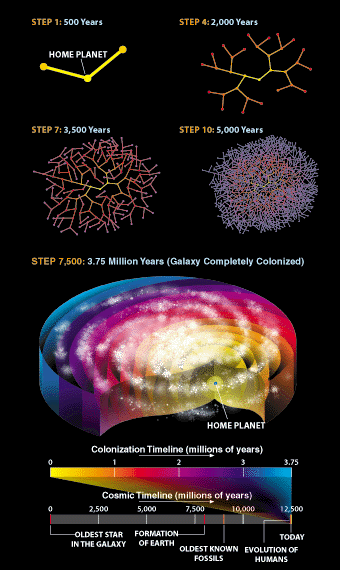
  • the galaxy could be colonized within few tens of millions of years

…yet we have no evidence of any civilization meeting these criteria. After browsing about the Fermi Paradox, I found this article suggesting 11 of the strangest answers to Fermi’s famous question, “where is everyone”. I’ve briefly discussed them below:

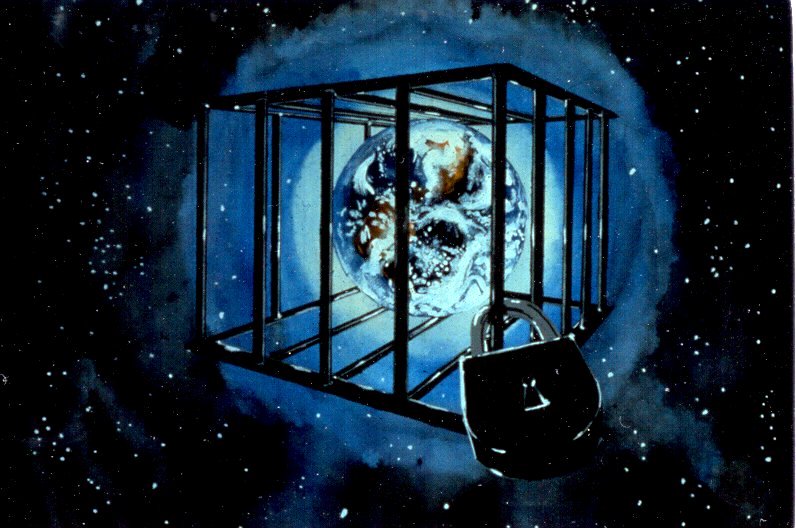
1. Zoo Hypothesis – extraterrestrial intelligent life has already discovered us, and we are stuck in a tiny zoo-like cage, unaware of the scale at which we are being observed. We are unaware that this is occurring because we are simply being observed, not interacted with. Proposed by John Ball in 1973

2. Self-Imposed Quarantine – effectively the opposite of the Zoo Hypothesis. Perhaps we are the only civilization out there crazy enough to go snooping around for others. It is possible that any civilization out there is protecting itself and laying low, rather than flashing party signs and welcome lights like we envision.

3. The Whack-A-Mole Thesis – Big Brother may be watching us. There’s the chance that we are being observed and we are becoming ever close to breaking through to an unknown civilization. Little do we know, there’s a giant hammer being held over us, ready to smack us back into line at the hint of any success. We are possible of creating artificial super intelligence, capable of destroying our entire galaxy, so Big Brother has to keep a watchful eye on us.

4. We’re made out of meat – everyone who is anyone capable of doing things is made out of meat. You and I are made out of meat, our neighbors and friends and enemies are made out of meat; the dumbest people we know are made out of meat; the most genius inventors of all our technologies are simply made out of meat. The machines we invented were invented by meat.

5. Simulation Hypothesis – we haven’t come in contact with anyone because we are living inside a computer simulation, and currently have no friends to interact with. Sounds a lot like Wreck it Ralph if you ask me.

6. Radio Silence – everyone is listening to our radio signal emissions, but no one is responding to us. Perhaps no one wants to take the first step, and we’re all just trying to stalk each other secretly

7. All Aliens are homebodies – If we think about how advanced our civilization is, and then apply some of the mastermind Hollywood creations of what we hope civilizations in outer space are like, I don’t blame the aliens for being homebodies. There’s the chance that other civilizations are so fascinating that they don’t want to waste time looking at less exciting civilizations like ours.

8. We can’t read the signs – language barrier. Our technologies aren’t advanced enough or possibly simple enough to detect other civilization’s signals. There is a range of frequencies out there, and we may simply not be hitting the right ones.

9. They’re all hanging out at the edge of the galaxy – we’ve already established through estimates that the highest potential for SETI successes is at the edge of the Galactic Disk. It is thought that civilizations will have a tendency to migrate outward of the galaxy as they become more advanced, and we are simply the snail of the race.

10. Directed Panspermia – maybe we have created this absurd typical image of an alien: slimy, green, funny body parts, but we are actually the ones who are aliens. Everyone is avoiding us because we look weird and talk funny

11. Phase Transition hypothesis – Perhaps the least strange. This one is comparable to the rare Earth hypothesis, summarizing that the universe is forever evolving. Currently, the rate of change of universe is simply too extreme to accommodate forming civilizations and they become destroyed before they have a chance to adapt.


Posted in Class | Tagged , , , , | Comments Off on 11 of the Weirdest Solutions to the Fermi Paradox

A Grim Future, Brightened by the Stars

Image

For my culminating post, I want to reflect on how my perspective on space and the future of astronomy has changed over the course of Astronomy 201. Firstly, everything I learned in this course, from gravity and planetary formation to stars and habitable zones, has given me a fundamental and scientifically realistic understanding of space and our galaxy. I think we all grow up with some part of us pondering the dark vastness of space, and how it relates to the human condition. This class allowed me to take those essential, soulful curiosities and put them into concrete terms. As much as this concreteness has solidified my understanding of mankind’s astronomical world, I still view the universe as an inescapable enigma.

Image

Thinking about the future of astronomy for this post brings me to an interesting understanding of astronomy’s immediate importance for our civilization. I think that having a sense of the physical processes that shape our universe, and being aware of our surroundings in space (including potential dangers and possible benefits), are absolutely essential knowledge for the continuance and well being of our peoples.  For example, the ability to detect and avoid collisions with interstellar objects in an Armageddon-type scenario is no longer the sole product of Hollywood’s special effects. Although these types of events are rare, I am grateful that astronomy and technology have made us less helpless in the realm of space. More realistic, however, is our potential need for resources on other planets, or even colonization off of Earth. This point leads me to the more biological concept of Malthusian catastrophe and the idea that Earth, despite our best technological efforts, cannot indefinitely support our exponentially growing population. Although there are many ways we could lessen population strain on our planet (our negative environmental impact could arguably be included as strain), it is difficult to argue that such changes can or will be effectively pursued by Earth’s population before catastrophic occurrence. I strongly believe that astronomy is one of the few sciences that might be able to save us from catastrophe, and it may be the most promising.


Posted in Science, Space Travel | Tagged , , , , , | Comments Off on A Grim Future, Brightened by the Stars

Guys, We are a Type 0 Civilization

The Kardashev Scale

As we persevere in our search for other intelligent life out there in the far reaches of space, we should also remember that, if they exist, we have no idea what they would look like, or how powerful they might be in comparison to us, or how they would respond to us contacting them.  This idea of how much “power” an alien race could have is an engaging one, and luckily, there happens to be a sweet scale that can help us to measure it!  It’s called the Kardashev Scale, and it was first proposed in 1963 by Russian cosmologist Nikolai S. Kardashev, who was actually influenced by a project Launched by Frank Drake (of the Drake equation) called Project Ozma.  Project Ozma’s goal was an attempt to locate extraterrestrial intelligences (ETIs) by scanning the sky for radio emissons.  Inspired by the project, Kardashev began to wonder if a large number of alien civilizations might be millions of years ahead of us, and if so, what their radio signatures might be like.  This caused him in 1963 to write a paper called “Transmission of Information by Extraterrestrial Civilizations”, in which he proposed a simple numbering system, from 1 to 3, that could be used to classify hypothetical alien civilizations based on the amount of energy they had at their disposal, specifically the power available to them for radio transmissions.  These days, the scale has been modified by all kinds of scientists, astrobiologists and cosmologists alike, to simply describe the amount of energy available to an ETI for any purpose, and is often used to speculate about the kinds of technologies that advanced civilizations may possess.  Here are the Kardashev Types:

(Type 0.7

Us, as estimated by Carl Sagan, although we are getting close to Type 1.)

Type 1

A Type 1 civilization would be close to Earth in terms of technological level, with an energy consumption of a bout 4 x 10^12 Watts.  This civilization has harnessed all the power available to it on its home planet (i.e. all the solar energy, thermal, hydro, wind, etc.), but has not yet begun to exploit all of the solar’s systems resources.  Defined even more radically, Type 1 status would only “truly be achieved once the entire planet is physically reconfigured to maximize its energy producing potential.”  For example, the entire mass of a planet could be remade into a form of a massive solar array to feed the civilization’s power-hungry machines.

Type 2

In order to advance to Type 2, a planet would need to make a jump in energy consumption that will be equal to the output of the Sun per second.  In order to reach this level, an ETI would need to capture the entire energy output of its parent star, with the best way to achieve this being the building of a Dyson Sphere.  The Dyson Sphere was hypothesized by Freeman Dyson in 1959; it’s a hypothetical megastructure that would envelope a star at a distance of 1 AU and cover an incredibly large area of 2.72 x 10¹⁷ km(about 600 million times the surface area of the Earth). The sun’s energy output of around 4 x 1026 Watts would then be available to utilize for work.  With all this available energy, a Type 2 civilization would be able to power its supercomputers and send out interstellar colonization waves.
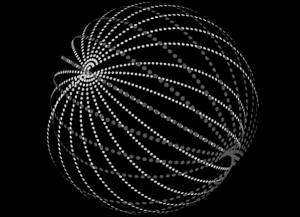
dysonswarm

Dyson Swarm, a type of Dyson sphere (courtesy, The Atlantic)

Type 3

Going one order of magnitude further, a Type 3 civilization would possess an amount of energy on the scale of its own galaxy, somewhere between 10^36 and 10^37 Watts.  The entire galaxy of a Type 3 civilization would be colonized, with every scrap of matter exploited for energy.  Consequently, to outside civilizations, a Type 3 one would appear completely invisible, with only a small amount of heat leakage registering in the far infrared (10 microns in length).  Essentially, it would look like a hole in a galaxy, or an inexplicably large swath of open space.  When looking for Type 3 civilizations, we might even do better to look for Type 2 civilizations on the brink of becoming Type 3, because their colonization waves would look like a giant bubble spreading outward from the parent star.

Type 4?

Hypothetically, ETI(s) that have harnessed the power of a galactic supercluster

Type 5?

Although highly unlikely, a Type 5 civilization would have the power of the entire universe at its disposal.

Problems With the Scale

Of course, what would any good hypothetical scale be without its problems?  First, there is the Fermi Paradox, which is “the apparent contradiction between high estimates of the probability of the existence of extraterrestrial civilization and humanity’s lack of contact with, or evidence for, such civilizations.”  We have no empirical evidence for the existence of Type 2 or 3 civilizations in our galaxy or galactic neighborhood, we do not see vast swaths of neighboring galaxies “disappear” from the visible spectrum (as predicted by the Scale), and we haven’t found any Dyson spheres yet either.  Additionally, the Scale assumes that advanced civilizations have an insatiable appetite for energy, but what if it never really wanted to expand beyond a Type 1 or 2 level?  Or what if it wanted to honor some kind of “Prime Directive” (woot woot Star Trek shout-out), or didn’t want to become some kind of Galactic Empire (woot woot Star Wars shout-out)?  All these things would preclude a civilization from maybe even going Type 3.  But, in the end, all this is conjecture, since we haven’t found anything yet.  I say, let’s just keep looking and hope anything we find doesn’t end up wanting to “kill all humans” (woot woot Futurama shout-out).

Also, here’s a video of theoretical physicist Michio Kaku explaining the Types and why we’re still at Type 0 (but straining for Type 1!).


Posted in Class | Tagged , , , , , , , | Comments Off on Guys, We are a Type 0 Civilization

Tardigrade – Water Bear!

This is one of the most amazing animals on Earth! It has a very geeky name “tardigrade”, but is also known as water bear as it lives in water. It can live in most extreme conditions from just above absolute zero to above the temperature of boiling water. It can also withstand dehydration, extreme pressures and radiations. Due to their love for extreme conditions, we call water bears an extremophile, i.e. microorganisms that live under extreme conditions.

Enjoy the following video!


Posted in Class | Tagged , , | Comments Off on Tardigrade – Water Bear!

My Universe

My Universe has changed throughout this course. I used to think that we were fully alone on Earth, and that there was simply no way that another civilization could exist besides our own. Now I realize that life outside of our own world is much more likely than I would have believed. It is interesting how many people do not believe in even the possibility of life outside of our own world. People are often ridiculed if they say that there is a possibility of aliens. Some even are ridiculed to the point that a meme is made about them, as is the case of Giorgio A. Tsoukalos. His meme, which is consists of a picture of him and a heading relating to aliens, an example of which is below, has become wildly popular.

Image

This shows the extent to which the general public is skeptical and uninformed of the possibility of presence of extraterrestrial life. This may be due to the fact that it is only recently that we have even been sure that planets exist elsewhere, meaning that there was a time where we didn’t even know if there was anywhere else for extraterrestrial life to exist period. This along with the often deserved ridicule that people find when they have “alien-encounters” has combined to make people extremely skeptical of alien life. I believe that this is an interesting topic, and the public should be further educated about the possibilities of an alien presence outside of our world.


Posted in Universe | Tagged , , | Comments Off on My Universe

Silentium Universi

Fermi’s paradox, Fermi’s question, the Great Silence, and Silentium Universi are all names ascribed to one of the most fundamental questions of astronomy: “Where is everybody?” It is a question based in rationality, because in the search for extraterrestrial life the numbers just don’t seem to add up. With enough probes and some decent rocket technology, it is theorized that the Milky Way Galaxy could be explored in at least 4 million years. Sure, 4 million years seems like a long time for our young and galactically dinky civilization, but our galaxy is more than 10 billion years old and technological advancement is an exponential phenomenon.

Scientists have considered a variety of possible explanations for the paradox of Silentium Universi. The first of these solutions is that aliens are here. They came and left leaving evidence behind, or they are us and humans are actual descendants of ancient alien civilizations, or aliens are actually keeping us in a well designed zoo of sorts. The second solution is that aliens exist but we have not yet communicated. It is possible that we do not know how to communicate properly, that it is only a matter of time before we do communicate, that we are being purposely avoided, or that civilizations simply do not last long enough to ably cross-communicate. The third solution is more pessimistic, and theorizes that life simply does not exist elsewhere, or that the genesis of life is extremely rare. It is difficult to conclusively say which solution is most likely, as we have little understanding of the processes that develop intelligent life.


Posted in Aliens | Tagged , , | Comments Off on Silentium Universi