It’s no secret Pluto has been out of the privileged circle of celestial bodies to be considered planets for over a decade now. But many don’t realize what events led to this ousting, and the reasonings for doing so.
Pluto had long since been considered a planet since its discovery in the 1930’s. Yet starting in 1992, discoveries were made which put this status in jeopardy. Several celestial objects were found in the Kuiper belt which were as large, if not larger, than Pluto. Naturally this lead to the question: should these be planets? Or should Pluto not be a planet?
This debate was fueled even more by the 2005 discovery of Eris, a dwarf planet in the scattered disc which was found to be 27% more massive than Pluto. This was the final nail in the coffin for Pluto’s membership to the planet club, with the International Astronomical Union establishing guidelines on what is considered a planet that explicitly dropped Pluto from the roster in 2006 at their General Assembly. Although Pluto may not be batting in the big leagues anymore, it will always be a planet in my heart.
This is a picture of Europa, one of Jupiter’s Galilean moons. Europa is considered one of the most likely places where life in our universe that isn’t on Earth might exist, and you can read more about that here!
Europa is one of Jupiter’s Galilean moons, meaning it’s one of the four largest moons that orbit Jupiter. What makes it particularly special is that it is considered one of the most likely places in our solar system (outside of Earth) that might contain life. Now, at a glance, it seems like that shouldn’t be possible. People often learn about how Earth is in a “sweet spot,” not being too close to the sun that life couldn’t exist due to the heat, or being too far away that all life would freeze away and die. Now, while things like atmosphere and other factors also contribute to whether a plant can sustain life, not just distance from the sun, it does remain true that Europa, even at it’s closest distance to the sun, is still well past the solar frost line, which makes one assume life wouldn’t be possible. Yet in reality, it being so far away is part of the reason there could be life present. NASA describes the three things needed for life as water, chemistry, and energy. Water appears to be plentiful on Europa, with the surface being completely frozen, and underneath the frozen crust, astronomers believe there is a huge ocean, kept warm by the moving core and colossal tidal shifts due to the mass of Jupiter. The “chemistry” means there needs to be a plentiful supply of carbon, hydrogen, oxygen, nitrogen, and a few other elements that scientists believe reside on Europa. The tricky part is the energy. On Earth, the “energy” comes from the sun, but since Europa is so far away from the sun, it can’t rely just on that. Scientists theorize that much of the energy that could create life on Europa is radioactive energy from Jupiter. Now, at a glance even this is confusing, as Jupiter give off so much radioactive energy that it should kill any life that would form on Europa’s surface. Yet as mentioned earlier, the surface of Europa is frozen, and scientists believe that if life exists, it exists in the ocean that is underneath the ice cover. It’s impossible to know if life actually exists on Europa until we get there, but there is enough evidence to show it could be there, and that by itself, is still incredibly exciting.
If you’ve been scrolling through random news articles over the past few weeks, you may have come across an article about a large asteroid that may end human civilization if it strikes the Earth. Just to be clear, this asteroid will not hit Earth and will barely have any effect on civilization.
NASA is currently tracking this asteroid that is headed our way. The asteroid (52768) 1998 is about 4 km wide, making it the biggest asteroid to pass Earth this year. The asteroid will come closest to Earth on April 29th – it will be about 6 million kilometers away from us, a large enough distance for us to not worry about a potential collision. The asteroid will travel at about 31,320 km/hr and will appear as a slow-moving star to observers here on Earth. Astronomers around the world are already tracking this asteroid – below is an image of the asteroid taken by a robotic telescope called Elena on March 6th.
Although this asteroid will have no effect on us, it’s still cool to see a moving object in space. The movement cannot be detected with a naked eye, but the asteroid’s flyby will be streamed online for viewers all over the world on the 29th.
The giants of our solar system, other than the Sun of course, are quite different from the terrestrial planets whether it comes to the atmospheres, the surfaces, size, or other planetary features. One key difference is the interior of these giant planets. Terrestrial planets, for context, have a very dense core followed by a rocky mantle and ultimately a thin crust (or surface). When it comes to the giants, or Jovian, planets, the interiors are similar in that they have layers but the compositions are quite different.
As you can see in this visual, the layers are present but the compositions are what make these planets distinct from the terrestrials. The cores consist of rock, metals, and different gases. Jupiter and Saturn are similar to one another while Uranus and Neptune resemble one another more. Jupiter’s and Saturn’s cores are surrounded by layers of hydrogen transforming from a solid to a liquid to a gaseous form. What we see from Earth are the surfaces of the planets which are primarily clouds of gas swirling around as the planets rotate. Uranus’ and Neptune’s inner cores consist of rock and metals while the outer core is made of water, methane, and ammonia. The core is then surrounded by gaseous hydrogen covered by clouds that we see from Earth. I just wanted to share this with you all since we tend to hear so much about the terrestrial planets. Hopefully, you learned a little something about the Jovian planets and will dig deeper to maybe understand them more.
Way out in the constellation Centaurus is a peculiar solar system 434 light years away that fascinates astronomers. The central star, named 1SWASP, is similar to our Sun in size and doesn’t appear to have any unusual characteristics for a main-sequence star. However, it was discovered in 2007 that 1SWASP is orbited by one enormous exoplanet when Eric Mamajek viewed a complex eclipse that showed the presence of a “Super Saturn.” This exoplanet (called J1407b) has also been called a “Saturn on Steroids” due to its enormous system of circumplanetary rings that are around 600 times the size of Saturn’s. For reference, if this planet changed places with Saturn we would see it’s ring system from Earth and it would appear 4-5 times as large as a full moon. Additionally, there are several gaps in the ring system that suggest the presence of large exo-moons. If anyone lives on those moons, they probably have an incredible view of the sky every night. I’m jealous!
Since the solar system is very young (only about 16 million years) it is theorized that the planet’s ring system will slowly diminish in size as time goes on. However, it appears that the rings orbit J1407b in retrograde motion, so this may allow for longer ring lifetimes than usual. Additionally, the rings may be able to be replenished by passing objects that get trapped in orbit. Whatever may happen to this “Super Saturn,” there’s no doubt that its rings are certainly amazing today!
The lectures from this unit, especially chapter 11 about the Jovian planets, reminded me of one of my favorite books; Sirens of Titan by Kurt Vonnegut. The novel is a comical science fiction story that chronicles the origin of Malachi Constant, a profit predestined to be sent into space and return to start a new religion on Earth. Winston Niles Rutherford is a wealthy space explorer who, as a result of being launched into the chrono-synclastic infundibulum which allowed him to experience all space and time, was able to prophesize Malachi Constant’s life path. This life path includes spending time in the Martian army, on Mercury, and stranded in a deep cave on Titan, the largest moon of Saturn. Malachi’s time on Titan is arguably the impetus to his future as a religious figurehead. Although entirely based on science fiction, the description of living on Titan made me even more excited to learn in class that a probe from the European Space Agency has landed on Titan. Titan is one of the few bodies in the outer solar system to which humans have sent a landing probe successfully.
In addition to exploring life in space, Vonnegut also delves into the concept of predestination. Rutherford was able to predict the entirety of Malachi’s life but could not allow him to forgo the necessary pain in the path to get there. At the beginning of the book, Malachi is a morally dubious character who tries to prevent these events from taking place. However, all of his actions end up leading him towards his destiny. This novel brings up a lot of the other moral implications of humans moving forward with space travel. Considering what I have learned in class, I choose to agree with Vonnegut and look ahead towards furthering the exploration of space.
The removal of Pluto as a planet was an emotional blow to anyone with a heart. It was a devastating betrayal leaving many asking questions that no one wanted to hear the answers to. While there were many reasons behind Pluto’s status change, the ultimate culprit is the dwarf planet Eris. Eris was discovered in 2003 as another object orbiting the Sun. While of comparable size to Pluto, it orbits at a much greater distance through the Kuiper Belt. The similarities between Eris and Pluto forced scientists to confront Pluto’s issues that they were previously able to ignore, or risk including Eris and other similar dwarf planets or trans-Neptunian objects as planets in the Solar System.
Not too much is actually known about Eris yet. We can guess that it is structured relatively similar to Pluto, and it does have some atmosphere in the parts of its orbit that it is warm enough for the atmosphere to exist. Interestingly, it was named after Eris the Greek goddess of discord, a fitting name because it caused disagreement about the status of Pluto. In addition, its one moon is named Dysnomia, Eris’s demon daughter. While the problems with Pluto’s planetary status were known before Eris, the discovery of this new dwarf planet was the catalyst leading to Pluto’s ultimate demise.
Pluto was discovered in 1930, and was classified as a planet. In 2006, as most of us probably know, Pluto was reclassified as a dwarf planet.
A significant amount of the population, whether justified or not, are opposed to the removal of Pluto from the official list of planets, primarily out of nostalgia for one of the celestial bodies they’d known as a planet their entire lives. So what prompted this reclassification?
In March of 2005, Makemake was discovered. It, along with Eris (discovered in July 2005) and other Kuiper Belt objects, triggered the assembly of the International Astronomical Union. They had a decision to make- expand the current list of planets, or add another classification of celestial bodies. We know how that turned out.
As I was reading about this decision, it occurred to me that I knew very little about Makemake, the dwarf planet that (with Eris’s help) demoted Pluto.
Makemake is roughly two-thirds the size of Pluto. It is slightly dimmer than Pluto, but still bright enough to be the second brightest known object in the outer solar system. Its orbital path extends beyond the farthest reaches of Pluto’s path, yet Makemake orbits closer to the sun than fellow dwarf planet Eris. Despite these similarities to Pluto- size, brightness, orbit- Makemake surprisingly lacks a significant atmosphere (Pluto has one, so we would expect Makemake to have one as well). The dwarf planet’s reddish-brown color led to the conclusion that it has a layer of methane at the surface (remember, no atmosphere).
Another similarity to Pluto is that Makemake has a moon of its own, nicknamed MK 2. This moon wasn’t discovered until April 2015 when it was observed by Hubble’s Wide Field Camera 3.
I personally have quite enjoyed reading about this dwarf planet, and it make me think…If the IAU assembly had voted differently in 2006, we would have more planets (I believe the vote would have upped the number to 12). There would be a good chance we would learn about the would-be new planets nearly as much as we discuss the terrestrials and jovians. We might even devote future exploration missions to these Kuiper Belt objects. What else might be different today if the dwarf planets were just planets?
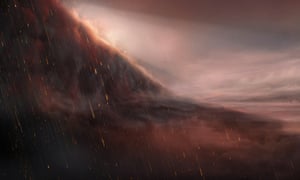
An artist rendition of iron rain on Wasp-76b via The Guardian
Two weeks ago, scientists observed an iron rain type phenomenon on an exoplanet known as Wasp-76b. Wasp-76b is a gas giant that is located approximately 640 light years away from the constellation Pisces. Wasp-76b orbits a different sun in its own galaxy. The distance between Wasp-76b and the sun it orbits is about 3% of the distance between Earth and our Sun. This leads to surface temperatures of over 2,400 degrees Celsius.
Recently, scientists detected winds on the planet measuring up to 10,000 miles per hour and a steady iron rain pelting the planet. The picture above is an artist’s rendition of what the phenomenon would look like. Observers have been able to locate over 4,000 exoplanets in recent years and it will be very interesting to see what more new discoveries lie ahead.
When I learned the order of the planets in elementary school, Pluto was still considered a planet. About 14 years ago, it was demoted to a dwarf planet. The International Astronomical Union has three criteria in determining planetary status. It is in an orbit around the sun, it has sufficient mass to assume hydrostatic equilibrium, and it has cleared the neighborhood around its orbit. To be a planet, you must have all three. Pluto actually orbits with other surrounding stuff in its “neighborhood”, meaning it can not count as a planet, and this, was given dwarf planet status. Jim Bridenstine from NASA argues that the IAU’s decision was unscientific, and was used as a means to keep the number of planet’s down to a manageable number instead of being forced to reevaluate the entire solar system. For now, Pluto remains a dwarf planet, but here is to Pluto lovers like myself: there is hope Pluto could once again be a planet.