A picture of several potential habitable worlds in the universe
Extrasolar planets, often called exoplanets, are planets that exist in other solar systems other than our own. These planets are very hard to find and study because their light is fainter than the light given off by the stars which they orbit. In 1992, astronomers Aleksander Wolszczan and Dale Frail noticed several planets orbiting the pulsar PSR B1257+12. They only detected gas giants similar to Jupiter, leading to the hypothesis that gas giants are more common than terrestrial planets. This hypothesis has been disproven because of the fact that these gas planets were simply easier to detect because of their massive size.
Studying these extrasolar planets could bring us much more insight on how the Earth came to be and what changes we may potentially see in both our solar system and our planet. Perhaps there will even come a time where humanity will have to travel from one habitable planet to another every few millennia because of the limited timespan of habitability for each of these planets. I personally believe that for humanity to live forever, we will have to create a planet-like space ship that simply floats in space, away from stars, black holes, and anything else that may easily destroy the spaceship.
Who knows? There may even be a human-like creature on some of these planets out there in the universe that are writing a blog for their astronomy class and wondering if there are others like them out there.
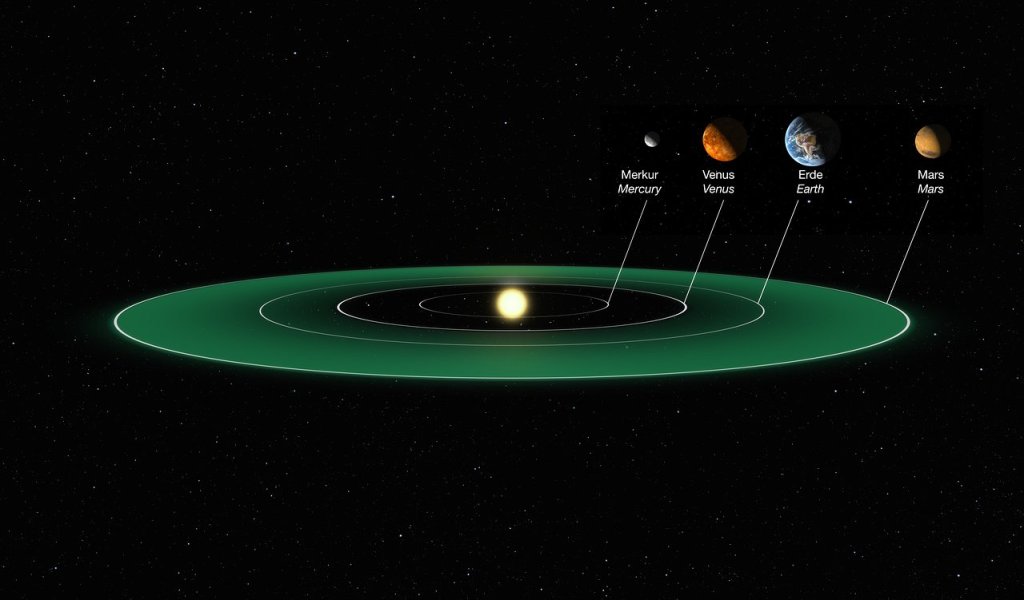
Astrobiology has long relied on the concept of a “habitable zone”, that is a zone around a star that is the right distance from said star to hold liquid water, and therefore life. This concept is absolutely valuable, especially insofar as it allows us to classify new exoplanets and identify potential exoplanets that may host life. However, we don’t have to leave the solar system to realize the limits of this concept, and how it potentially forecloses the search for life in many other environments.
The first key limitation of the habitable zone is that it assumes heat originates solely from the central star. By looking at the Galilean moons, we can immediately see that that assumption is flawed. Europa and Ganymede both are far outside the habitable zone, and both have liquid water beneath their surfaces. How? Tidal heating. As the moons pass by each other, and orbit Jupiter, differences in tidal forces heat the moons to the extent that liquid water becomes possible. This is critical since these moons are among the best possible candidates for life within our solar system, with the conditions of the subsurface oceans being reminiscent of what we think Earth looked like around the start of life. The existence of liquid water on these moons indicates that a focus on habitable zones may preclude an examination of all possible bodies on which life may exist
The second key limitation of the concept of the habitable zone is the assumption that liquid water is a necessary prerequisite to life. While this certainly maps to our understanding of life on Earth, it is theoretically possible that life could exist using methane or some other compound as the key ingredient. This is important, since methane can exist in liquid form far outside the bounds of the “habitable zone”. One example of a body where this life could exist is Saturn’s moon Titan, where while it is quite cold, there is a significant amount of liquid methane. Whether or not life could exist in an environment like this is an open question, but these solar bodies provide key challenges to the concept of the habitable zone.
While life likely won’t be found on any of these bodies (nor Enceladus, a moon of Saturn with liquid water and organic compounds), they provide important theoretical challenges to the concept of where we think life can exist. As we seek life elsewhere, we should consider the habitable zone as important, but remember that astronomy can be very diverse, and a larger variety of environments may support life than we initially expect.
Unfortunately, this question has an easy answer: not much. So far, no exoplanet has been confirmed to have a moon, even though scientists are detecting planets the size of the Jovians. Even though nothing has been confirmed, however, there have been some interesting potential discoveries. We say potential because again, the systems are so far away it is hard to confirm anything.
One astronomer from the University of Padua in Italy, Cecilia Lazzoni, claims she found two giant exomoons. In both cases, the planets are about 11 to 13 times as large as Jupiter, and their moons are around Jupiter size. The question is if these systems can even be understood as planets and their orbiting moons. Some say these planets could be classified as brown dwarfs, objects that can only complete half of the proton-proton chain and thus don’t achieve star status. Brown dwarfs are normally classified as 13 times as large as Jupiter, but the definition is completely clear. If the object is a brown dwarf, then the moon could actually be a planet. Another explanation for these systems could be calling them binary planets, similar to the idea of binary stars.
Other researchers from Columbia University claim to have evidence of an exomoon that is around Neptune size, orbiting around a planet several times as large as Jupiter.
This kind of discovery is exciting because, even if they aren’t called exomoons but end up being planets, they force us to expand how we classify and think of extrasolar systems. Additionally, similar to how astronomers consider Europa and other Jovian moons as possibilities for containing life, some consider exomoons as candidates for life outside our solar system. Dr. Phil Sutton from the University of Lincoln said,
“These moons can be internally heated by the gravitational pull of the planet they orbit, which can lead to them having liquid water well outside the normal narrow habitable zone for planets that we are currently trying to find Earth-like planets in…I believe that if we can find them, moons offer a more promising avenue to finding extra-terrestrial life.”
Exactly like our Jovian moons! So although exomoons might offer possibilities outside of what we know about our own solar system, we can still apply the knowledge we find in our solar neighborhood to other systems far, far away.
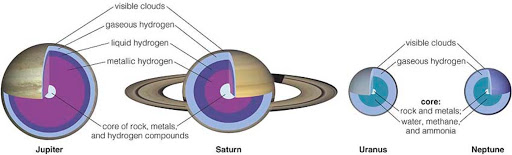
The Jovian planets are often called “gas giants,” making it sound as if they were entirely gaseous. However, this name can be misleading, as it is true Jupiter and Saturn became giant primarily because they captured so much hydrogen and helium gas, but their strong gravity compresses most of the “gas” into forms of matter quite unlike anything we are familiar with, and Uranus and Neptune are made mostly of materials besides pure hydrogen and helium.
A spacecraft plunging into Jupiter would quickly be destroyed by increasingly high temperatures and pressures, as demonstrated when the Galileo spacecraft dropped a scientific probe into Jupiter in 1995, the probe only survived to a depth of 200 kilometers, about 0.3% of Jupiter’s radius. As a result, we can only learn about Jupiter’s interior through a combination of theoretical modeling and laboratory experiments. This has indicated that Jupiter has fairly distinct interior layers, with the layers not differing much in composition – all being mostly hydrogen and helium except for the core – but differing in the phase of hydrogen. Beginning with the outermost layer, the cloud-tops, temperatures stand around 125K and atmospheric pressure is about 1 bar – same as the pressure at sea level on Earth. Continuing down, the second layer is liquid hydrogen at a scorching 2000K and a pressure of 500,000 bars at a depth of 7000 kilometers. Then, at a depth of 14,000 kilometers, pressure increases to 2 million bars, forcing hydrogen into a compact, metallic form. This layer of metallic hydrogen is by far the largest layer, conducting electricity quite well and generating Jupiter’s magnetic field. Finally, we reach the core, a mix of hydrogen compounds, rocks, and metals compressed to an extremely high density that while the core may be about the same size as Earth, it contains ten times as much mass.
Saturn has the same basic layering as Jupiter, but its lower mass and weaker gravity make the weight of the overlying layers less than Jupiter. However, Saturn has thicker layers of gaseous and liquid hydrogen and a thinner and more deeply buried layer of metallic hydrogen. Uranus and Neptune have somewhat different layering as their internal pressures never become high enough to form liquid or metallic hydrogen, so they only have a thick layer of gaseous hydrogen surrounding their cores of hydrogen compounds, rock, and metal. Interestingly, this core material may be liquid, making for very odd “oceans” buried deep inside. The cores of Uranus and Neptune are larger in radius than the cores of Jupiter and Saturn, although the same mass, due to being less compressed by their light-weight overlying layers.
It’s pretty perplexing as to why Saturn’s moon, Titan, has such a thick atmosphere but a planet like Mars does not. Since the most widely accepted explanation of why Mars has such a thin atmosphere is it losing its magnetosphere as its core cooled and does not contain nearly as much metallic iron has the Earth’s, it would make sense that Titan would follow the same pattern since it doesn’t have a magnetosphere. The explanation behind this discrepancy is due to the composition of Titan’s atmosphere. Since Titan’s atmosphere is almost entirely nitrogen and nitrogen is able to withstand the lower amounts of solar radiation that Titan receives relative to Mars even without a magnetosphere, Titan is able to maintain an atmosphere of nitrogen. This also explains why Titan wouldn’t have any oxygen, since this is not true for oxygen molecules as they would be broken up by this radiation. This also explains the situation on Mars, since it was believed to once have oxygen, but due to losing its magnetosphere the oxygen was then broken apart and most likely bonded with the iron on the surface, giving it its red tint. The only thing left unexplained is why Mars or the other large Jovian moons lack the nitrogen that Titan and Earth have. Information from this blog and more detailed information on this subject is found in this video.
Scientists believe that Jupiter has 79 moons, the most in the solar system. This is most likely because Jupiter is more massive, therefore is can hold on to more massive stuff the orbit around it. Additionally, the fact that Jupiter developed further away from the Sun in the formation process giving it access to more objects to grab into its orbit. Jupiter has four very large moons called the Galilean Moons. These moons include Io, Europa, Ganymede, and Callisto.
Io is the most volcanically active body in the solar system. Io’s surface is covered in sulfur in an array of colors. Jupiter’s immense gravity causes tides on the surface of Io. This tidal heating generates enough heat for volcanic activity and to drive off any water. Io’s interiors consist of a core, and a mantle of partially molten rock, topped by a crust of solid rock covered with sulfur compounds.
Europa’s surface is mostly made of water ice. There is evidence that it may be covering an ocean of water of slushy ice underneath it. There is no cratering on the surface of Europa signifying the surface is relatively young. Europa is heated by tidal heating to the point that the craters are filled with liquid. This moon is very interesting to astrobiologists because the properties and conditions of Europa suggest that it may be a habitable zone where life can prosper. Europa has a core, a rock envelope around the core, a thick, soft ice layer, and a thin crust of impure water ice.
Ganymede is the largest moon in the solar system. It is larger than the planet Mercury. It is the only moon known to have its own internally generated magnetic field. Ganymede has a core, a rock envelope around the core, a thick, soft ice layer, and a thin crust of impure water ice.
Callisto has a heavily cratered surface that is ancient. There is a very small degree of current surface activity. The layering of the interior of Callisto is not very defined and appears to be a mixture of ice and rock.
“The most distant galaxy ever discovered in the known Universe, GN-z11, has its light come to us from 13.4 billion years ago: when the Universe was only 3% its current age: 407 million years old. But there are even more distant galaxies out there, and we at last have direct evidence for it.” NASA, ESA, AND G. BACON (STSCI)
“Space,” it says, “is big. Really big. You just won’t believe how vastly, hugely, mindbogglingly big it is. I mean, you may think it’s a long way down the road to the chemist’s, but that’s just peanuts to space.”
— Douglas Adams, The Hitchhiker’s Guide to the Galaxy
So you want to study space?
Now, how exactly are you going to do that?
Astronomers over the ages have struggled with that exact problem for even longer than astronomy was recognized as a field. We can’t exactly walk over to the Sun and collect a few samples, nor can we travel millions of light years away, or even see what stars at that distance look like with the naked eye. With our most basic abilities, our five senses, we can normally barely use one, our sense of sight, to gather information from space. To imagine that we have grown from believing that the sky was a enclosed, spinning dome surrounding the Earth, to sending humans onto the Moon, to exploring the depths of our solar system and beyond with probes, and now, capturing spectacular imagery of stars and planets that are impossibly far away from us using the strongest telescopes.
One of the most famous early astronomers, Tycho Brahe, was known for his extremely precise naked-eye astronomical observations. He lived in the 16th century, before telescopes were invented and used. Even then, using only his eyesight, he was able to record data accurate to one arcminute, which is 1/60 of a degree! Besides proving that comets and supernovas were much farther away from us than the Moon, the data he collected also proved invaluable to future astronomical models. Even without a telescope, past astronomers were able to prove that the space around us was not merely a projected dome, surrounding us at the same distance away.
In the grand scheme of human history, the “common” knowledge that the planets in our solar system revolve around the Sun hadn’t been widely accepted until after Galileo had solidified arguments against an Earth-cented one, which was in the late 16th to early 17th centuries. That is a mere, give or take, 400 years ago that people used to believe the Earth was the center of the universe! Even public opinion and religious authorities were hurdles to overcome in the history of astronomy.
Fast forward to modern day astronomy, where we have all these amazing tools to help us learn more about how vast space is, what is out there, and how it all connects together. Even now, astronomers struggle with problems such as the Milky Way blocking us from viewing what’s behind its arms, or the length of time it takes for our space probes to reach the farther planets in our solar system, such as Uranus and Neptune, and collect data for us. Though we are able to image planets and galaxies millions of light years away, we still don’t know everything about our own solar system, our home.
These are truly some of humanity’s greatest achievements to be able to learn so much about things that are so far away from us. We’re able to determine the temperature and composition of stars that we’d never be able to get remotely close to, much less touch. We’re able to predict galactic collisions 4.5 billion years from now. (Hello, Andromeda!) We have equations that tell us about how the same physical principles that we use on Earth can explain phenomena in space. We’re even able to establish a timeline of major events from 13.8 BILLION years ago, which was the beginning of our universe, A.K.A. everything, ever!
It’s truly mindblowing, if you think about it. Let’s pat our astronomers on the back.
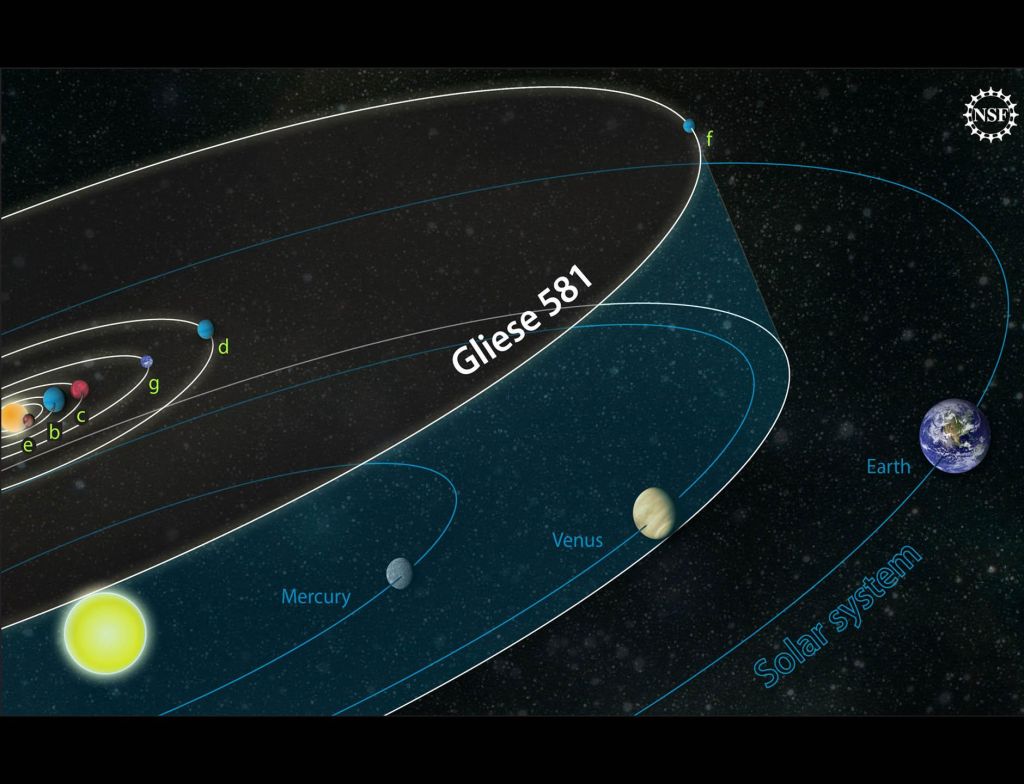
Upon learning about exoplanets, I’ve become fascinated with one 20 years light years away from Earth called the Gliese 581c, which resides in the Gliese 581 system. The Gliese 581c was discovered in 2007 using the radial velocity method of detection (tugs on its planet star). At the time of its discovery, it was the smallest exoplanet detected around a main sequence star and the known exoplanet which most resembled our own Earth.
While thought to reside within the habitable zone, it actually lies just beyond it, making it unfit for civilization. The Gliese 581c also suffers from a runaway greenhouse effect due to its proximity to its host star.
Cool facts about the Gliese 581c:
Located third in order from its host star
Orbits a red dwarf
Classed as a Super Earth (has up to 10x the mass of Earth)
Tidally locked (one side faces its host star while the other is in constant darkness)
The Northern Lights are a natural phenomenon that appear to be fresh out of a fantasy novel. Otherwise known as Aurora Borealis, these lights are the product of the Earth’s magnetic field and high energy particles from the sun. Normally our magnetic field is invisible, but in certain locations, like the Earth’s poles, they become more visible when impacted by high energy light from our solar system’s star. The different colors are the result of the composition of our atmosphere (green for oxygen, and red/blue for nitrogen).
While our magnetic field is a sight to behold when made visible near our poles, its true role in our lives is much more significant. The light that is being absorbed by our magnetic field would prove deadly to life on earth if it were left unimpeded. Furthermore, some species are able to actually navigate by detecting these magnetic fields. Migratory birds and fish are able to navigate long distances thanks to these forces. Scientists are still currently conducting research on other walks of life, and it seems that a larger portion of the animal kingdom can sense these magnetic forces than we first thought. The Earth is unique in how strong its magnetosphere is. This strength is due to having electrically charged liquid, and rotation. We aren’t alone in this regard, Jupiter has a strong magnetic field too!
Mars’ rocky surface has craters that differ between the southern and northern hemispheres!
My previous blog discussed the geology of Venus, so this week I thought it would be fun to research the geology and makeup of Mars! Mars and Earth have more similarities than you would think. Having a similar axis tilt, a day just slightly longer than 24 hours, similar land areas because of Earth’s oceans, the presence of polar caps, and season variations during the Martian year, which is about 1.9 Earth years, Mars is not too different than Earth in these aspects.
Like Earth, Mars also experiences many different geological processes. One process is the impact catering on Mars. In the southern hemisphere, Mars has a high elevation and there are many scars from large impact craters that have landed on the planet. In the northern hemisphere, there is a lower elevation and not as many impact craters. Scientists say that these differences between the hemispheres shows us that the southern highlands are an older surface than the northern ones. Moreover, this also suggests that the northern plains had many of their impact craters destroyed by other geological processes. The main geological process that erased these northern land craters was volcanism. On the surface of mars, there are many volcanoes that have rising mantle material which erupt and erase craters. While we have not observed any active volcanic activity on Mars, I think it would be extremely fascinating to observe one. Maybe this could give us even more insight into the differences of elevations and craters on the planet’s surface. What do you think observing an exploding volcano on Mars would tell us? Furthermore, mars also has tectonic plates and erosion. It is crazy that most of the things that happen on Earth also happen on this planet!
Sources: Bennett, The Cosmic Perspective, 8th Edition 2017