Dwarf Perspective

Source: NASA

There are many celestial bodies in the Kuiper Belt. One notable object is a dwarf planet named Makemake. This dwarf planet was one of the objects NASA used to demote Pluto from its previous planet status down to dwarf planet status. NASA wasn’t aware of other bodies that looked like Pluto, and when they found more, they could categorize Pluto and Makemake better. This dwarf planet is reddish in color, lacking of an atmosphere, smaller than Pluto, and has an even smaller moon associated with it. Hopefully we can make more discoveries of bodies within the Kuiper Belt range and further.

Posted in Class, Dwarf Planets, Observables | Tagged , , , | Comments Off on Dwarf Perspective

Plasma Bubble Around Uranus

On January 14, 1986, Voyager 2 captured a picture of Uranus, capturing the planet’s chilling-blue color. Although the giant planet was already known for being odd — spinning on its side and having an off-center magnetic field. However, it was also recently identified that the icy planet has a giant magnetic bubble around it made of plasma called a plasmoid. When Voyager 2 originally passed the planet, it picked up a magnetic signal that was so tiny that it went noticed until scientists recently went back to the data and noticed it. This exciting discovery can be used as an explanation for why the planet itself is losing mass. The bubble is estimated to be about at least 127,000 x 250,000 miles across.

Hopefully scientists can send another mission to Uranus in order to study the plasmoid and Uranus other unique features with our newer technologies.

Posted in Class | Tagged , , , | Comments Off on Plasma Bubble Around Uranus

Would Landing on Europa Make Us Europeans?

As I commented in a previous blog post, one of the most fascinating questions that a person studying the solar system can ask is whether life exists outside of our Earthly home. Within this question lay an abundance of philosophical arguments, all counteracting one another and seeking to define the ‘correct’ answer to this question. Are we self-centered enough to believe that we are the only unique life-carrying planet in the universe? Is that not what makes us special and defines our existence These questions, along with a host of other, could all be answered through the possibility of future exploration of Europa, one of Jupiter’s moons.

Europa’s composition offers the compelling possibility of life / the development of life

Europa offers a compelling case study to scientists of all sorts – biologists, astronomers, etc.—due to its composition and location. Europa is thought to have more liquid water than that in all of Earth’s oceans trapped beneath a thick and icy crust. Under this crust and in these oceans, some scientists have hypothesized that life could develop in a manner similar to that of Earth. While it would require a space probe landing on the surface of Europa and then undertaking a drilling project to even “scratch the surface” of these hypotheses, this project could quite literally change our understanding of the entire universe. However, as a result of not only the ice but Europa’s location around Jupiter renders photosynthesis (one of the key ingredients — nay the key ingredient — to life on Earth) nearly impossible. This point begs the question: are there other forms through which life can be created by a volcanic seafloor’s heat like on Europa or is photosynthesis and the Earth’s marvelous story of life the end all be all? Stay tuned!

Posted in Aliens, Class, SolarSystem | Tagged , , , | Comments Off on Would Landing on Europa Make Us Europeans?

So Close, Yet From So Far ☄️

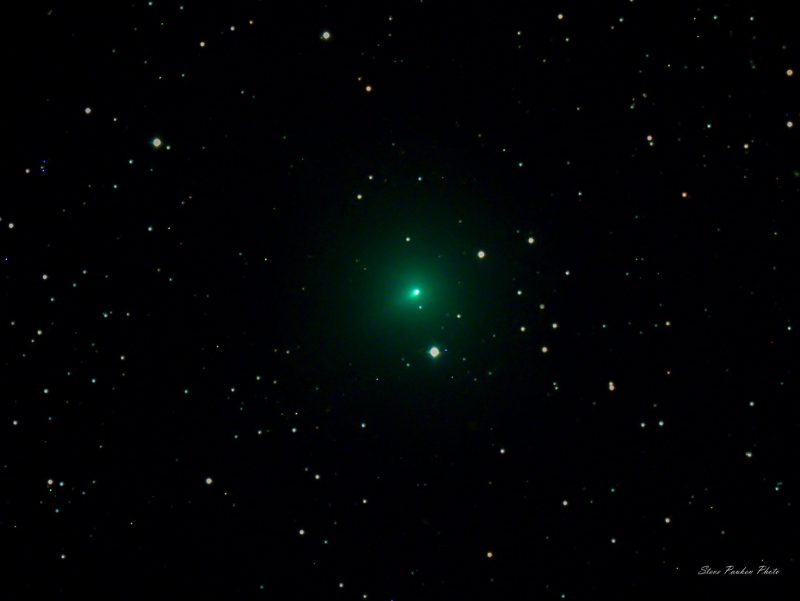
Comet Atlas, captured on March 16th, 2020 by Steve Pauken

The above image is of Comet Atlas, which is a comet that has been getting closer and much, much brighter over the past few weeks. If it doesn’t fizzle out, Comet Atlas will be able to be seen by the naked eye in as little time as a couple of weeks, at places without much light pollution.

Comets are indeed very pretty to look at in the night sky, but sometimes we ponder the question of where they come from. It turns out that these balls of gas, dust, rock, and ice largely come from an area on the edge of our solar system; the Kuiper Belt and the Oort Cloud. Haven’t heard of these two before? They mostly consist of clouds of small, icy bodies. Sometimes, these objects get gravitationally pulled a little too close to the rest of the solar system, and this changes their orbit slightly which passes by the inner solar system and straight into the Sun, where it’ll never be seen again. However, most of the time, we are able to spot them through binoculars and telescopes or even just our eyes, and we call them comets.

The Kuiper Belt is closer to us than the Oort Cloud, but the Oort Cloud’s existence is based merely on speculation and we don’t really know how big it is, or exactly how far away it lies. However, we believe that long period comets, comets that take 200 years or more to complete one orbit, come from the Oort Cloud, and short period comets mostly come from the Kuiper Belt.

The Kuiper Belt and the Oort Cloud were created when the solar system first formed. The remaining gas, dust, and rocks that didn’t coalese into planets were slingshotted away by gravitational force and formed parts of these spherical clouds. Some material was too far away from any of the planets, but not too far to escape the solar system, so it continues to reside in the Kuiper Belt.

Both the Kuiper Belt and Oort Cloud are constantly changing and even diminishing, since objects continually collide with one another and turn into smaller, dustier fragments, then get blown away by the solar wind. Some comets burn up on their orbit into the inner solar system, and never return. Though we’re not sure of all the details yet, it’s still fascinating to find that beyond the commonly known orbits of our planets, we are surrounded by bits of our solar system’s nursery.

Posted in Class, SolarSystem | Tagged , , , | Comments Off on So Close, Yet From So Far ☄️

Solar Winds

Solar winds are arguably one of the most destructive forces in our solar system. As a kid, I never took these forces into account when thinking about space travel. In my mind, as long as you avoided flying your space ship directly into the sun (which I thought was on fire, of course), our star was not to be worried about. Unfortunately, solar winds have to be taken into account when traversing space.

A rendering of solar winds and the sun’s corona

Here on earth, tornadoes and hurricanes are some of mother natures most immediately damaging phenomenon. One of the things that make these occurrences so scary, is that they can seem to appear out of nowhere. Just recently, Nashville was hit by a devastating tornado. There was little to no warning for those that were affected by it. Tornadoes can have wind speeds up to 300 mph, the recent Nashville tornado is estimated to have had 165 mph winds. Comparatively, solar winds can reach speeds up to 500 miles per second. That’s a top speed of 1.8 million mph!

This incredible speed leads to a large transfer of energy into whatever the winds collides with, and luckily for us, we have our magnetosphere to protect us. I mentioned the magnetosphere in my previous post about the northern lights, but there are other things that occur when the wind makes contact with our magnetosphere. The near invisible collisions can cause the magnetosphere to become deformed, leading to turbulence. this turbulence can lead to a number of things, interference in terrestrial communications, satellite malfunctions, and even issues in our power grids. Solar wind is a part of our local space weather, which we need to be conscious of, whether we are traveling in space or living here on Earth.

An awesome photo by NASA on solar wind!
Posted in Class, Science | Tagged , | Comments Off on Solar Winds

How’s the Weather Up There? ⛅

A beautiful picture of our weatherless Moon!
Captured by u/ajamesmccarthy

On an especially brutally stormy day, you may have thought to yourself, “Why does it have to be this way? Why do we have to be so inconvenienced?” Well, if we colonize Mars or the Moon someday, your wish may come true. That’s because weather stems from the presence of an atmosphere! Weather is mostly caused by heat from the Sun and movement of air.

Without an atmosphere, there are no air molecules to be affected by the planet’s heating. Without these moving particles due to temperature differentials, there is nothing to cause wind. In fact, wind simply cannot occur without an atmosphere because it IS air. Clouds would also be unable to form, because they are masses of liquid droplets suspended in the atmosphere. (There’s the additional problem of requiring water to evaporate!) Even if clouds could form without an atmosphere, they would be blown away by the solar wind due to the lack of protection an atmosphere would normally provide. Thus, rain cannot occur, nor snow, sleet, and other precipitation.

Though, that would probably be the least of your problems, since you’d be physically unable to breathe in such a place without assistance of some kind. Earth’s atmosphere is made of precisely the right amounts of nitrogen, oxygen, and other gases that we need to survive normally. (Probably because we have only ever known living on Earth, and developed on Earth as a species.) Oh, and the lack of atmospheric pressure on your body would quickly start making your insides feel like they’re becoming your outsides…

Long story short, while not having to deal with rainy day traffic may seem like a blessing, not having an atmosphere at all makes things much, much worse!

Posted in Class, SolarSystem | Tagged , , , | Comments Off on How’s the Weather Up There? ⛅

The Lesser Known Planetary Rings

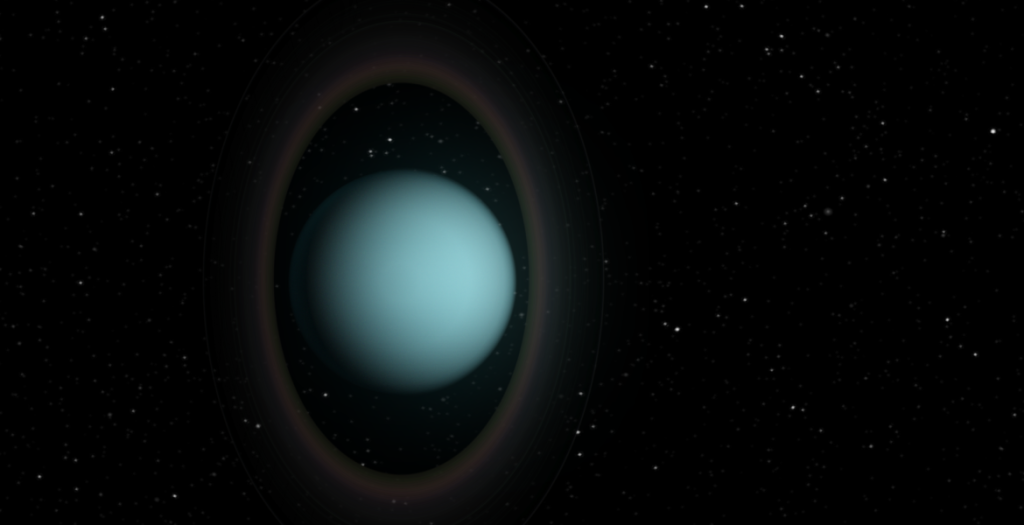
The rings of Uranus, which are not easily visible.

When quizzed about planetary characteristics in elementary school, the typical questioned asked when referring to Saturn is, “Which planet in the solar system has rings?” While answering Saturn is not incorrect, it isn’t completely correct either. Other planets with rings in our solar system are Jupiter, Uranus, and Neptune. A more accurate way to ask this question is, “Which planet in our solar system is known for having visible rings?”

The rings of Neptune.

            Planetary rings are, essentially, orbiting disks around a planet that are comprised of debris and other materials. These planets that are lesser known for their rings are all gas giants. Due to their size, gas giant planets, which are Jupiter, Uranus, Saturn, and Neptune, have a higher gravitational pull compared to the terrestrial planets and it all has to do with size. Gas giants have more moons and more objects that get stuck in orbit around these planets, which explains how these rings form. The only outstanding feature that makes Saturn’s rings stand out more than other rings present in our solar system are the size and the brightness that makes them more visible. 

The rings surrounding the largest planet in our solar system, Jupiter.
Posted in Class, Planet Rings, SolarSystem | Tagged , | Comments Off on The Lesser Known Planetary Rings

The beautiful tails of comets

What distinguishes comets from other celestial bodies is their beautiful tails. Comets, with nuclei made of ice and dust, go through a process called outgassing as they move toward the sun. The icy part of a comet becomes gaseous due to the fast warm-up and brings dust away from the comet’s body.

What’s most interesting is that a comet has multiple tails. The tail we usually refer to are the gas tail, which points straight away from the Sun. However, if we look closely, we can see the dimmer dusty tail, which curves toward the comet’s orbit and thus deviates itself away from the gas tail.

Even though each typical comet has a gas tail and a dusty tail, there is still another reason for which comets can have multiple tails. Since comets have irregular shapes and rotate irregularly, a comet’s surface is not heated uniformly. Therefore, there exists the possibility that different regions of the same comet emit tails at the same time. How luck y we will be if we can witness it in our lifetime!

A comet can have multiple tails

References:

1.What Are Comet Tails?

Posted in Class | Tagged , , , | Comments Off on The beautiful tails of comets

Exoplanet’s Exotic Weather

Scientist thought that Venus’s weather was bad. From the planet’s acid rain, to the horrendous temperatures and pressures to the clouds that smother the planet in sulfuric acid. It’s the closest image that scientist have to depicting hell. But what if there’s something that may be even worse? What if Earth’s raging twin actually has a calm temperament compared to other planets.

This was found to be exactly the case with exoplanet WASP 7-B. This gas giant exoplanet has completely expelled anything in our solar system from being “the possible scariest/worse.” During the day, WASP 7-B reached scorching temperatures of up to 2,400 degrees Celsius (enough to vaporize metal). The night gives off a picture that’s just as daunting: iron rain. Found in the Pisces constellation, this planet rest about 640 light-years from out solar system. It has been nicknamed a “hot Jupiter” because while being only slightly smaller than Jupiter, it sits ten times closer to its star than Mercury does to the Sun! This extreme proximity has caused WASP 7-B to be a tidally locked star, with one side of the planet living in an eternal day while the other side never sees the end of the night. The proximity also causes WASP 7-B to get about 1000 times more radiation than the Earth does from the Sun.


This is an artist depiction of the iron rain from https://astronomy.com/news/2020/03/astronomers-find-an-exoplanet-where-iron-rains-from-the-sky.
Posted in Class | Tagged , | Comments Off on Exoplanet’s Exotic Weather

Living on Titan?

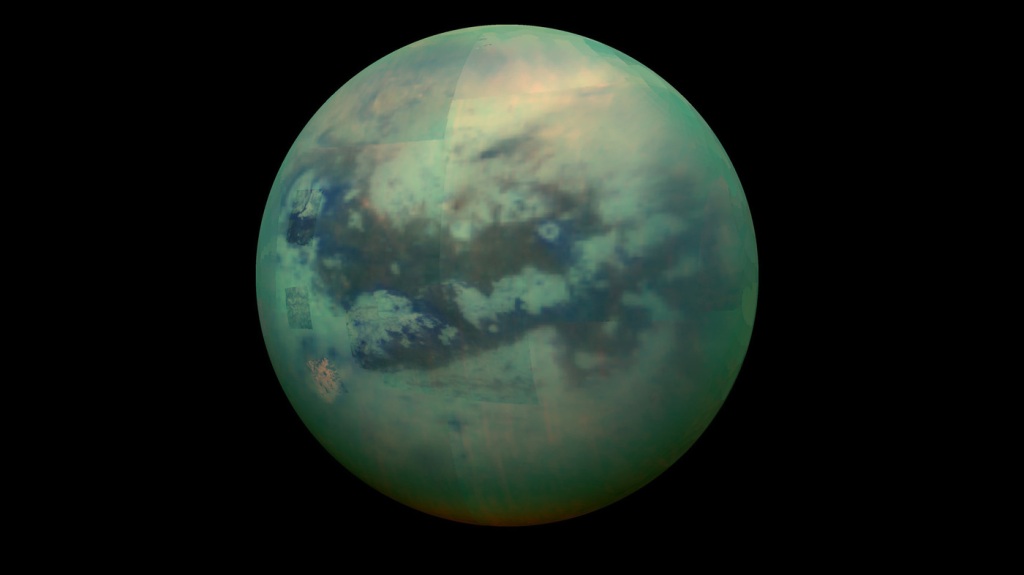
Could human beings inhabit Titan, one of Saturn’s moons? Titan is one of the least hostile places for humans in the outer solar system. Titan has liquid methane lakes and oceans on its surface, and even has weather. Titan’s atmosphere is very dense – 95% nitrogen and 5% methane. The gravity on Titan is slightly weaker than the gravity on the moon. The pressure is quite similar to that on Earth. This very interesting article explores the possibility on living on Titan or Enceladus, another one of Titan’s moons.

A composite image of Saturn’s moon Titan taken by the Cassini spacecraft.

Scientists are investigating if methane based life exists on Titan. If a human being was on titan, they would only need an oxygen mask and protection from the weather. Could humans inhabit titan some day?

Posted in Class, Universe | Tagged , , , , | Comments Off on Living on Titan?