The Discovery of the Speed of Light

While Aristotle believed that light could travel instantaneously, the first experimental attempt to measure the speed of light came from Galileo Galilei in 1667. He placed two people with covered lights on the top of hills that were about a mile apart. The first person was instructed to uncover his light, and when the second person observed that light, he was to uncover his own. Galileo was able to determine that light traveled at least 10 times faster than sound. 

The first numerical estimate for the speed of light came just 10 years later from Ole Römer, who observed that the eclipses of Jupiter’s moon always came later than mathematically anticipated. He estimated that light took 10 – 11 minutes to travel from the sun to Earth. In 1728, James Bradley estimated the speed of light to be 185,000 miles per second, using the apparent change in position of the stars due to Earth’s motion.

In the mid-1800s, two French physicists narrowed the estimate of the speed of light to about 1,000 miles per second of what is accepted today. Hippolyte Fizeau used a spinning wheel with prongs and a mirror set up five miles away, varying the speed of the wheel to measure how long the light took to travel to the mirror and back to the wheel. Leon Foucault used a rotating mirror. 
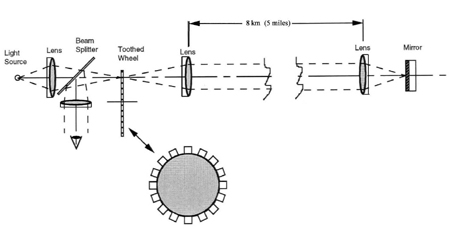
Fizeau’s spinning wheel, from SPIE

The story seems to end with Albert Michelson, who aimed to repeat Foucault’s experiment in 1879, but with longer distance and higher quality mirrors and lenses. He measured 186,355 miles per second: which was accepted as the most accurate measurement into the 1920s. Michelson’s number comes very close to today’s accepted speed of 186,282 miles per second—an impressive feat that earned him a Nobel Prize!

Source: SPACE.com

Posted in Historical, Light, Observables, Physics | Tagged , , , | Comments Off on The Discovery of the Speed of Light

Vastness of the Universe

The universe is astronomically big (cheesy pun). We live on Earth, which is in our solar system, which means that we orbit the Sun. Our Sun is just one star out of the millions upon millions of stars in our Milky Way galaxy. Our Milky Way is just one galaxy out of 30 or so galaxies in what is called the “Local Group.” The Local Group is part of the Virgo supercluster of galaxies, which is comprised of over 700 galaxies. (Feel tiny yet?) In addition to this, the Virgo supercluster is one of the approximately 100,000 galaxies in the Laniakea super-duper-cluster. Laniakea is Hawaiian for “immense heaven.” And Laniakea is not the only supercluster in the universe! 

The observable universe is currently 46 billion light years across–and EXPANDING. There is no known edge or center of the universe. It just IS. What a beautiful representation of the Creator! Only a boundless God could create such a boundless universe. God was not born, nor will He die. Like the universe, He just IS. The beginning and the end. The One who was, is, and is to come! I like to think that as God sits on His heavenly throne, He is continually stretching the universe, fashioning new stars and planets and galaxies and meteors and superclusters. And how gracious of Him to give us brains with the capacity to explore it all! I think that it brings Him great joy when we discover something that He created and take delight in studying its intricacies. By designing new technologies and making observations and seeking to understand the nature of the heavens, I believe that we are obeying His command to “love the Lord [our] God with all [our]…mind.”

When you consider the vastness of the universe, what things come to mind? Do you ever feel small? Are you in awe or indifferent? Let me know in the comments! Thank you so much for reading! 🙂

Picture from Forbes

Posted in Class, Galaxies, Observables, Universe | Tagged , | Comments Off on Vastness of the Universe

Extrasolar Planets: Are We Alone?

Source: Universe Today

The age-old question: are we alone in the Universe? Humans from the beginning of time have looked out into the night sky and wondered this. I know I have. Astronomers have been searching endlessly for extraterrestrial life. The potential habitable worlds (as seen in the picture) are known as extrasolar planets. An extrasolar planet, also known as an exoplanet, is a planet that orbits a star other than our Sun. There are billions of solar systems besides our own, and many of them likely have their own planets. The first recorded mention of this concept was made by Italian philosopher Giordano Bruno. He argued that fixed stars are similar to our Sun and are accompanied by planets. Extrasolar planets are very hard to detect because they are even fainter than the stars they orbit. Because of this, the first exoplanet discovery was not made until 1992 by astronomers Aleksander Wolszczan and Dale Frail, who used the Arecibo Observatory in Puerto Rico. Wolszczan and Frail observed many terrestrial-mass planets orbiting the pulsar PSR B1257+12. Thanks to technological innovation, astronomers have made incredible discoveries since then. As of September 2017, 3,667 exoplanets in 2,747 systems have been identified. The hunt to find life is still on! Comment down below to start a conversation about exoplanets, extraterrestrial life, or anything else.

Posted in Class, Exoplanets | Tagged , , | Comments Off on Extrasolar Planets: Are We Alone?

Astrolonomy?

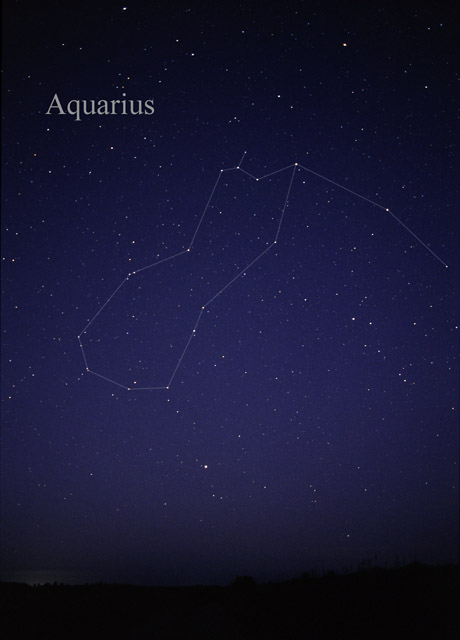
A little over two weeks ago, we entered arguably one the thirteen coolest months of the zodiac: Aquarius. (Yes, we still love you Ophiuchus). But what does that really even mean? What is Aquarius?

Well, as I am sure you can tell from the constellation, Aquarius is clearly a water-bearer. But it is also much more than that. In astrology, those born in the month of Aquarius are known for their distinctive social conscience, intelligence, occasional coldness, and perpetual need for hydration. However, astronomically, the scientific and cultural significance of Aquarius extends far beyond personality traits and physical characteristics. Aquarius is one of the oldest and most widely recognized constellations in the night sky, as it was first recorded in the second century by Ptolemy in Ancient Greece. But the recognition and appreciation of Aquarius spread much father than just Greece. For example, Ancient Egyptian astronomers associated Aquarius with the annual flood of the Nile, which brought necessary life and nutrients to the river valley. Similarly, Babylonian astronomers believed Aquarius to represent their god Ea, also known as “The Great One” in their native tongue. Also, Aquarius is an absolutely massive constellation (it is the 10th largest in the sky, spanning 980 square degrees). In addition, though none of the stars are particularly bright, Aquarius is home to a yellow supergiant star, several planetary nebulae, and many fascinating exoplanets that may hold extraterrestrial life!

Posted in Class, Historical, Observables, Stars | Tagged , , | Comments Off on Astrolonomy?

Leap 🐸 Year

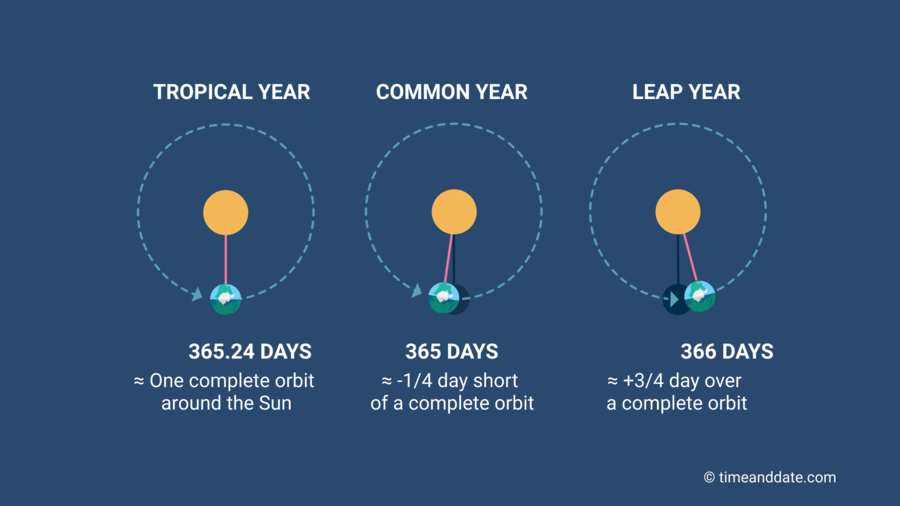
I can’t be the only one that questioned why we would get an extra day and the Olympics every four years when I was younger. While this isn’t the time to discuss the Olympic schedule, this did provide me with a chance to discover the real reason February 29th pops up every four years. As Dr. G informed us in class, the Earth’s revolution actually takes 365. 2422 days, called a tropical year. However, if we ignore the extra few 0.24 days, our calendar would be extremely out of whack after thousands of years. To work around this, a common year (365 days) would be observed normally, and every fourth year an extra day slides into February, creating the leap year. Something else I find very interesting is that exceptions exist for leap years to account for it being an extra 0.2422 day instead of a perfect 0.25. Leap years will not occur in years ending in “00” that are not divisible by 4, so 1700, 1800, and 1900 all ended up as common years.

Posted in Class | Tagged , , | Comments Off on Leap 🐸 Year

“He’s Such an Ophiuchus”: The Forgotten 13th Zodiac Sign

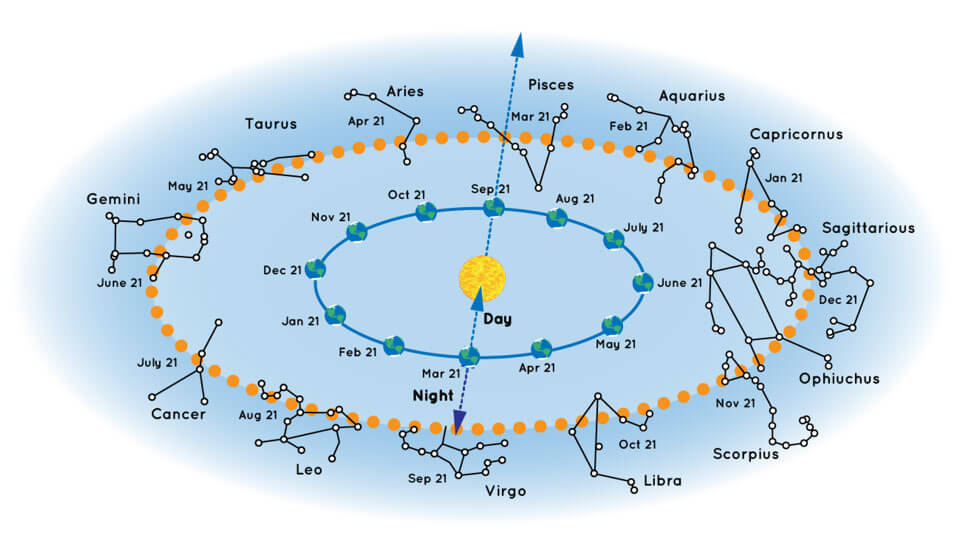
In 2016, NASA shared this image of the zodiac constellations. Within this picture, we see the twelve signs commonly talked about in astrology, but we also see the presence of a less-discussed zodiac member: Ophiuchus.

Image result for ophiuchus constellation
An image of the constellation, Ophiuchus, the serpent-bearer. Source: Pinterest

According to CNN, Ophiuchus is one of the 13 members of the Babylonian zodiac. However, 13 zodiac signs did not fit conveniently into their 12-month calendar, thus, they decided to scrap Ophiuchus. Additionally, Babylonians continued to cut corners by altering the lengths of the remaining 12 zodiac signs and assigning them all equal lengths within the calendar year. This, combined with the fact that we no longer see stars in the same position as the Babylonians did (due to the Earth’s precession), means that the astrological sign you were born with, is likely not the one that the sun was actually in when you were born. Particularly, those born between “November 29 [and] December 17” (Bustle) would have Ophiuchus as their sign. Despite astrology being a pseudoscience, it’s still fun to analyze how your birthdate can impact your personality traits. This Bustle article speculates that an Ophiuchus would fall somewhere in between signs the precede and follow it: Scorpio and Sagittarius. This means that Ophiuchuses are passionate, desirable, and lucky, but prone to jealousy and a bad temper.

Does your birthday make you an Ophiuchus? And if so, do you feel like the personality traits hold true? Do you think astrology holds any truth at all? Comment below & let me know (:

Posted in Historical, Stars | Tagged , , | Comments Off on “He’s Such an Ophiuchus”: The Forgotten 13th Zodiac Sign

Ephemerides: An Astronomer’s Excel

Almanach Perpetuum of Spanish Astronomer Abraao ben Samuel Zacuto (from Wikipedia)

From the first time I observed lunar eclipses to now understanding how they occur, I have always wondered how astronomers are able to predict every piece of information about them years in advance. Also, in the bigger picture, I did not know how astronomers knew where the planets and stars were in our Solar System and galaxy… I needed answers! In approximately 4th century B.C. (Britannica), early astronomers created tables that mapped the trajectory of celestial bodies in our sky. These tables are called ephemerides (plural of ephemeris), and they have developed over time from handwritten tables of information to massive databases that are constantly being calculated with modern super computers and algorithms. Surprisingly, one of the first uses of a modern computer was to calculate these trajectories! Above is an image of one of the early ephemerides created in 1496 called the Almanach Perpetuum. Created by Spanish astronomer Abraão ben Samuel Zacuto, the table was one of the first uses of the printing press in Portugal. Ultimately, ephemerides are an extremely awesome set of tables that map out the stars in our solar system to help us know where celestial bodies are, in turn enabling astronomers to accurately predict every detail about future (and past) lunar eclipses!

Posted in Class, Instruments, Stars | Tagged , , | Comments Off on Ephemerides: An Astronomer’s Excel

The Speed of Light: Blasting Towards the Weighted Scales

Light travels at a speed of about 300,000 kilometers per second. At this speed, you could literally travel the circumference of the Earth 7 times in ONE second! The libra constellation is located approximately 40,000 light years away from earth. A light year is the distance traveled by light in a year (which is about 95,000,000,000,000 km). If we were to travel at the speed of light, it would take us about 40,000 years to reach Libra from earth. Safe to say we won’t be seeing those weighted scales anytime soon. Light moves incredibly fast, but the universe is also INCREDIBLY huge. There are even some phenomena that occurred millions of years ago, but we cannot see them because the light has not had enough time to reach us. Fortunately, we have this cool pic (sourced below) to view for the time being.

All stars in the Libra Constellation.

Posted in Class, Light, Space Travel | Tagged | Comments Off on The Speed of Light: Blasting Towards the Weighted Scales

Ancient Interpretation of Solar Eclipses

In ancient Iraq, it was believed that a solar eclipse meant something awful was going to happen to the king or ruler. Ancient Mesopotamian astronomers could accurately determine when an eclipse would occur. When a solar eclipse was projected to happen, the court and priests would prepare for this event by planting a substitute king to replace the real king. The substitute king was given the title of king and wore the real king’s clothes. He was also provided with a queen and earned royal status through various rituals. The real king would then go into hiding. Once the solar eclipse was gone and it was deemed safe, the substitute king and queen were killed, and the real king retook his position.

After learning about this interpretation, I was feeling pretty sympathetic for the substitute king and queen. However, I am glad that astronomers discovered that a solar eclipse actually happens when the Moon passes between the Sun and Earth, so another ritual like this is not necessary.

2017 Total Solar Eclipse (taken from Britannica)

Posted in Class | Tagged , , , , , | Comments Off on Ancient Interpretation of Solar Eclipses

How big the Universe is, and What it is Full of

Almost daily I complain about how far the walk is from Sutherland House to Poke Bros. I think to myself “agh this campus is so big.” Big, of course, is relative to how long my strides are, and in reality the 1.6 miles I am away from Poke Bros is nothing. Right now the observable universe is estimated to be about 93 billion light-years in diameter, and much longer walk than Sutherland to Poke Bros. With so much space you might wonder what it’s all full of. Here are some quick estimates on what scientists believe is out there: 1 trillion comets (ish), 700 quintillion planets (this is way more than I thought I don’t even know how many 0s that is there must be aliens on at least 1 of these), and estimated two trillion galaxies which each can contain 100s of billions of stars. Also, fun fact, three whole earths fit into that red spot on Jupiter. Now for some reason the walk to Poke Bros doesn’t seem so long after all! : )

The Observable Universe

Posted in Class | Tagged , , | Comments Off on How big the Universe is, and What it is Full of