The Cosmic Calendar

Neil deGrasse Tyson explains the Cosmic Calendar on Cosmos

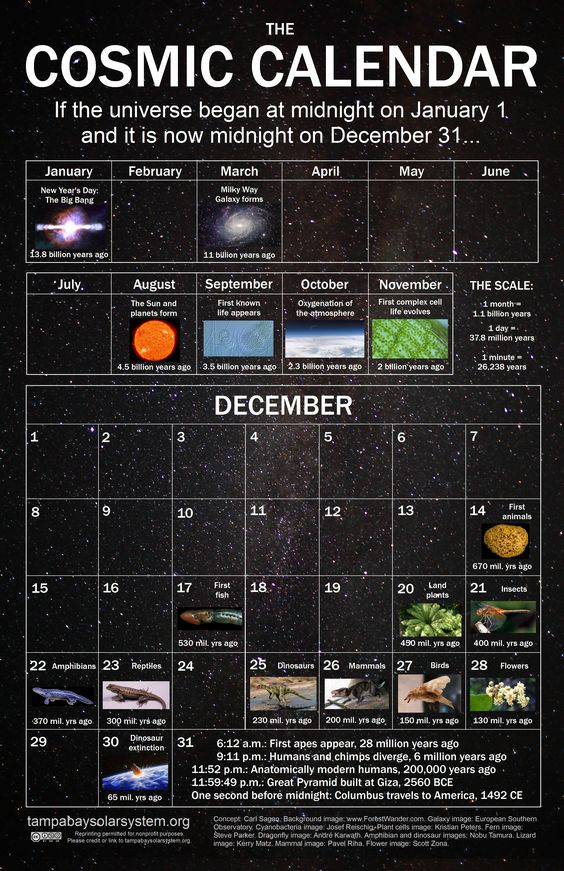
Definition: a calendar in which the 14-billion-years of the universe’s existence, from the time of the Big Bang until this moment, are scaled to a period of one year.

Origin: The idea of the Cosmic Calendar was first described by astronomer Carl Sagan on the original version of the television show Cosmos in 1980.

Key dates: 1

Jan 1 – The Big Bang

February – The Milky Way forms

September 3 – Earth forms

December 26-30 – Dinosaurs roam the Earth

Night of December 31 – All of humanity’s existence

Thus, a month on the Cosmic Calendar is about 1.2 billion years, a day on the Cosmic Calendar is about 40 million years, an hour is about 1.6 million years, a minute is about 26,000 years, and a second is about 430 years. Which means your entire life will probably be less than 1/5 of a second on the Cosmic Calendar.

I first heard about “the Cosmic Calendar” on Neil deGrasse Tyson’s show Cosmos and was very intrigued by this method of thinking about the scale of the universe. With an average life expectancy of almost 80 years in America, any amount of time greater than a century begins to be outside of an individual’s area of personal experience. In today’s human-centered world, ancient civilizations we learn about in history class seem like the beginning of time. Therefore, learning that humans only started to exist on the evening of December 31 of the Cosmic Calendar is shocking at first.

If you are like me, the size of the universe can be both intimidating and mind-blowing…and give you a headache…and make you really sleepy. Whether it’s the expanding of an already infinite universe or the fact that 1.6 billion suns can fit inside the star Betelgeuse, the universe is hard to comprehend on a human scale. Thus, this scale of one year helps put an incredible time span into the 365 day period to which we are so accustomed. However, this model does not make our little sliver of time inhabiting the Earth any less staggering. Many of us can spend a whole day in bed; it often feels like days blend together or are inconsequential to our years or lives in general. Therefore, it is stunning that, on the Cosmic Calendar, the time between the evolution of modern humans and you reading this blog right now occurred in the amount of time it takes to sing the National Anthem. In one second, the Cosmic Calendar went from the Renaissance period in Europe to TikTok dances on iPhones.

The Cosmic Calendar is a powerful and useful tool in our attempt to visualize an entire “year’s” worth of universal changes from 11:59:59… on December 31.

[1] Bennett, Jeffery, et al. The Cosmic Perspective: The Solar System. 9th ed., Pearson, 2020.
Posted in Class, Universe | Tagged , , , , , | Comments Off on The Cosmic Calendar

Our Entire Universe in One Year

Imagine if we were able to fit the history of our entire universe—from the Big Bang all the way up to today—into a single calendar year. That would be crazy right? Well look no further because that’s exactly what the Cosmic Calendar is.

Image via Pinterest

Created and popularized by Carl Sagan, the cosmic calendar compresses 14 billion years of the universe’s history into just a year with the Big Bang happening on the very first second of January 1st. When viewing the universe’s history through the cosmic calendar, our definition of a long time is actually considered rather short. The extinction of the dinosaurs took place a mind-boggling 65 million years ago. In terms of the cosmic calendar, however, the events of the dinosaurs literally took place just yesterday. Furthermore, our solar system formed 4.5 billion years ago. But in terms of the cosmic calendar, our solar system and its planets actually took shape in early September. The cosmic calendar also really put the existence of human life into perspective. Despite what most human perceived to be a long and rich history, the appearance of early humans did not happen until 9 p.m. on December 31st, the last day of this calendar year. In fact, the history of civilization is all compressed into the last half-minute of this day in the calendar. For me, this piece of information helped me realized just how minuscule our time on Earth has been as well as just how far we as humans have developed in so little time!

Posted in Class, Historical, Universe | Tagged , , , , | Comments Off on Our Entire Universe in One Year

The Far Side of the Moon

I’m no professional astronomer. No matter where I am in the world, when I look up at the night sky I see the same thing. I’ve rarely ever been able to see recognizable patterns in the stars, let alone identify specific ones, like Polaris. However, in every night sky, there is always a celestial body that remains the same. The side of the Moon that faces Earth is constant. As a result, the other side has long been mistaken as “the dark side of the moon,” when actually, the far side of the moon is constantly illuminated by the Sun! (see video below).

Animation created by NASA Video, showing satellite images of the far side of the Moon being illuminated by the Sun.

Our Moon does rotate, but by the time it completes one full rotation on its axis, it will also have completed one full revolution around the Earth. The two bodies are tidally interlocked, thus leaving one side of the Moon always facing us, and the far side always facing the great beyond.

Furthermore, the Moon itself isn’t shaped into a perfect sphere. Its uneven distribution of mass creates a torque force, making any turning movement by the Moon impossible without a strong enough external force (and that force would have to be pretty strong! 😝). To imagine torque, you can think of pushing open a door that has a spring hinge. You have to push pretty hard in order to open the door, and even then, the moment you let go the door swings back into its original position. Similarly, something (something with tremendous force) would have to turn the moon in order for its far side to face us, but it has a physical tendency to remain in the position it currently is in.

Luckily for us, modern satellite imaging allows us to study that elusive face. I can only wonder how mystifying the far side of the moon would have been for ancient astronomers.

I’d love to hear your thoughts on this and/or about ancient astronomy! Please comment below ☺

Posted in Class | Tagged , , | Comments Off on The Far Side of the Moon

Eclipses and Shadow Snakes

Back in 2017, I was lucky enough to watch the Solar Eclipse here in Nashville! It was such a cool experience, and I can’t wait until I can see one again! One thing that stood out to me was weird shadows on the ground just before and after the Sun was totally eclipsed. I remember reading articles pointing out the same phenomena that I had noticed, but I didn’t look too much into the actual cause of it.

These strange shadows have been noted for years – even as early as the 9th century – in conjunction with Solar Eclipses, but until more recently, they have largely been a mystery. Though the information on these is not fully known, they are most likely due to turbulent air in the atmosphere as the sunlight shines through the part that hasn’t been covered by the moon yet. They are also unpredictable; they vary from eclipse to eclipse and the area that someone views them in. Overall, they are fascinating to watch, and I recommend looking out for them next time you see an eclipse!

Image result for shadow snakes eclipse

These shadows move and flicker in the moments leading up to the total solar eclipse

Posted in Light, Observables, Sun | Tagged , | Comments Off on Eclipses and Shadow Snakes

The Cosmic Calendar

The Cosmic Calendar was created to help visualize the chronology of the universe. It takes the 13.8 billion year history of the universe and scales it to 1 year. I think it is a great concept because it really helps to put in perspective how long the universe has been around. To think that Christ wasn’t born until the last 4 seconds makes the scale seem wild. At this scale, there are 437.5 years per second, 1.575 million years per hour, and 37.8 million years per day. I wonder how long it took to figure out the math for this to occur. I believe it probably wasn’t that difficult but seems very easy to mess up. Wiki Pics

Posted in Class, Science, Universe | Tagged , , , | Comments Off on The Cosmic Calendar

Size of the Universe

In our day to day lives, we feel significant.  The trivial highs and lows we experience daily feel important and quite relevant.  But in the grand scheme of things, how truly inconsequential are we, not only as individuals but our whole planet.  In order to understand this, we must try to grasp how vast our universe is.  Also with that understanding, we can see how unlikely it is that we are the only planet with life.

For starters, Earth is 3.5 million times larger than a human.  That alone can make us seem insignificant.  Beyond that, Earth makes up only a tiny fraction of the entire Solar System, which 36 BILLION times bigger than our planet.  As one human, we are less than a quintillionth of the entire Solar System.  This alone is an almost inconceivable number.  Here is a quick video to help put into comparison how many one quintillion is in terms of pennies.  We each represent less than one penny.

Beyond our Solar System, things keep getting bigger.  The Milky Way consists of 200-400 billion stars, the Sun being just one of them.  If the Sun were smaller than a grain of sand, the whole Solar System would fit into the palm of your hand, yet the Milky Way would take up the entirety of North America.  The farther out we look, the smaller and smaller we begin to feel.  Here’s a cool video from Nasa showing just how small we are in comparison to our entire galaxy.

The Milky way represents just one of hundreds of billions of galaxies in the observable universe.  Numbers like these make it nearly impossible to believe that we are the only planet special enough to have life.  Although we feel, and are, important, in the bigger picture, our small lives are such a miniscule piece of the entirety of the universe.  I find it hard to believe that no other plants in the vast number that exist is able to sustain life.  I am interested to hear what others think, both about our significance in the universe and the likelihood of other life.  Please leave a comment below letting me know your thoughts on the subject!

This series of images starts at the Earth, and zooms out to the edge of the observable universe. Image credit: Andrew Z. Calvin
Posted in Aliens, Class, Universe | Tagged , | Comments Off on Size of the Universe

The Milky Way in Other Cultures

The Milky Way Galaxy was named not from the candy bar, but from the intriguing way it appears, looking like a river of spilled milk on the dark background of space. Where this name came from however is equally as intriguing, and, many cultures have various names for the Milky Way. But, each one has a myth for the reasoning.

The Greeks were the first to name it, calling it “galaxias kyklos,” meaning “milky circle.” This was based on the myth that the Greek god Zeus brought his newborn son Heracles to Hera for milk while she was asleep. Hera soon awoke, however and pushed Heracles, spilling milk into the heavens. The Romans then built on this, naming it Via Lactea or “road of milk.” The Finns call it “Linnunrata,” the “path of the birds” due to them seeing the white light as a flock. Spaniards use the same name as the Romans but also a second name, Camino de Santiago as pilgrims used it as a guide to the holy site of Santiago. In East Asia it is known as the “Silver River” from the Chinese legend that the Celestial Queen Mother used a pin to cut a river in between two lovers to keep them apart.

Reading about the differing names made me realize just how much of an impact on cultures the Milky Way has had. These names have persisted for centuries, and have provided mystery for human beings’ origins. Let me know what y’all think about this! And for more information on our galaxy, check out this video about what the Milky Way is and this Gizmodo article.

Milky Way Mythology
Posted in Class, Galaxies, Historical | Tagged , | Comments Off on The Milky Way in Other Cultures

Muons and Time Dilation

In my opinion, one of the coolest parts of astronomy is relativity, the theory describing the warping of spacetime.  If you’ve ever seen Interstellar, you’ve been exposed to one part of the theory: time dilation.  In short, time dilation is a phenomenon that causes time to pass more slowly in one place than another (relative to that other place).  Time dilation can be caused by gravity or – as I’ll discuss today – high velocities.

Background information: “Muons have a mass roughly 200 times that of the electron, but decay moderately rapidly, with a half-life of 2.2 microseconds. Muons are formed in the upper atmosphere, when high-energy cosmic rays collide with atomic nuclei in the air. This raises the question: why don’t they all decay before they reach the ground? Even travelling at 99.5% of the speed of light, the time taken to reach the ground is many half-lives,” (source).

In other words, muons travel super close to the speed of light, and they should decay before reaching Earth. We receive muons on Earth, though, raising the question of why they don’t decay on their way down from the atmosphere.

As it turns out, as velocity increases, time slows down relative to a stationary observer (source).  Let’s look at this in other words to try to understand it:

-Stationary muon: If I were to create a stationary muon, I could stand next to it and time its half-life to be 2.2 microseconds.

-Moving muon: If I were to hang out in the atmosphere and follow a muon down to Earth (I would travel at the speed of light with the muon), I would also time its half-life to be 2.2 microseconds.

So, each half-life is 2.2 microseconds. But here’s the kicker: those 2.2 microseconds are not equal when compared to each other.  What does that mean?  Imagine this: you stand still on Earth and time 2.2 microseconds, and at the same time, I travel through space at the speed of light and time 2.2 microseconds.  We could compare our times after finishing, and we would find that my 2.2 microseconds took MORE TIME to conclude than yours did on Earth. In other words, relative to you being on Earth, time would have passed slower for me (traveling at the speed of light) than it would have for you (stationary on Earth).

Check out this video and this video for more information and illustrations of all this.

So, what do we know?  A few things:

-Relative to a stationary observer, increased speed slows down the passage of time.

-Muons’ half-life is so short that they should decay in the time it takes them to travel to Earth after being created in the atmosphere.

-Muons travel at 99.5% the speed of light (let’s call it the speed of light for our purposes).

So, what does this mean?  Because muons travel at the speed of light, their time is dilated relative to stationary-on-Earth muons.  Therefore, the muons making their way from Earth’s atmosphere down to Earth have a “longer” half-life (again, relative to those 2.2 microseconds on Earth).

Significance of this: muons making it to Earth is one line of reasoning we use to support Einstein’s Theory of Relativity.

A final thought: though you and I aren’t muons, there are still some cool things we can do with all this information…

-Next time you hear someone say, “It’s all relative,” you can respond with, “Well, actually, yes.  It is.  Have you heard of muons?” and then proceed to show off your scientific brilliance by regurgitating all this information.

-When you walk outside, you can imagine the muons making their way to Earth from the sky.

-GPS systems find your location by pinging satellites in Earth’s orbit, and because those satellites move very quickly, time passes slower for them relative to time on Earth.  As a result, GPS systems have to counter the effects of time dilation (the effects we discussed re: muons traveling to Earth).  This is connected to muons only by extension, but it’s still cool to know!

Posted in Class, Physics | Tagged , , , | Comments Off on Muons and Time Dilation

SkyView

The app SkyView is a great way to apply your growing knowledge about astronomy to actual space! While it may be easy to look at a star map and tell which stars are which it’s much harder to do that when you are actually looking up at them from Earth. The app SkyView allows you to hold your phone up to the sky and you can point your phone at a specific star and it will tell you what it is! The app even works during the day which is a cool reminder that even if we can’t see the stars in the day they are always there. The app also allows for a helpful 3D representation of the celestial sphere because it allows to turn your phone in any direction allowing you to see the equator and even the stars currently on the other side of the Earth. This app allows you to gain a much greater appreciation for the stars in the sky as you can recognize and learn about them each individually instead of just seeing them in the same way that you would see clouds in the sky. One of the cool ways to use the SkyView app is when you are walking at night and you spot a strip of stars in the sky and are curious about what constellation it might be. You can point your camera to the stars and it will show you the full shape of the constellation and its name.

Screenshot from the SkyView app.
Posted in Stars | Tagged , , , | Comments Off on SkyView

Eclipses and History

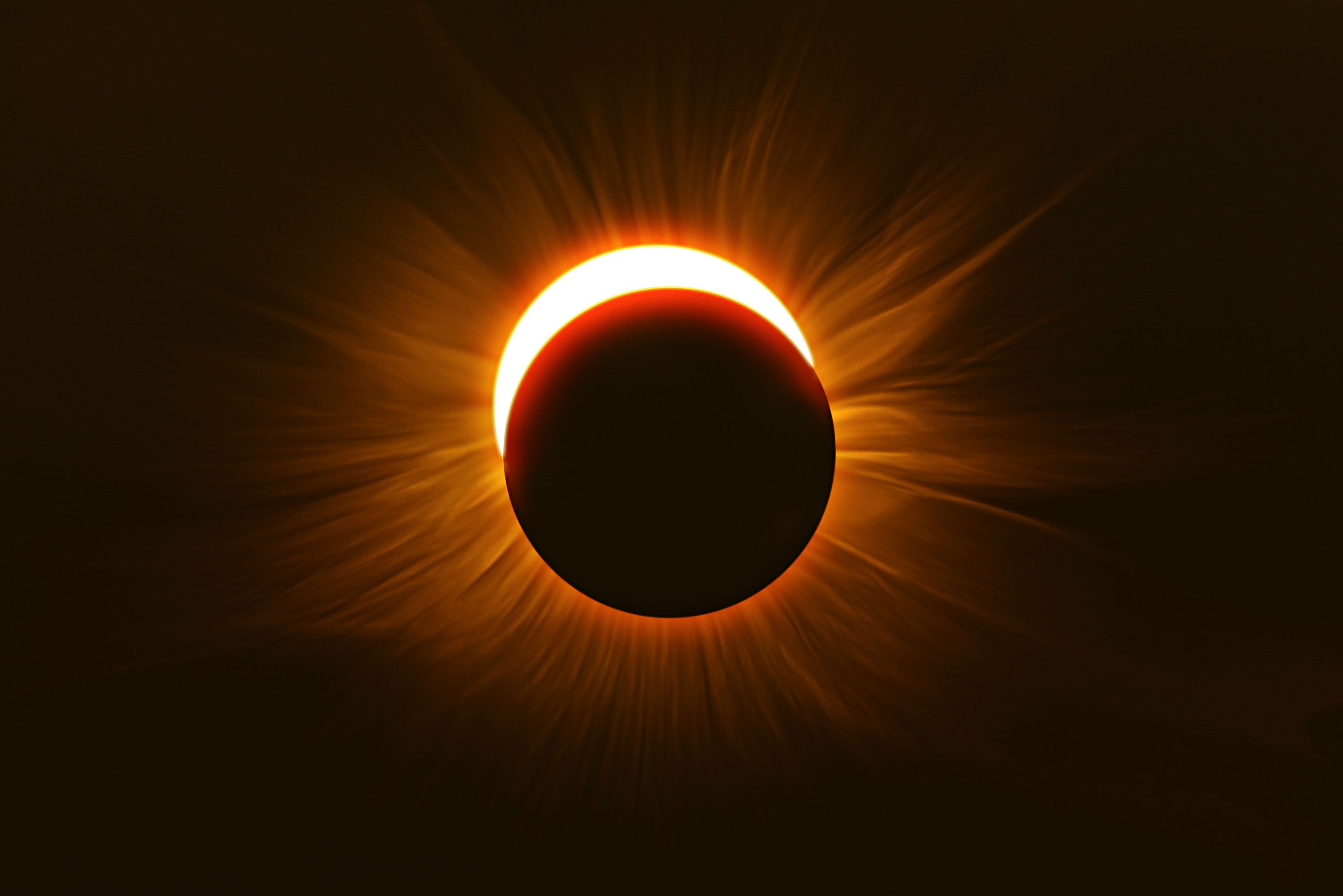
Image of Eclipse

A seemingly everlasting problem historians run in to are exact dates. Since each ancient civilization had their own calendar and their own way of measuring time, it’s a challenge for historians to connect the dots between civilizations and produce an accurate timeline of human history on the Earth. However, historians have discovered the common denominator that could be key to piecing together our Earth’s history, eclipses. There are many ancient texts and records detailing eclipse events and traditions and rituals surrounding it. With our extensive knowledge of how eclipses work, we can work backwards and connect each eclipse event to an exact date. Using these dates, historians can gain more knowledge about humanity’s history.

Posted in Historical, Sun | Tagged , , | Comments Off on Eclipses and History