Celebrating the Vernal Equinox

Spring is a season that is characteristically associated with birth and life. It symbolizes an end to Winter and the transition to the (personally) much more favorable, Summer. While I probably enjoy Summer more than Spring overall, there is something about the feeling I get seeing all the plants grow, the leaves come back, tons of baby animals and warmer temperature. I am far from the only one who holds this sentiment, as most cultures, past or present, have some celebration or recognition for the Vernal Equinox.

In the West

It is not much of a secret that the origins of the celebration of Easter draw heavily from Pagan tradition. The most accepted theory is that, instead of completely erasing Pagan holidays, the Romans just began converting existing traditions to fit Christianity. What we are left with is a holiday that falls around the equinox, give or take, to celebrate the resurrection of Jesus Christ. Which we do with… bunnies and eggs? It actually makes more sense than what is seen at face value. Maybe Christianity just got lucky with the timing, but it is quite the coincidence that the holiday for “rebirth” and “resurrection” came in a time that was already celebrated for fertility and birth (hence bunnies and eggs). Though this connection is still somewhat of a reach, this holiday was reached as a compromise between too holidays beautiful in their own rights. The name “Easter” is even thought to come from the Germanic Pagan Spring goddess “Ēostre”.

Holi in India

Holi, also known as the Festival of Colors, is a celebration that takes place across India as Spring arrives. It is a holiday of rebirth, but not in the literal sense. Holi is characterized by “forgiving and forgetting”, and a repairing of any strained relationships. People from all walks of life celebrate together, smearing colors on each other and spending time with each other. The significance of Holi can not be overstated, as it is and integral part of forgetting past failures and growing.

Shunbun no hi in Japan

Shunbun no hi is less of a religious or historical celebration of the equinox, and more of an amalgamation of the sentiments universally felt at this time period; of growth and new beginnings. Many people will take the more symbolic route, however, and participate in traditions such as visiting their place of birth or spending time with their parents. Watch this video to learn more about this beautiful holiday!

Posted in Class, General, Historical | Tagged , , , | Comments Off on Celebrating the Vernal Equinox

The Cosmic Calendar

How long the universe has existed is often difficult to understand, especially when its duration vastly surpasses our human history. As a whole, we understand through experiences collected in our lives, using these to mark and scale information. However, the measure of the universe is something unfathomable next to our comparatively short lives. Its length and the sections that construct its existence are often very difficult to visualize, making it hard to even understand the history of our solar system and planet. This is seen as civilizations like Greece and Rome are thought of as very ancient history, something that developed an incredibly long time ago, but in reality this gap is no more than an instance in our cosmic history. However, the cosmic calendar aims to rationalize this passing of time and present it in a way that allows us to truly digest the information.

Photo by VISAV

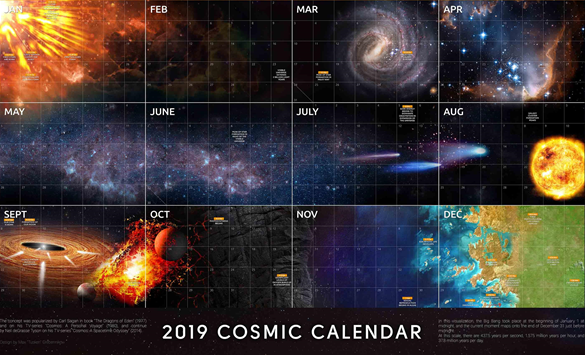
The Cosmic Calendar condenses the 13.7 billion year lifetime of the universe into a single calendar year, with the first of january signifying the beginning of the known universe marked by the big bang, and the final seconds of the year representing the present. The calendar was first developed by Carl Sagan, an american astronomer and host of the show Cosmos, and is used as a scaled historical representation of the universe. 

In this calendar, every month represents a little more than a billion years, every day around 37.5 million years, every hour 1.56 million years, and every second 434 years. The first second of the calendar signifies the Big Bang and the creation of the universe, however it is not until 3 billion years later, March 15th, that the Milky Way Galaxy was created. And another 6 billion years later for our sun form, followed closely by the rest of our solar system. Then September 1st, on the cosmic calendar, life started to appear in the oceans of earth, life that could produce oxygen through photosynthesis. And over time, in the month of December, this would create the atmosphere and give new species a chance at life. For example, the first insects appeared on the December 21st, then the dinosaurs on the 24th, and birds on the 27th. It’s not until the last few minutes on december 31th, the last day of the cosmic calendar, that humans begin their existence. In the entirety of the existence of the universe humans only make up a few minutes.

Posted in Class | Tagged | Comments Off on The Cosmic Calendar

What the heck is a light year?

You’ve probably heard the term light year a lot. You likely heard a planet or star described as a certain number of light years away. But what exactly is a light year? And why do we use light to measure time and distance? How fast does it really go? Light moves at approximately 300,000 kilometers per second. As far as science knows, nothing can travel at the speed of light other than light itself. Because it’s the fastest thing in the world, it’s an easy metric to use to judge how far away things are in space. This is where the concept of a light year comes in. A light year is the distance that light can travel in one (Earth) year. A light year uses a speed (light) and an amount of time (a year) to create a measure of distance (a light year!). However, it’s important to distinguish a year from a light year— they are not the same! Light years are really useful to describe the distance of things in space because of the sheer enormity. For example, our moon is only about one light second away. If you want more information on light years, here’s an article from NASA (where I got my picture from)!

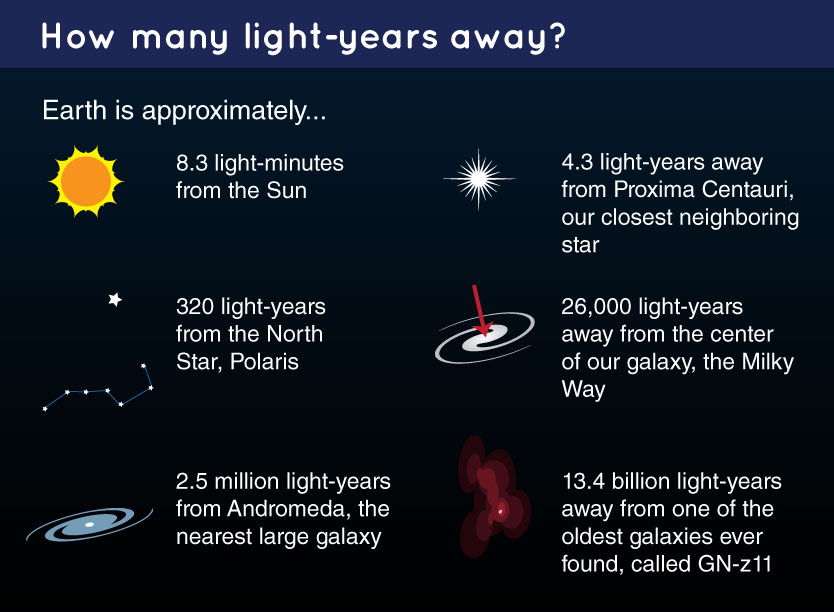
A chart explaining how far away certain objects are from Earth. The Sun is 8.3 light-minutes away. Polaris is 320 light-years away. Andromeda is 2.5 million light years away. Proxima Centauri is 4.3 light-years away. The center of the Milky Way is 26,000 light-years away. GN-z11 is 13.4 billion light-years away.
Source: NASA. Same article on light years linked above.

Posted in Class, Light | Tagged , , , | Comments Off on What the heck is a light year?

Blog Post 1: Universal Scale

Picture taken from this online tool for visualizing universal scale

In the preface to our textbook, A Cosmic Perspective, Dr. Tyson opens up his foreword by emphasizing the importance of having a cosmic perspective. He defines this kind of perspective as one that understands our place in the cosmos and the meaning that has for us as a species. But how do we go about establishing a perspective such as this? Sure we could try to have people read dense research papers about the latest astronomical discoveries, but people tend to learn better with visual aids. To this end, I was able to find a free online visualization tool (linked in the picture caption above) that shows the scale of our universe, from the smallest units of measurement, all the way to everything that’s observable to us. Exploring this tool can help us to understand the vast expanse that we inhabit, and subsequently where our place in it is. Maybe once we realize how much more is out there than just us, we can start realizing how inconsequential some of our issues on Earth are when compared to the vast expanse of space before us. Even though Earth may be an oasis for us, it truly is surrounded by a desert too large to cross at the moment. This alone should be enough incentive for us to strive for peace and prosperity in our oasis, so that we don’t destroy it before we find another.

Posted in Universe | Tagged , , | Comments Off on Blog Post 1: Universal Scale

The Western Zodiac’s Origins

IMAGE SOURCE: Astrology Bay

One of the most interesting aspects of Astronomy for me specifically is the element of spirituality or philosophy it tends to invoke. To witness the majesty and scale of universe evokes such wonder that, if you’ll allow some hyperbole, can at times be akin to a religious experience. I comment this not to say that such a feeling is even necessarily rational, but that it makes sense then that we humans would pay attention to the stars in our ancient days, and note one of the most interesting features of the sky: that our sun travels in a particular pattern through the sky, crossing through the same sets of stars on a consistent schedule, namely, the constellations of the (western) Zodiac. It is of little surprise that these took upon particular significance to our ancient kin, and continue to bear some similar significance to this day. As we undertook our studies this past week and learned about the sun’s relative “travels” through the stars, it made me wonder the precise origins of the Zodiac.

Astrology, or the practice of divination by way of the heavens, has been in practice since at least the beginning of the second millennium BC, and likely for long before. We have archaeological evidence of astrological practice within Mesopotamian society from around 1900 BC. Astrology was likewise developed in other cultures similarly far back, such as with Hindu astrology in the 1400s BC at the latest, and developed independently in China around 900 BC. The Zodiac emerged out of this general practice of Astrology, specifically in the context of Babylon. The Babylonians are the origin of the Zodiac we know today, splitting the groups of stars along the suns path into twelve distinct constellations, each with their own associated meaning, often correlated to one of their gods. This codification occurred around the 500s BC, though the exact time is of course unsure, and they used their system of twelve 30 degree arcs of the sky for time keeping, astronomical, and religious purposes. The Greeks then came along, under the conquering banner of Alexander the Great in the late 300s, and modified the existing Babylonian system to fit with their own religious system, by more or less replacing the names of the constellations. It is from the Greeks that the Zodiac spread throughout the Western world, and gave us the Zodiac we know today.

Posted in Class, Historical, Stars | Tagged , , , , | Comments Off on The Western Zodiac’s Origins

The Cosmic Calendar

Photo via Penda Kujua

It’s difficult to fully comprehend just how long the universe has existed and how little humans have been around in comparison. Our human lifespans are a mere blink an an eye in the context of our universe, often making is difficult to see an accurate view of the formation of our solar system and galaxy. The Cosmic Calendar however offers a look into the formation of our universe in a way that allows us to put it in perspective.

The Cosmic Calendar condenses the entire creation of the universe into a single calendar year, allotting every month with more than 1 billion years. In this scale we can see when events occur in relation to each other, putting the immense age of the universe into an understandable format. On January 1st, the Big Bang occurs, bringing our universe into existence. However, it’s not until around March 15th that our galaxy, the Milky Way begins to form.

Fast forwarding through time at a rapid pace we arrive at September 6th, when living things begin to appear in the oceans of Earth. These creatures take in C02 and release oxygen, setting the stage for Earth’s future atmosphere. Mammals appear around December 16th and dinosaurs not until December 26th. Humans do not make an appearance until the last 30 seconds of the Cosmic Calder, representing around 200,00 years. All of human history from cavemen to the pyramids of Egypt to the current day fit in this small space in time.

The cosmic calendar gives a new understanding to the magnitude of time and the astounding age of our universe while demonstrating how young humans and life in our universe truly is.

Posted in Class | Tagged , , | Comments Off on The Cosmic Calendar

How Small We Really Are

Despite how big we all thing we are, when looking at the true size of our earth compared to the size of the universe we come to realize our insignificance. When the distance of the earth to other planets is put into simple mathematic equations we can truly try to understand how big this universe truly is. One of the biggest accomplishments of the USA was when we sent a man to the moon, and the moon was only 238,855 km away, when compared to the next closest planet(Mars which is 225 million km away) it seems almost like going to further planets would be impossible, as Mars is 968 times further away than the Moon is to earth. When we put this in relation to other planets or even galaxies, we truly understand our insignificance. We think everything going on is on this planet, but with all the other galaxies and unknowns in space, we should be able to appreciate where we are and what we’ve become on this one tiny planet.

Compared Distances

Posted in Class, Universe | Tagged , | Comments Off on How Small We Really Are

Blog1– the vast size of the universe

<a href=“https://www.youtube.com/watch?v=hTuJby2_97E“>Universe Size Comparison Youtube</a>

I am very excited to share this size comparison video of the universe, which I accidentally discovered last year. I watched this video for many times afterwards, and I could not stop myself gasping with astonishment at the vast size and the scale of the celestial bodies in the universe and the universe itself. This video also makes me reflecting about the position of humanity in this world. I consider this video very intuitive and helpful because it contains all kinds of celestial objects including comets, planets, stars, black holes, galaxies and Galaxy clusters. These objects are put into sequence based on their physical size, from the size of a small comet to the size of the largest black hole which is beyond our imaginations. Most importantly, the comparative size of different parts of our solar system, is frequently put back to the sequence to compare with the objects we never heard before.

Posted in Class, Stars, Universe | Tagged , , , | Comments Off on Blog1– the vast size of the universe

introductory post

Hello my name is Justin Oresky, I am from Long Island, New York. I am very bad at technology and am very excited to try out new computer stuff. Given my bad technology I thought I might as well add a link on how to work an I-Phone as my hyperlink :). Below is a photo of me playing tennis!

Bad Backhand

Link for I-Phone

Posted in Class | Tagged , | Comments Off on introductory post

The History of Winter Solstice Celebrations

Saturnalia in Ancient Rome

The winter solstice occurs every year around the 21st of December. In the northern hemisphere, this day marks the longest night of the year. It also signifies the official start of winter. Throughout history, many cultures have developed their own ways of celebrating and honoring the winter solstice.

Saturnalia

Saturnalia is an Ancient Roman holiday that was held in the days leading up to the winter solstice to celebrate Saturn, the god of agriculture. During this time, schools and business would close. People would dress in a special type of clothing known as synthesis and decorate their houses. During gatherings, people enjoyed gambling and giving each other presents. Many of the traditions they had are closely associated with what we now know as Christmas.

Dong Zhi Festival

Quite literally translating to “arrival of winter” in Mandarin, the Dong Zhi Festival (or Winter Solstice Festival) is celebrated by many East Asian countries. One of the most well-known traditions is eating tangyuan, which are small glutinous rice balls that often have fillings such as red bean or black sesame. In various parts of China, people also enjoy eating dumplings, rice cakes, and soup.

Inti Raymi

Inti Raymi is a ceremony that was celebrated in the Incan Empire to honor Inti the sun god. Because the Incan Empire was located in the southern hemisphere, this celebration was actually held around June 21st, the shortest day of the year for countries below the equator. This ceremony lasted for nine days and was filled with lots of music and colorful costumes. Although Inti Raymi was banned in the 1500s by Spanish colonizers, it continues to be celebrated today by many indigenous people.

Posted in Class, Historical | Tagged , , | Comments Off on The History of Winter Solstice Celebrations