Sunsets

Sandbridge sunset, taken by my dad August 20, 2012

Sunsets baffle me. My favorite part about living in Virginia Beach, VA is that I live on the bay and walk in the opposite direction not even half a mile and land on the beach. I’m lucky enough to get incredible photo shots of the sun rising in the East over the ocean and setting in the West over my backyard. I understand that a sunset occurs when the sun goes below greater than 180 degrees azimuth. What I am most interested in is the variations in color and how we can often see great colors and views, even after the Sun has set below the horizon.

How does this relate to axial tilt and why do we see some rays of sunlight longer than others? To me, it would seem as though we would see a distinct pattern, but sunsets appear to be randomly casted and colored in the sky. The sun appears to be a bright yellow color; why is it sometimes dark red when it sets, setting off fiery reds and oranges in the sky (see picture above!), and at other times a deep, mellow orange that shows purples and blues?

I’d love to get some more answers on this, and even though it isn’t so scientific in its composition, I can’t help but wonder what it is that causes such great variation in the appearance of a sunset.


Posted in Class | Tagged , | Comments Off on Sunsets

Precession Is All But Precision

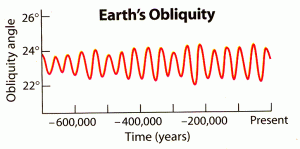
The earth has an axis of tilt of about 23.5 degrees, and precession, a gradual wobble that alters the orientation of Earth’s axis, does not change the amount of axis tilt. This is why our seasonal patterns remain constant. However, over long periods of time this obliquity angle (tilt) does slowly change due to the changing positions of other planets in the solar system. Currently, the tilt is decreasing in magnitude ever since reaching a maximum angle of 24.2 degrees 9,500 years ago. The consequence of this is that the tropics of Cancer and Capricorn are gradually moving closer to the equator. According to Astro.edu, they are actually moving at a rate of 14 meters per year!!

Astro.edu

Astro.edu


Posted in Class | Tagged , , , | Comments Off on Precession Is All But Precision

The Cosmic Calendar

The idea behind the cosmic calendar is to put the timeline of the entire universe into the perspective of one calendar year. Below is a picture of the calendar.

Image

This calendar really puts into reality how short humans have really been around. It takes until 11:54 on December 31 for modern humans to appear on the planet, and it isn’t until 11:58 that humans migrate out of Africa. Permanent settlements and agriculture don’t appear until there are approximately 23 seconds left til midnight, Jesus isn’t born until around 5 seconds left and Columbus doesn’t “discover” America until there is one second left in the last day. This gives the perspective of how, on a cosmic scale, how truly unimportant and small humans are. It makes me wonder how much longer humans have on the top of the food chain before something else supplants us.

The photo credit


Posted in Universe | Tagged , | Comments Off on The Cosmic Calendar

The Universe is More Observable Than What Meets The Eye

Picture Source

Picture Source

In class we talked about how the observable universe is 13.7 billion light years. The reason for this is because the universe is 13.7 billion years old so we therefore cannot see anything beyond 13.7 billion light years because there would be nothing to see; the universe did not exist. But one must also remember that the universe is expanding and has been expanding for 13.7 billion years. So objects that we see now were once a lot closer to us but are now are much further away than 13.7 billion light years. By virtue of this fact we know the that the observable universe today actually expands to 93 billion light years from edge to edge, with earth being at the center.

Source:

Source Article


Posted in Class, Observables, Universe | Tagged , , | Comments Off on The Universe is More Observable Than What Meets The Eye

The 13th Sign of the Zodiac

The zodiac system was first developed roughly 2,500 years ago in ancient Babylonia. Unfortunately, the astronomers who first developed the system did not know about the precession of the Earth’s axial tilt. Even after this precession was known, Western astrologers … Continue reading
Posted in General, Observables | Tagged , , | Comments Off on The 13th Sign of the Zodiac

The speed of light in everyday terms

Justifying the use of \”light years\”

https://www.youtube.com/watch?v=Wp20Sc8qPeo

The idea of light years is pretty mind blowing.  Click on the above picture to watch a cool video explaining how we measure distance with time in everyday life.  The difference between saying I live 10 hours from Nashville and the nearest star is 4 light years away, has to do with the fact space is almost a perfect vacuum.  In those 10 hours, I will have to stop for gas, probably slow down due to road work, and maybe speed a little.  Even if I were to drive at exactly the speed limit the whole way, without stopping, I would not be going at a constant speed.  If my car was a packet of different waves of light, instead of suitcases, these would be refracted as it moved through different “materials” (areas with different speed limits).  In space, however, there are so few molecules that they very rarely interact with light waves.  This means that it is so close to a vacuum, light does travel at c.  The consistency of this speed is why it is so helpful to measure the incredible distances in the universe.


Posted in Class | Tagged , , | Comments Off on The speed of light in everyday terms

Twinkle Twinkle Little Planet

Sounds wrong because the extra syllable blemishes the aesthetic quality of the symmetry of the rest of the poem.

trollface

Planets do twinkle, in fact. Its just that we do not notice. And it is the hallmark of a truly good (and bored) scientist to correct a misconception, even if it is only superhuman vision that can salvage the fallacy.

The atmosphere is a sea of air. Air is a fluid. Which means it is not vacuum. Therefore it has a refractive index. The density of air changes with altitude, so the refractive index also changes. Any light that enters the atmosphere (except from the normal vector, obviously) is bent.

Stars are very far away. They are so far away that they appear as point sources of light. So if we were to draw a ray diagram for a star, we would only need a single line to denote star light. It so happens that due to the constant ‘flow’ of the atmosphere, some times that star light is refracted so that it momentarily does not reach our eyes. That is called twinkling.

Simulation

Simulation

Planets are not that far away. Since they are nearer they can be resolved as light sources with a dimension. So a ray diagram for a planet will have multiple lines denoting light coming from different points on the planet. That light is also bent the same way as star light. And individual rays also sometimes bend enough so that they do not reach our eyes. But there are enough rays that do reach our eyes that we do not notice the slight change in the planet’s brightness. Hence we do not notice the planet twinkling.

Image Source


Posted in Class | Tagged , , , , , , | Comments Off on Twinkle Twinkle Little Planet

Once in a Blue Moon?

While studying lunar phases for tomorrow’s test, I wondered what the common phrase “Blue Moon” meant.  According to Wikipedia, Blue Moon is a term used to describe the second full moon in one month.  A two-full-moon month occurs approximately once every 3 years, and the it can only occur is because most months (with the exception of February) are longer than the moon’s cycle of 29.5 days.  Because this is a somewhat rare event, “Once in a Blue Moon” is a coloquial phrase used to describe something that occurs rarely.

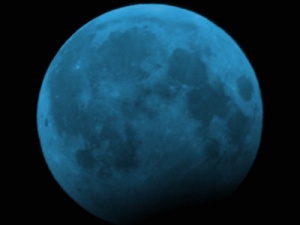
During a Blue Moon, the full-moon is not actually the color blue.  Instead, it usually appears as a full-moon normally would.  However, volcanic particles and smoke from large fires in the atmosphere can make the moon appear blue, but this has nothing to do with the common coloquial phrase (See Photo).

blue-moon

The Moon can appear blue when certain particles are released into the atmosphere.


Posted in Moons | Tagged , , | Comments Off on Once in a Blue Moon?

Switching to Light Speed

What is the fastest thing that Humans have ever built?  According to Aerospace Web, the fastest man-made object were the Helios probes built and launched into space to study the Sun.  These orbited the Sun in elliptical fashion, allowing them to zoom around the Sun at very high speeds.  These are said to have reached a top speed of 150,000 miles per hour.

Light travels at a constant speed of 186,292 miles per second, meaning light travels more distance in one second than the Helios probes traveled in one hour.  This really humbles the capacity of human achievement in interstellar travel, and also puts the speed of light into perspective.  Light is over 3600 times faster than man’s fastest invention yet, and it still takes billions of years to cross the observable universe.

Helios Probe:

Image


Posted in Light | Tagged , , | Comments Off on Switching to Light Speed

Total Solar Eclipses: Cool Now, Terrifying Then

The term umbraphile is not a common term found in most peoples’ lexicons, and even those who parse in Greek may be confused by the translation of “shadow-lover.” However, despite their rarity, umbraphiles do exist, and the shadow which they love is the one the moon casts on the Earth during a total solar eclipse. These people often travel hundred of miles at great expense to view total solar eclipses. Now this may not seem weird to us: solar eclipses are amazing to behold and, really, who cares what rich people do with their free time? However, this hobby would not fare well with many of our ancient predecessors because, to them, solar eclipses were fearful omens from god. Consider this: you’re a 6th century B.C. soldier from modern day Turkey, a man with little use for Astronomy and a lot of use for a big spear. In the middle of a battle, the sun goes dark, the stars become visible, and all that is left of the blazing fireball that grows the crops that feed your children is an eerie ring in the sky. What do you do? You drop your weapons and pray to your deity of choice for forgiveness for fighting an divinely unsanctioned war and hope the light comes back! This actual event was recorded by the Greek historian Herodotus, who writes of a war between the Lydians and the Medians being quenched by a total solar eclipse. In a world where something as small as a bird could be construed as an omen, total solar eclipses were a huge deal. Granted these fears eventually were assuaged by Astronomers who could predict these occurrences, but imagine further back to the time of the simple neanderthal. I’m willing to bet more than one of our archaic friends soiled their loincloth at the sight of a solar eclipse in totality!


Posted in Historical | Tagged , , | Comments Off on Total Solar Eclipses: Cool Now, Terrifying Then