The whole asteroid thing!

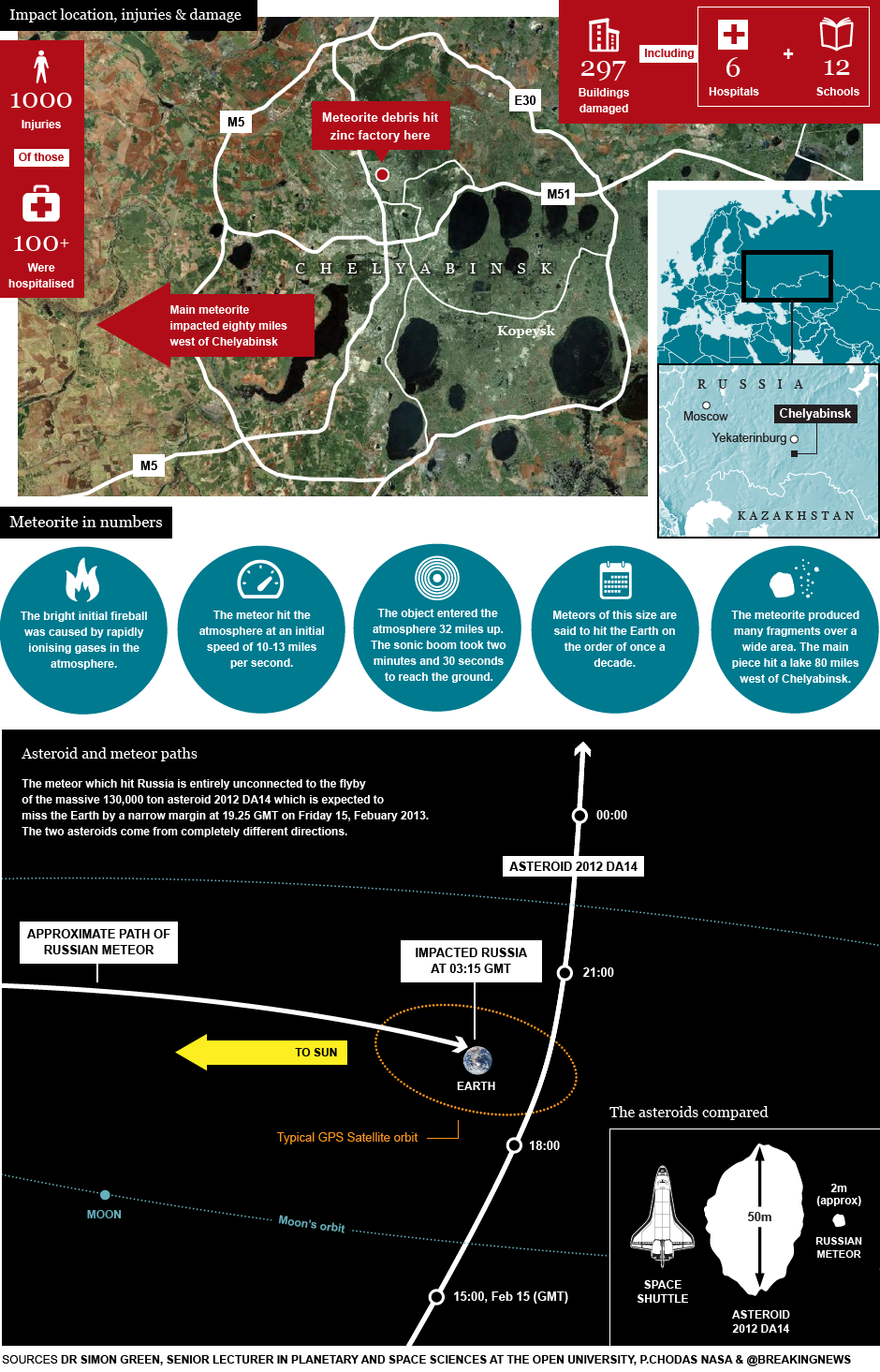
There have been some pretty amazing things going on with asteroids the past couple of days, namely the passing of Asteroid 2012 DA14 and the Russian Meteor Event.   But they were completely unrelated!  Here is an excellent infographic for you (click to make bigger):

Infographic from The Telegraph (UK)

Infographic from The Telegraph (UK)
– click to make bigger

We weren’t going to be seeing that little 50-foot asteroid coming at us from Sun-ward…  The Sun is the most powerful gravitational slingshot in the Solar System but if we know the trajectories of ALL little rocks in the Solar System, then we could know a bit more.  But it will take a LOT of observing time to see them…  These little ones (like the Russian one) are VERY difficult to see, I just don’t see us catching them all but we can sure try :)  I think we just need a big force field ;)

Here are some of my favorite posts about the Russian event:


Posted in Observables, Small SS Objects | Tagged , , , | Comments Off on The whole asteroid thing!

Gamma Ray Bursts – the Big Bang’s nephews

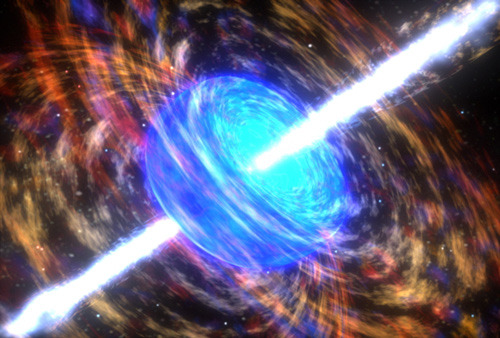
Gamma rays are light waves with the highest energy and frequency as compared to all other types of light waves. Although they come from different types of astronomical objects, the most mysterious are the ones that come from gamma-ray bursts. A gamma-ray burst or GRB is “an intense flash of gamma rays, lasting anywhere from a fraction of a second up to a few minutes“. For a long time, it was believed that the source of these GRBs must be from within the Milky Way galaxy simply because astronomers thought it was impossible for these phenomenon to occur too far away; these explosions outshine everything else including the stars closest to us. Now it is known that some of these gamma-ray bursts even come from the most distant galaxies we know. This just shows the absolutely ridiculous amounts of energy that such explosions must release!

A GRB is believed to be caused when an extremely massive star can no longer support itself and collapses on itself, forming a black hole. Before all of the matter falls into the black hole, some of the energy is focused into extremely powerful and focused beams of light that shoot out of the two opposite ends of the star forming a gamma-ray burst. Although not confirmed, there are theories that such events can also occur if two neutron stars collide into each other.

Whatever the cause, gamma-ray bursts contain enough energy to completely convert a 1000 Earths into pure energy (E = mc*c) in a matter of seconds! GRBs might even have been a cause of the Cambrian extinction that took place a long time ago and wiped out nearly all life on Earth. As interesting and spectacular as they are, I think the Earth would do just fine without having a close encounter with one of these anytime soon.


Posted in Universe | Tagged , , , , | Comments Off on Gamma Ray Bursts – the Big Bang’s nephews

Blog #B4 X-Ray Vision?


Afshin_Darian_-_NASA_Infrared_Telescope_Facility


Above is a photo of the NASA Infrared Telescope Facility (NASA IRTF) located in Mauna Kea Observatory in Hawai’i.    The size of the telescope is 3 meters which is a very large viewing field for astronomers to look into our universe and identify distant galaxies and stars.  Interestingly, this telescope is used specifically for infrared astronomy, which means the telescope identifies and studies objects that are visible in infrared radiation.  This telescope is perfect especially with locating objects in space because is not affected by the Earth’s atmosphere and thus the images are not blurry due to the telescope’s high resolution.  This telescope is located on one of the highest altitudes compared to where the other two infrared telescopes are located and saw it’s first light in 1979.  There was a great debate over where the location of this telescope would be located and ultimately researchers chose Hawai’i.  I wonder if they chose this due to it’s location of the Earth and to have different points throughout the world (other telescopes are located in the Swiss Alps, Canada, England, and Chile). Because of Hawai’i’s clear skies, this might have also played a factor into placing the telescope there.  With the advancement of technology and higher resolutions, I wonder if this would change the frequency of the power of future developments in telescopes and provide clearer and more distant photos of galaxies or if we could use different waves and lights to see images and if that would be possible to do so.


Posted in Observables | Tagged , , | Comments Off on Blog #B4 X-Ray Vision?

The Art of Spectroscopy

Image

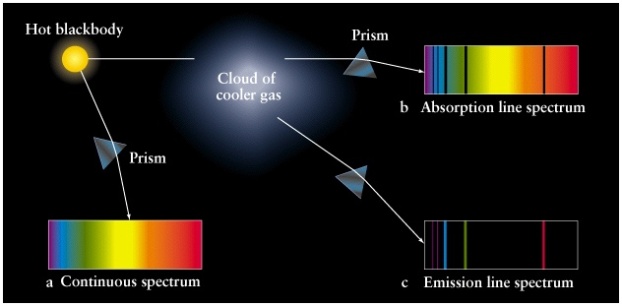
To talk about spectroscopy, we first need to talk about its origins.  Spectroscopy was first discovered in the late 17th century by the late and great Sir Isaac Newton.  Although only the bare bones, Newton founded the idea that refracting light into a prism could create an array of colors- a spectrum.  Spectroscopy’s next big step came from Gustav Kirchoff, who came up with the “Kirchoff Laws”.  Kirchoff discovered the three different spectra that light could produce- a continuous spectrum, an emission spectrum, and an absorption spectrum.  The picture above gives a great diagram distinguishing between the three spectra.  One may wonder, why is it important to distinguish between these 3 different spectra of light?  Well, by analyzing the different spectra of light, we can determine an object’s chemical composition and its velocity.  These pieces of information are vital in determining the origination of the object and what the future holds for this object.  Overall, spectroscopy is a really interesting and important segment of astronomy and will continue to develop with more technological innovation!

Helpful Resources: Newton, Spectroscopy, The Three Spectra 


Posted in Historical, Light | Tagged , , | Comments Off on The Art of Spectroscopy

Blog #B3 Emitting and Absorbing Light

I’m not going to lie, understanding how atoms absorb and emit light is one of the most confusing things to me.   There is just so much involved with the process that its easy for me to get confused on how electrons change energy levels, which direction do they change, what a photon does, etc.  However, after watching this video, I feel more confident in my ability to describe how light works on an atomical level.   The narrator illustrates how electrons move within the atom and what is the result of that (i.e. how much energy is emitted, what happens to the photon).  One of the most helpful sections for me was when he described what frequencies occur and how that ultimately affects what type of light we see.  When the frequency is really high, we won’t be able to see visible light.  Another key was that different atoms emit light at different frequencies so thus it is harder for some objects to emit light as opposed to others.  Even though that seemed like a basic fact, I’m glad for the clarification by this video.  For visual learners, I strongly recommend this video before our upcoming test as he explains it clearly and effectively and avoids confusion by his diagrams.  I am left with a few questions about the size of the shells and how much energy is required to move the electron between each energy level.  Another question is how does the electron move back to it’s original state and will this affect the light?  Will it be damaged in any way or will the electrons be able to “cool down” and avoid alterations to the orinal state?


Posted in Light | Tagged , , | Comments Off on Blog #B3 Emitting and Absorbing Light

Artificial Gravity

p0140xss

Artist’s rendering of a typical design for a space station that produces artificial gravity, by the BBC.

Given the importance of gravity to life here on Earth, it’s interesting to think about the lack of gravity used in space exploration.

Of course there’s gravity in space, but not anywhere near the amount of gravitational force we feel on Earth. So why doesn’t NASA design its space shuttles and space stations to create artificial gravity for the astronauts? After all, we don’t exactly see Han Solo or Captain Kirk floating around their respective ships, eating globs of grape juice and somersaulting in mid-air. And if being in space causes a slew of problems for the astronauts living there – including weak and brittle bones, kidney stones, atrophied muscles – why not just design the ISS to provide artificial gravity and prevent these conditions in the first place?

Actually, in the beginning of space exploration, people assumed our spaceships would have artificial gravity.  These early designs almost all have giant spinning wheels, which generate centripetal force as they spin and thus simulate gravity on Earth. So, why did the plans change? There are two main reasons our astronauts float around the ISS instead of walking through its hallways.

The first reason makes a lot of sense.  A lot of the tests NASA scientists do involves performing experiments in reduced gravity, also referred to as microgravity. If we wanted to test how plants grow under normal gravitational conditions, we could do that just as well on Earth.  We need an environment where we can see how things function in microgravity, hence our need for a space station where astronauts are experiencing microgravity.

The second reason? Money. Since every space station designed so far has not included artificial gravity, it would be expensive to develop and test a design for a new space station which provides artificial gravity, let alone build it. With NASA’s budget and the state of the economy, there is not likely to be the money for playing around with giant spinning wheels on spaceships anytime soon.

It’s a bummer, really, because some of these designs look really cool. I suppose it would be strange to watch a video of astronauts who were eating normal food or walking around on a space station after years of tuning in to watch floating crew members show you how they use the bathroom or wash their hands in microgravity.  But think of all the possibilities if we did create a way for artificial gravity to be produced in space.  The article mentions space hotels, but I think artificial gravity is a real prerequisite if we ever want to have a large number of people living in space, whether that’s on missions to Jupiter or a full-time colony on a space station in orbit around the Earth.


Posted in Physics, Space Travel | Tagged , , , , | Comments Off on Artificial Gravity

Bullet Dropped vs. Bullet Fired

In this blog, I explore the phenomenon of gravity and how it is constant throughout our world. In my senior year of high school, I took a physics class that taught me a resounding lesson about gravity, and how anything thrown or fired at a constant level will take the same amount of time to hit the ground as if you had just dropped that same item at the same height. At first, I didn’t believe it. How could something like a bullet, going more than 700mph can obey this law of gravity. In the video above, it shows the renowned crew of MythBusters trying to test out if this physics fable is true or not. It is a series of five little clips, you can view them all on youtube, but this one specifically is the last clip, that finally proves that a bullet dropped vs a bullet fired does indeed hit the ground at the same time.

If you try to put in values in Newton’s law of gravitation, it becomes even clearer than this happens. Obviously, you put in the constant G, M as the mass of Earth, and the little m as the mass of the same bullet (must be the same). The only other variable that is in the equation is the distance between the level that you are dropping/shooting the bullet and the center of Earth, which would also be the same. Thus, since all values are the same, whether you are shooting or dropping the bullet, it equals the same gravitational force and would take the same amount of time to hit the floor from a specified and constant height. Obviously, if you had fired the bullet at any different degree other than straight would alter the calculations and would require other physics equations, but if the height the bullet is constant the and the bullet is shot at a level degree, then one can see the unfailing forces of gravity at work.

Understanding this makes me realize just how hard of a job a sniper and his spotter must be. When trying to hit targets that are over a mile away, with bullets going way over 1000 mph, taking into consideration wind, humidity, distance, movement, and basically all the constant and unfailing forces of physics our world exhibits, it seems almost impossible that these people could hit anything with accuracy. Additionally, the job of the sniper is to get in and get out, without revealing their position, so every single shot is crucial and carries tremendous weight. I just read an article about how the deadliest sniper in US history, Chris Kyle(shown in the above picture), who had saved many US troop lives, was murdered this past month. It is unfortunate Kyle had to pass away like this, but we all thank him for time and service for this country. I bring this up to shed light upon realization of how powerful and sharp his mental skills must have been, to have been such a successful soldier and sniper, by taking into consideration all the of the physics and calculations that goes into one shot.


Posted in Physics | Tagged , , , , , | Comments Off on Bullet Dropped vs. Bullet Fired

Gravitational Lensing

Isaac Newton may be well known for his Law of Universal Gravitation, but the law has a fundamental flaw—it states that only things with mass can be affected by gravity.  Photons, the quanta of light, have no mass, but we know that they are affected by gravity.  One of the ways we can see how photons (or just light) are affected by gravity is called gravitational lensing.

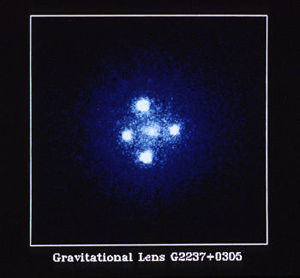
Gravitational lensing occurs when light from a distant object is bent around a closer object.  If you image space as a stretched out flat sheet and objects creating gravity wells that distort the sheet, it becomes easier to imagine how this lensing occurs.  The warped space causes light to travel in paths that appear curved, but are really lines travelling through curved space.  Because of this, we can sometimes see multiple images of objects if their light travels through warped space, such as in the very cool Einstein’s Cross.

Newton’s Law of Gravity is incorrect because light, which has no mass, is affected by gravity.  So, what does gravity depend on?  The answer is two-fold: energy and momentum, both of which light has.

Gravitational lensing does more than show us light is affected by gravity and give us pretty pictures.  We can use gravitational lensing to infer the existence of dark matter.  Dark matter is matter that does not emit any light, and thus is “dark”.  However, there exists matter that is not dark matter but is still invisible to humans because it emits electromagnetic waves in the non-visible range.  Even if we could see every wavelength of light, we could still not directly observe dark matter.  However, we can observe the effects of dark matter.  Like regular matter, dark matter has mass, so it also warps space-time.  This warping can cause gravitational lensing to occur around an apparently nonexistent object.  By observing the lensing, we can infer where dark matter is.


Posted in Light, Physics | Tagged , , , , | Comments Off on Gravitational Lensing

Historical Astronomers in Context

Johannes Kepler (December 27, 1571- November 15, 1630)

Johannes Kepler was initially hired as Tycho Brahe’s apprenctice.  When Tycho died, Kepler was left to make sense of his observations; after years of analyzing them and trying to make sense of them in terms of circular orbits, he finally realized that planetary orbits are ellipses, not circles.  He then developed his three laws of planetary motion and created a model that proved far more accurate than Ptolemy’s geocentric model.  Because this model was accurate, unlike the one created earlier by Copernicus, it paved the way for Galileo to solidify the idea of a heliocentric universe, and much of Newton’s worked stemmed from the three laws of planetary motion.

Kepler lived during a very important time in global history.  One major event that occurred during Kepler’s life was the establishment of England’s first colony in America: Jamestown, Virginia (1607).  This led to the height of England’s colonial era, and the Revolutionary War

Another major event was the start of the Thirty Years’ War (1618), a series of wars fought amongst many European nations.  The true causes of the war are contested, but it was some combination of discontent stemming from religious, economic, and political problems spreading throughout Europe at the time.  The war was very destructive and capital intensive, which put a strain on Europe as a whole given the number of those involved.

Francis Bacon (January 22, 1561-April 9, 1626):

Francis Bacon was another important figure living during this time; the ideology of his work coincides with the increasing support for the heliocentric model of the universe.  Bacon’s most significant work was as a scientific philosopher; he disagreed with Aristotelian thinking, and sought to create a new method of scientific thinking and inquiry that focused on empiricism rather than superstition.  His work laid the foundation for the modern scientific method, and cast much greater public doubt toward Aristotle’s methods.

Looking at events and historical figures of this time period gave context to the Kepler’s life, as well as the lives of the other astronomers of this time.  It is interesting to think that as these astronomers were making such drastic advancements in Europe, colonial life in America was just beginning in its most basic form.  I was also intrigued by the coincidental gap between the work of Galileo and Isaac Newton, who made the next significant contribution to this field, occurred exactly during the Thirty Years’ War; this suggests the possibility that the chaotic state caused by the war may have impeded secondary concerns like scientific research for a period of time.  Finally, I saw a parallel between Francis Bacon’s scientific philosophy and the work of astronomers during this era.  Astronomers were rejecting the work of Aristotle and Ptolemy on the basis that it did not agree with empirical evidence they found, while Bacon was concurrently disagreeing with Aristotelian thinking as a whole on the basis that it relied on superstition rather than empiricism.


Posted in Historical | Tagged , , | Comments Off on Historical Astronomers in Context

Historical Astronomers in Context

Galileo Galilei

Galileo Galilei is important to astronomy for several reasons.  Although he often receives credit for inventing the telescope, he did not actually do that.  He did, however, greatly improve upon them, to such an extent that they could be used to peer far into space.  His other great contributions were being the first to see craters on the Moon, discovering sunspots, tracking the phases of Venus, seeing the rings of Saturn (as well as the planet itself), viewing the four largest moons of Jupiter (now called the Galilean moons) and maybe even discovering Neptune 200 years before it was officially recorded.  In addition to all that, he was also the first great advocate of the Copernican view of the solar system.

Concurrent Historical Events

Eighteen years after his birth, Galileo would have experienced the 1582 institution of the Gregorian calendar by Pope Gregory the XIII.  This calendar is the one still used in the West today, and accepted in most other parts of the world.  Another historical event that Galileo lived through, especially important for Americans, was the 1607 founding of Jamestown in Virginia.  Jamestown was the first permanent English colony in the New World and would be the capital of the Colony of Virginia for 83 years, from 1616 until 1699.  He also would have lived through most of the Thirty Years War, one of the bloodiest religious wars in world history.  It was fought between Catholics and Protestants on mainland Europe and lasted from 1618 to 1648.

Concurrent Historical Figures

During Galileo’s time, William Shakespeare (26 Apr. 1564 [baptised] – 23 Apr. 1616) would have been writing and acting in plays.  Shakespeare is, of course, one of the most influential English writers of all time, having written around 40 plays throughout his career and also having invented around 1700 of our now common English words.  Another great historical figure who lived at the same time as Galileo was Cardinal Richelieu (9 Sept. 15854 Dec. 1642).  While a cardinal, he was also a duke and a Minister in France.  He oversaw many of the day-to-day aspects of governing France and was responsible for helping King Louis XIII consolidate monarchic power, thereby turning France into a strong, centralized state.  Finally, Galileo would have been alive for Sir Francis Drake’s (1540 – 28 Jan. 1596) second circumnavigation of the globe (after Ferdinand Magellan), from 1577 to 1580.  Besides being the first Englishman to travel all the way around the world, he was also something of a pirate, attacking Spanish ships on their way home from the New World, laden with gold and other treasures.

Reflection

After finishing this assignment, I was really impressed by the sheer amount of history there is.  Even the 16th and 17th centuries themselves are jam-packed with world events.  When I think of history, I tend to think of one event at a time, but that really isn’t an accurate way of thinking of it.  So many things are happening at the same time all around the world, it boggles the mind.  Researching all of the important figures who were around at the same time as Galileo also made me wonder how much he would have known of the events going on outside of Italy.  There was no internet or even reliable post service at the time, so I would like to know how important information about the world was disseminated, especially from nation to nation.  One last observation I have is that even though there was so much going on all around, the things that stand out most are the actions individuals took that they are still remembered for today.  Galileo played a relatively small role in relation to other events happening around him, but his discoveries resound through the ages down to the present day.  Even comparatively small actors can eventually have a large impact.


Posted in Historical | Tagged , , | Comments Off on Historical Astronomers in Context