A very ‘pINTERESTING’ blog post

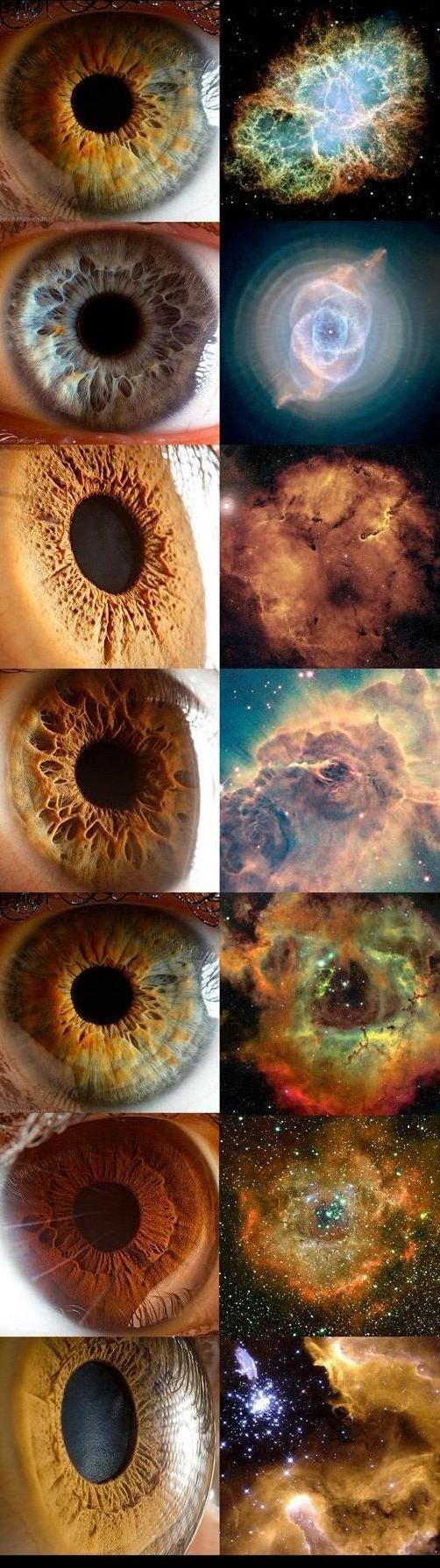
After reading about all the various forms of social media, apps, etc that involve astronomy, I wanted to write about another really awesome incorporation of astronomy into our online resources.. Pintrest! I use Pintrest to gather, sort and categorize a wide variety of ideas, including DIY crafts, style, recipes  home decor, fitness tips, etc. For anyone who doesn’t use Pintrest, you can ‘pin’ a link, a picture, etc from any website, then organize your ‘pins’ into different ‘boards’. You can follow different peoples boards to see what they are pinning.  I came across this really cool Carl Sagan memorial board and found this picture that I ABSOLUTELY love! It is completely tied to the idea that we are made of star stuff, as discussed in the forward to our textbook. I think this image does a really good idea of reenforcing this idea and can help give us an even greater appreciation for the solar system. The resemblance between our eyes and nebulas is uncanny!
Image

After I found this board, I began searching for other solar system related boards and came across SO MANY really cool ones. The last one I will share on this blog post is called Solar System Teaching Ideas and this is my favorite pin from this board. Maybe next year Dr. G can teach moon phases like this!

05-recipes-ramadan-kids-ore-moon-phases


Posted in Class | Tagged , , , , , , , | Comments Off on A very ‘pINTERESTING’ blog post

The Mystery of Saturn’s Moonlets

Natural color view of Saturn, composed from a ...

Natural color view of Saturn, composed from a series of pictures taken by the Cassini spacecraft. (Photo credit: Wikipedia)

Research done by Loughborough University physicists has recently led to new a understanding  of the formation of moonlets (small natural satellites) in Saturn’s F Ring. Previously, it was believed that strong tidal forces from Saturn and its other rings and moons would keep the moonlets from clumping. They’ve now discovered the moon Prometheus has a direct effect on F Ring moonlet formation, creating structures called streamer-channels.  The reason this research is so important is because the F Ring is very similar to a protoplanetary disc around a newly forming star, which could help us better understand the formation of our own solar system.

The original article can be found here.

The 400-meter moonlet "Earhart" in S...

The 400-meter moonlet “Earhart” in Saturn’s A Ring, just outside the Encke Gap. (Photo credit: Wikipedia)


Posted in Physics | Tagged , , , , , | Comments Off on The Mystery of Saturn’s Moonlets

The Doppler Effect

The Doppler effect is pretty amazing, in part because it both contradicts what one would naturally think and yet still makes perfect sense when you take the time to think about how we visualize the world. I say this because if you had never heard of the Doppler effect before, you would probably call me crazy if I told you that the speed at which you travel towards an object affects the color of the object you see. However, when you take the time to think about the way that we perceive light it makes perfect sense: we see light come in with different wavelengths, and our eyes and brain then translate those wavelengths into the colors that we see. When we move towards or away from an object, it creates the effect of these wavelengths compressing and expanding, respectively. Thus, when we see an object moving towards us, since the wavelengths are getting shorter, this makes us “see” a color with a compressed wavelength, which is a higher energy color, and therefore shifts towards the blue end of the color spectrum. This effect is called a blueshift. When an object moves away from us and we see an expanded version of the wavelength, this is called a redshift, as the object moves to the lower energy end of the color spectrum, moving it towards red.

220px-Redshift_blueshift.svg

Above is a diagram showing the basic difference between a red and blueshift. The formula to determine the new frequency of light is fnew = (c+velocity of receiver)/(c+velocity of emitter)*foriginal. This, however, changes as we move into special relativity. The formula is now fnew = sqrt((1+velocity of object/c)/(1-velocity of object/c))*foriginial. This is due to the theory of special relativity determined by Einstein, which is based around the thought that nothing can surpass the speed of light (c) in any given reference frame. This formula, however, only really matters when the velocity is close to the speed of light. The Doppler effect is pretty interesting when we take the time to think about it.

Picture source


Posted in Physics | Tagged , , | Comments Off on The Doppler Effect

Space Food

Eating in a zero gravity environment can be quite tricky. Before astronauts had refrigerators and freezers in space, the preservation of food limited the size of the menu. Only nonperishables could be brought into space. The first astronauts ate freeze dried powders and bite-sized cubes of food; they also ate semiliquid substances (similar to jello) from tubes. None of this food sounds very appetizing and likely was not very palatable because this food had to contain all of the astronauts’ nutrition.

Freeze dried foods became easier to prepare with better rehydration methods, and more conventional foods were added to the menu, such as shrimp cocktail. Cubed foods were coated with gelatin to help keep them together.

Modern space dining is vastly improved. For example, after years of development and millions of dollars, developers have created Korean kimchi for astronauts to eat in space. Even with improved preservation techniques and an expanded menu, some original challenges still remain. Any food that leaves crumbs is problematic. Imagine eating a bag of Doritos in zero gravity: an individual chip is too large for you to fit in your mouth in a single bite, but biting in in half leaves tiny Doritos particles everywhere. These tiny bits of chips that you usually just brush off your shirt when you stand up will now float around and most likely interfere with some expensive and important equipment.

Let’s say you still want that Doritos taste in your mouth. You order the Doritos Locos tacos from Taco Bell, and they send it up to you in space. If you’ve ever tried eating one on Earth, you know that it gets quite messy. In space, that mess is now floating around your head as you are munching on an overrated, over-advertised taco.

You’re disappointed about not having the taco, but at least you still have the soft drink right? If you drink carbonated beverages, you’ll end up “wet burping.” Turns out, gravity actually separates the gas and liquid in your stomach, and without it, you’ll burp both out. Disgusting.

Hope is not lost though. If space food isn’t to your liking, you can always sneak your own food on board.


Posted in General | Tagged , , | Comments Off on Space Food

Types of Light

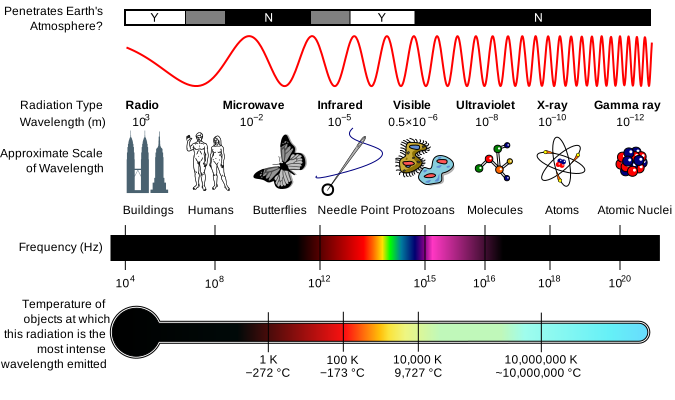
The electromagnetic spectrum consists of radio waves, microwaves, infrared waves, visible light waves, ultraviolet waves, X-rays, and gamma rays. Of these seven types, humans can only sense visible light waves, which have a wavelength ranging from 380nm to 760nm. Considering that the whole electromagnetic spectrum has wavelengths ranging from hundreds of thousands kilometers long (radio waves) to less than a hundredth of a nanometer (gamma rays). In other words, the electromagnetic spectrum contains wavelengths spanning 20 orders of magnitude and humans (without technological aid) can only detect less than half of one order of magnitude.

Of our five senses, only one deals with electromagnetic radiation. Our eyes allow us to see wavelengths in what we call the visible spectrum. The cone cells in our eyes allow us to detect the differing wavelengths of visible light and we perceive these differences as different colors. We have three types of cones in our eyes: one for short wavelengths, one for medium, and one for long. The combination of varying levels of activities of the three types of cones allows us to see the whole color spectrum.

Here’s an interesting thought: you cannot imagine a color that you haven’t seen. How would you explain the concept of color to someone who is blind? How would you describe the color red?

So what if humans could detect other types of electromagnetic radiation? What exactly would we see? The disappointing answer is that we don’t know. We could sense sources of electromagnetic radiation. If you walked outside, you would sense ultraviolet radiation from the Sun and radio waves from broadcasting towers and your phone. You would sense microwaves from your microwave oven while preparing lunch. We might see more “colors” depending on the wavelength of the electromagnetic waves that we see.

Thermal imaging cameras that use infrared radiation to sense the environment assign colors to various wavelengths of infrared. The X-rays that are emitted from space have varying wavelengths as well, and astronomers use false color to differentiate the wavelengths. In reality, the other types of electromagnetic radiation do not actually have color, we just assign wavelengths from the visible spectrum to illustrate the difference in wavelengths of other types of waves. Trying to visualize other types of radiation is like thinking of a color that is not on the visible spectrum: you just can’t do it.


Posted in Light, Physics | Tagged , , , , , | Comments Off on Types of Light

Setting Sail

Humans seem to have always been fascinated with what lies beyond our immediate world–our Earth. We have created stories about the stars above, how they came to be, what they are made of, and who they are. Throughout time, conversations of traveling to these stars entered the realm of conversation. I guess I have gotten a little wrapped up in this conversation, because I too would love to see the possibility of far out space travel become a real possibility.

So naturally, I turned to google. I knew that space travel (barring some amazing ability to defy the laws of physics) would require a tremendous amount of rocket fuel, an intense slingshot maneuver, or some other type of strategic motion. The latter is what I was principally interested in. Solar Sails… that seemed interesting.

Back in the 70s, NASA had proposed a mission to send a probe to Halley’s comet. What was to be unique about this mission however is that it would be propelled only by the pressure of sunlight hitting a giant solar sail. Unfortunately, the funding for the mission never came through because there was a tremendous amount of doubt about the ability for this method to work–and it seemed incredibly risky. (Source: How Solar Sail Technology Works) Nevertheless, the seed had been planted…

cosmos-1__1

Artist depiction of Cosmos-1
Source: Cosmos 1

The Planetary Society was the first group to pick up this idea with their project Cosmos-1. Ultimately, the Cosmos-1 spacecraft launched on June 21, 2005. However, because of a rocket failure during launch, the solar sail never successfully deployed.

sunjammer-solar-sail-prototype

An early prototype of a successful solar sail
Source: NASA Solar Sail in 2014

Today, we sit in a place where NASA wants to (successfully) launch the World’s Largest Solar Sail–124 feet on each side! (Source: NASA Solar Sail in 2014) I personally am fairly skeptical. Funding is low right now, and the value of this sail in space seems pretty minimal. But, if it is a way to potentially create a cheaper form of space travel, count me in. I guess the next step is to construct a capsule that someone could travel in while attached to such a solar sail!

If you are interested, you can learn more about the specifics of how solar sails work here. It is actually an awesome site with some interesting videos that I spent a good hour or so on!


Posted in Space Travel | Tagged , , , | Comments Off on Setting Sail

Clear Path to the Stars

In class we talked about the different types of telescopes and the different shortcomings of reflecting versus refracting telescopes. In all though, a challenge that all types of ground-based telescopes face is the interference caused by Earth’s atmosphere. This interference causes distortion of EM waves coming through the atmosphere from outer space. The bending of the rays affects astronomer’s ability to view objects in outer space with any clear angular resolution. This atmosphere twinkle effect causes large, powerful telescopes to not be able to perform to their full ability. Instead of clear images, distortion takes over and makes binary star systems look like a single star (for instance).

Thus, it makes sense that astronomers would look for the perfect location to place their powerful, expensive telescopes in order to collect the best possible data here on Earth. One of these perfect placements is that of the Keck Observatory in Mauna Kea, Hawaii.

Twin Keck Telescopes at sunset

The Twin Keck Telescopes at sunset
Source: W. M. Keck Observatory

This observatory is positioned on top of a mountain in Mauna Kea. Here the air is relatively thin and the location of the physical observatory is relatively far from city light pollution. This special location allows for the Keck Telescopes to collect data from the infrared part of the EM spectrum, a feat that is relatively difficult in parts of the Earth’s atmosphere that is more moist. Knowing that the atmosphere in this area is more conducive to a strong telescope, the images that the Keck Observatory can collect are naturally of a high-caliber. Below is one of those amazing images.

Picture 2

Brown Dwarf Duo captured by the Keck II Telescope
Source: W. M. Keck Observatory

My research for this article prompted me to think about what other parts of the world are more conducive for powerful telescopes of this nature… Stay tuned.

Primary Source: Keck Telescope SCIENCE KIT


Posted in Instruments | Tagged , , , , | Comments Off on Clear Path to the Stars

Frickin’ Laser Beams

Image

On July 5, 2012, the world’s largest laser fired a record shattering shot that generated more power than the entire United States does at any given moment. The laser, located in Livermore, California, is housed in a building the size of three football fields dubbed the National Ignition Facility (photo above). The NIF laser is an extraordinary machine of precision. Each experimental shot requires the coordination of 60,000 control points including motorized mirrors and lenses, sensors, amplifiers, cameras and more, ultimately targeting a point about the size of a pencil eraser. 192 beams of optically amplified, electromagnetic radiation-emitting light, that all fire within a few trillionths of a second, combine to produce 500 terawatts of peak power and 1.85 megajoules of ultraviolet laser light.

Image

Funded by the National Nuclear Security Administration (NNSA), the NIF’s primary mission is to provide a better understanding of the physics behind nuclear reactions. However, this remarkable technology is also helping to conquer the physical barriers of scientific observation. The laser can generate temperatures of more than 100 million degrees and pressures more than 100 billion times Earth’s atmosphere. These conditions can potentially simulate the extreme states of matter found in the cores of planets, stars and other celestial objects, giving astronomers and physicist an unprecedented view of stellar mechanics. One hopeful goal for the NIF laser is to develop an understanding of fusion ignition, the point at which nuclear fusion (the process by which stars burn) becomes self-sustaining. Achieving laboratory fusion ignition would theoretically allow scientists to provide abundant and sustainable clean energy through nuclear fusion by converting mass into incredible amounts of energy. Experts still speculate on the timeline of such achievements, noting the technical challenges of putting star stuff in a container.

For more images and videos of the NIF laser, including a fascinating Ted Talk by Dr. Ed Moses, click the second photo above!


Posted in Light, Physics, Science, Stars | Tagged , , , , , , | Comments Off on Frickin’ Laser Beams

HINS-Light > Purell?

Image

Spectroscopy refers to the interactions between matter and light, or radiated energy, and the dispersion of an object’s light into its various wavelengths (i.e. colors). Dissecting an object’s light through spectroscopy helps modern astronomers determine the physical properties of stars. However, the study of light aids more than just astronomers in scientific battles today. New technology known as HINS-light (high-intensity narrow-spectrum) is utilizing nuances of spectroscopy to fight off highly resistant hospital bacteria that plague health systems nation wide. Developed at the University of Strathclyde in Glasgow, Scotland by a multidisciplinary team of experts, the HINS-light decontaminates the air and exposed surfaces with a light focused on a narrow band of visible-light at a 405 nm wavelength (violet). The new technology kills pathogens and is harmless to patients and staff, allowing for the continuous decontamination of hospital rooms. The HINS-light works by using its narrow spectrum of light to excite molecules within bacteria, which then release highly reactive chemicals that are lethal to the tiny prokaryotes. Clinical trials proved the current HINS-light system capable of reducing surface bacterial levels by 86%!


Posted in Light | Tagged , , , , , | Comments Off on HINS-Light > Purell?

Doppler Shifts

When I first learned about the Doppler effect, I found that the easiest way to think about it was to imagine an ambulance driving past me at a very high speed.  When the ambulance is approaching me, the sound its siren makes is higher because its waves are more compressed, and when it passes me, I hear the sound get lower in pitch because when it is traveling away from me, the sound waves are less compressed.  I found this concept relatively easy to translate into my understanding of Doppler shifts in terms of spectroscopy and wavelengths of light.

However, one thing that puzzled me was what occurs when a star, for example, isn’t moving directly toward or away from Earth, but away at a diagonal.  What sort of shift do we observe then?  Once I discovered that the observed shift had to do with radial velocity, I was surprised to discover that Doppler shifts are actually key to our observation and discovery of extrasolar planets, as seen in the image above.


Posted in Class | Tagged , , | Comments Off on Doppler Shifts