The Universe

One thing I have been struck by this semester is how full the universe is, but at the same time, how empty it is.  When we look up at the night sky, even in ideal conditions with excellent eyesight, we would see at most a few thousand stars.  That gives you some perspective when I tell you that there are 200 to 400 billion stars in our galaxy.  That means there are a hundred thousand thousand times the number of stars in our galaxy than what you can see in the night sky.  Even that number is nothing compared to the number of stars there are in the universe.  Estimates for the number of galaxies range from 100 billion to 1 trillion galaxies, and each galaxy has 100 billion to 1 trillion stars in it.  If you multiply those two numbers together, you get an estimate for the total number of stars from 1022 to 1024.  For a bit of reference, that is about an Avagadro’s number (6.022 x 10²³) of stars.  When you include all of the planets, dust, gas, and dark matter, the universe seems incredibly full of stuff.  However, when you think about the massive size of the universe, it seems empty.

We don’t know how big the entire universe is because we cannot see all of it.  We can only see stuff that is close enough for the light to have had time to reach us.  So, we must focus on what we can observe, appropriately named the observable universe.  The observable universe is a sphere centered around Earth with a radius of about 46 billion light years.  If you really want to know, that means the volume of the observable universe is around 4 x 1032 ly3.  If the stars were distributed evenly across the universe (they aren’t), each star would have its own 4 billion cubic light years.  On the other hand, if galaxies are distributed evenly across the universe (a more reasonable assumption), each galaxy would have its own 4 x 10²⁰, or 400 quintillion cubic light years. To get a sense of how mind-blowingly huge the universe is, watch this “Flight through the Universe” video. Incidentally, a commenter calculated you’d have to be moving around 1.26 quadrillion times the speed of light to get this effect.

Of course, this doesn’t really affect us.  We aren’t going to be travelling between galaxies, and down here on Earth, everything is nice and dense.  You’ve got your ground and your trees and your buildings and everything, so no unbelievably huge spaces here, right?  Well, on a human scale, yes, everything if fairly compact.  However, if you get incredibly small, say atomically small, huge empty spaces start to appear.  The nucleus of atom, which contains most of the mass of the atom, is only about 1.1 x 10⁻¹⁴% of the total size of the atom.  Most of the atom is just space, defined by the electrons.

So, yes, the universe is weird.

Sources: 1, 2


Posted in Universe | Tagged , , , | Comments Off on The Universe

Extremophiles in the Berkeley Pit

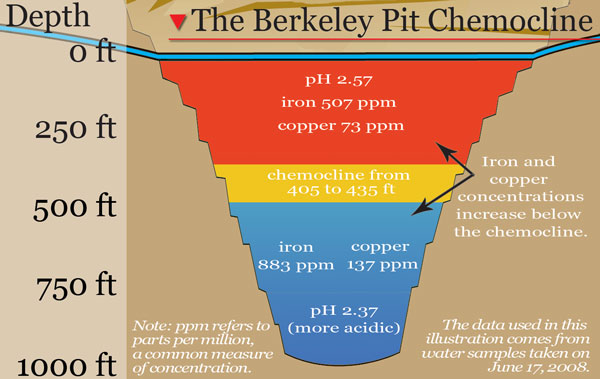
In Butte, Montana there is a toxic waste site, the Berkeley Pit, which has been discovered to be the home of various extremophiles. Some of these have even been identified to possibly produce anti-cancer agents and anti-inflammatories. The Berkeley Pit is a lake that is filled with about forty thousand gallons of acidic, metal contaminated water and until 1995 it was believed that nothing could survive in these harsh conditions. The lake is a rich source of piezophiles, acidophiles and metallotolerents some of which could prove helpful in both medical and environmental studies. One of these microbes is a type of yeast that has previously only been found in the rectal swabs of geese. This uncommon yeast absorbs about 87% of the metals in the water, which could therefore be used for toxic waste cleanup. This article provides more information about the research being done in the Berekely Pit.

It’s incredible that there are organisms that can survive in such extreme environments and it really changes my perspective on the possibility of life outside Earth. Additionally, it’s possible that life on other planets could hold the missing piece of many of the remaining mysteries of life.


Posted in Aliens | Tagged , , , | Comments Off on Extremophiles in the Berkeley Pit

Benfits of Astronomy on Earth

One of the most commonly used NASA technology is memory foam


          Astronomical research does not just benefit the limited field of astronomy; rather it serves to improve many other fields of study. From the first missions into orbit to current research of interstellar travel, astronomy has benefited our standard of living here on Earth. Many people have heard that memory foam was invented by NASA, but there are many more important technologies that were developed as a direct result of the space program. Some of these developments include magnetic resonance imaging (MRI), water purification, cordless power tools, kidney dialysis, and many different insulators and materials. In fact, NASA claims that “more than 1,300 documented NASA technologies have benefited U.S. industry, improved our quality of life and created jobs for Americans.” This means that most of the technology that we use today was in some way developed through space research. If this is not a reason to expand our funding and global interest in space I don’t know what is!

            Besides benefiting current technology, astronomy also benefits our future survival. There may come a day in the distant future when our planet is faced with a huge catastrophe that will force use to leave Earth. This could be anything from a rouge asteroid to our own destruction of natural resources. No matter what happens, if anything does happen, the exploration and research of space will allow us to predict and prevent these events. We may even be able to move to a different planet if we need to! While this may sound like science fiction right now that is how a moon landing must have sounded like just a century ago.

            In conclusion, astronomy is crucial to our society because of its benefit to current and future technologies. In addition, it may even save our species from extinction! It is a shame that our society has not channeled more interest and funds towards this research. With all the benefits that space exploration and research produce there is no excuse not to.


Posted in Instruments | Tagged , , , | Comments Off on Benfits of Astronomy on Earth

The Smallest Bears in the Universe


Water Bears

These little guys are a part of a special group of organisms called extremophiles. While their name may be a bit misleading, water bears (or moss piglet) measure about 1.5mm long and can live in some of the harshest conditions. This ability to survive in places where most living things would find unbearable separates this group of organisms, and gives hope to scientists searching for life in a universe that isn’t always 72 degrees Fahrenheit with a slight breeze.

There are different types of these creatures, specialized for different types of environment. While we have been discovering these organisms here on Earth, there are types of extremophiles that seem to have the ability to live elsewhere in the universe, even in our own solar system. For example, on a recent space mission the lovely water bears were brought along for the ride and exposed to the dangerous vacuum of space for 10 days, only to return unharmed and some even reproduced. This provides scientists with the unique ability to look in previously ruled out environments in the universe for signs of life.

Although it may not be little green men flying in disks, these little creatures could be the first aliens we discover on another world.


Posted in Aliens, Class | Tagged , , , , | Comments Off on The Smallest Bears in the Universe

Holes and Wrinkles

There is a lot of misconception about two of the more arcane forms of proposed space travel: Warp Drives and Worm Holes. They work on the same principles but function in wholly different ways.

General Relativity explains that any mass or energy can bend space and time. Since there is energy everywhere space and time are already curved. We can there fore tweak with the curvature of space-time in different ways to produce different effects.

For example, Worm Holes are analogous to tunnels. When there is enough mass or energy concentrated at two points, the space-time bends to form a tunnel between the two locations.

time-travel-wormhole1


This means that we can reach another point before light, not because we are faster, but because we have a lesser “distance” to travel. So for example if a wormhole were to connect earth to the moon, you could step into the wormhole and go to the moon, and then quickly get back. But since light had to travel a longer distance, your image on the moon might reach you when you came back to earth. You would literally be able to make a thousand virtual copies of yourself. However, wormholes are extremely unstable. Some equations predict that they will immediately collapse as soon as something passes through. Negative energy and negative matter will be needed to stabilize a wormhole. Mankind is still far away from producing and using antimatter at a large scale, so worm holes will remain, for the near future, a fantasy.

Warp Drives also use the same principle. However they only distort space and time around the traveler while keeping him in a “bubble” of normal space-time. Imagine a small toy car on a bed sheet. The car can only travel a few centimetres per second. But you want to reach the other end of the bedsheet quickly. So you scrunch up the sheet in front of the car, effectively reducing the distance it has to travel. Once the car has traversed the wrinkles, you stretch out the sheet again. In a sense a Warp Drive is a less extreme version of the Worm Hole. A worm hole is just like the portals in the game Portal: the distance between destinations is effectively zero. But in a warp drive, you still have to cover some distance. Consequently it is also easier to make. But where worm holes can facilitate inter-galactic travel, warp drives are only viable for interstellar journeys.

240px-Star_Trek_Warp_Field


Image 1, Image 2


Posted in Physics, Science, Space Travel | Tagged , , , , , , | Comments Off on Holes and Wrinkles

Earth-like planet discovered

Very recently, on April 23 of this year, astronomer Eric Agol has discovered a very Earth-like planet 1,200 light years away.

Image

Through a very complex algorithm Agol had created, he had found this planet orbiting a star in a habitable zone that included temperatures suitable for water, and thus for life itself. This discovery is especially fascinating not only because of the discovery itself, but the methods used. Trends have been showing that more and more planets are being found through such models, rather than telescopes. The planet was found through the transit method, as the readings on the graph indicated a brief dip in brightness of the star as the planet came in front of it. Moreover, this discovery was missed by astronomers using the Kepler telescope, the most telescope in use to date.

Agol continues to say that there are 242 other stars with systems similar to the one he found in the Milky Way Galaxy, and that our Kepler telescope is only looking at 1/400th of the galaxy. With a little math, this amounts to 100,000 planets similar to Kepler 62f (the planet he discovered). This number demonstrates the potential for finding life at some point in the near future.

This article relates to a variety of topics we have studied this year, extra solar planet finding techniques, the Drake Equation, Fermi’s Paradox, Galaxies, and Telescopes. It is so cool to see how all these topics coincide and build on each other to create a product greater than the sum of its parts. I am fascinated to see where astronomy will take us in the future, and will definitely keep up to date with our progress.

Source: Click Here


Posted in Class, Science | Tagged , , , | Comments Off on Earth-like planet discovered

Where are the aliens?!

Image

Many years ago, the possibility that aliens exist always seemed fictional. Although this possibility seemed negligible, there always seemed to be the hope for their existence. Humans have sworn through time to have seen UFOs, or extraterrestrial life, trying to confirm this desire. However, as it stands today, this hope has yet to be converted into reality. However, modern science stresses that life almost has to exist outside of Earth. So why haven’t we found it?

This previous statement essentially embodies the Fermi Paradox, which revolves around our high estimates of extraterrestrial life combined with the fact that we have no tangible evidence of their existence yet.

These scientific estimates, are thus based on what has become known as the Drake Equation. The Drake Equation takes into account several factors that can give a number for the amount of worlds inhabited with aliens, however these factors can have a wide range of values that gives an even wider ranger number of potential worlds that inhabit life.

According to official scientific estimates, the lowest possible value theorized today would be 8 * 10^-20 worlds. Clearly this is less than 1, and gives rise to the idea that we are truly alone.

However, with the highest estimates, this value escalates to 36.4 million worlds.

This is a tremendous amount, and gives rise to huge excitement to the fact that we are probably not alone. These estimates also tell us that we still have lots of research and learning to do, because this range indicates that much of our knowledge in several fields is still incomplete. Still, the power of these numbers cannot be denied. There is a very real chance that aliens are out there, and it would seem that they indeed are out there. Finding them is another story, and hopefully (or not?) we will find aliens in our lifetime. How far we have come.


Posted in Aliens, Class | Tagged , , | Comments Off on Where are the aliens?!

Interstellar Propulsion

A solar sail developed by the Japan Aerospace Exploration Agency


             There is no better way to learn about space then to actually go there. We can only discover so much from far off images and spectrometry techniques. This is why organizations like NASA and DARPA are trying to develop new methods of space travel to send us to other stars. There are a few different interstellar travel technologies currently being researched. Some of the more interesting methods include both warp drives and solar sails.

            While a warp drive seems like a fantasy out of Star Trek, the physics surrounding it is feasible. Scientists have proposed that it would be possible to warp the fabric of space-time surrounding a ship. By compressing the space-time in front of the ship an expanding it behind the ship it would be possible to travel faster than the speed of light. This is possible because the ship is not traveling at all, rather it is manipulating the space-time around it so that it is only moving relative to its surroundings. This technology is still far in the future, although researchers have started trying to replicate this warp phenomenon on a minuscule scale.

            Another strange interstellar technology is solar sails. This method of propulsion uses photons to push a craft through space. This is possible because the tiny force added by each photon continues to add up as the craft travels due the minimal friction in space. Even still, it would require a massive sail to travel quickly. In fact, professionals estimate that it would require a sail the size of Texas to reach the closest star within a reasonable timespan. This presents huge design problems, especially since a sail this huge would have to be microns in thickness.

            Even with huge challenges in the way of developing interstellar technology, researchers are still committed to this goal. Not only will this research advance the field of astronomy, but it will stimulate new developments in a multitude of different disciplines.


Posted in Physics | Tagged , , , , | Comments Off on Interstellar Propulsion

Why Have They Not Visited?

The Drake Equation allows us to estimate the number of civilizations in our own Milky Way Galaxy. Even if conservative numbers are used for each of the factors in the equation, the equation yields a value in the hundreds or even thousands for the number of civilizations in the galaxy. With the numbers of galaxies in the universe numbering in the billions, life should have been common throughout the cosmos. Yet we have not been contacted by or seen evidence of any extraterrestrial civilizations during our time here on Earth. This conflict between what we should observe and we haven’t is called the Fermi Paradox. Named after Enrico Fermi, the paradox asks a simple question – If aliens are so common, where are they?

There have been countless solutions proposed for the Fermi Paradox. One of the solutions proposes that maybe all the civilizations out there are quarantining themselves from other extraterrestrials. This self-imposed quarantine by the civilizations is actually justified given that most depictions of advanced civilizations coming to Earth in science fiction results in our destruction. Another reason why people think others may not be trying to contact us is simply because they have no spacefaring ambitions to find other worlds with life such as we humans do. Some people however, think that other civilizations are trying contact us but our present technology does not allow us to decode their signals. This would involve using ways to communicate that is beyond our current grasp of Physics to be able to interpret.

Whatever may be the reason we haven’t been visited yet, it is almost certain that we aren’t alone in the vast cosmos. The sheer number of stars with planets in our galaxy alone is so high that it is improbable and even arrogant to suggest that Earth is the only planet with life. If the Drake’s equation estimates are to be considered, it would only be a matter of time before our guests arrive.


Posted in Aliens | Tagged , , , | Comments Off on Why Have They Not Visited?

The Fermi Paradox

The galaxy is a pretty big place.  With around 400 billion stars, it seems very likely that some of those stars have planets that can support life, that some of those planets have intelligent life, and maybe some of that intelligent life becomes space-faring.  Even if we say the chance of a star having a planet that harbors a space-faring civilization is one in a hundred million, that still leaves around 4,000 civilizations in our galaxy.  This begs the question, “Where is everybody?”

This is precisely what Enrico Fermi was wondering during a lunch break with his friends at 1950 in Los Alamos.  Amid a conversation about interstellar travel and extraterrestrial life, Fermi was struck by the idea that we should have seen evidence of intelligent alien life by now.  He reasoned that if technology develops on alien worlds at the exponential pace it has on ours and if interstellar travel is possible, then a civilization could colonize the galaxy in a few million years.  A few million years may seem like a long time, but considering that the age of the galaxy is around ten billion years, or ten thousand million years, a few million years is not actually all that long.  Even if we use conservative estimates for how fast one can travel in space and how long a colony might take to produce its own colonies, a colonization of the galaxy would take much less time than the age of the galaxy.  If what Fermi assumed is true, then we should have seen or been visited by an alien civilization.  As far as we know, there are no other civilizations in the galaxy besides ours, so what happened?  Why haven’t we found aliens?

If you enjoy incredibly nerdy songs, then I would recommend this song about the Fermi Paradox:

There have been many ideas about how to resolve this paradox.  We could assume that life is so uncommon that no intelligent, space-faring civilizations exist in our galaxy.  However, I am too optimistic to believe this.  Maybe civilizations that develop advanced technology inevitably destroy themselves, or maybe advanced technology is very uncommon.  It is also possible that there are other advanced civilizations out there, but interstellar travel is just too difficult to accomplish, and we will never our stellar neighborhood.  I find all these views to be too pessimistic for my liking.

Another set of ideas says that there are other alien civilizations out there, but for a variety of reasons won’t or can’t contact us.  They may be keeping us as a sort of zoo and observing us, though I find this unlikely.  I like the idea that they have tried to contact us, but we weren’t listening.  We have only been listening to radio signals from space for a very short time, and it’s entirely possible that we received a signal when we were facing the wrong direction.

The only scientific answer to Fermi’s Paradox is, of course, that we don’t know.  Every idea is pure speculation unless we can find actual evidence.

Sources: 1, 2, 3


Posted in Aliens, Space Travel | Tagged , , | Comments Off on The Fermi Paradox