The Voyager program was first to photograph Io, when it deployed its two high-resolution imaging probes (Voyager I and Voyager 2) on September 5 and August 20, 1977 to investigate the Galilean moon. Io, one of Jupiter’s four Galilean moon, is a fascinating celestial object. In fact, Io is the most volcanically active world in our Solar System. Io’s surface is incredibly young and geologically active. As a result, not a single impact crater has scarred its surface.
Interestingly, the a plethora of the volcanoes that pock Io’s surface are similar to those on Earth. For example, Io’s taller volcanoes share a similar appearance to the volcanoes along the Earth’s mid-ocean ridge. These are built from the gradual flow of basalt lava that stack over time and form a low-sloped volcano. Moreover, Io’s volcanoes experience outgassing. The main gases released during this process is sulfur dioxide, sulfur and some sodium. Indeed, the sulfur condenses and returns to the surface, where it gives Io’s distinct orange and red color, while the sulfur dioxide glosses the surface in a white coat. But why is Io so volcanic?
Io’s volcanic activity informs us that it has an incredibly hot interior. Scientist have determined that the process causing this hot interior is called tidal heating. Tidal heating works in the same way as the tidal forces on Earth. Jupiter exerts a tidal force on Io that causes the moon to maintain the same face towards Jupiter as it orbits. Io’s orbit is slightly elliptical in shape so its speed and distance from Jupiter change, causing the strength and the direction of the tidal force to change. This changes the size and position of Io’s tidal bulge, which results in Io being continuously pulled and stretched in various directions, generating friction inside its interior and giving the moon its distinctive fiery features. 
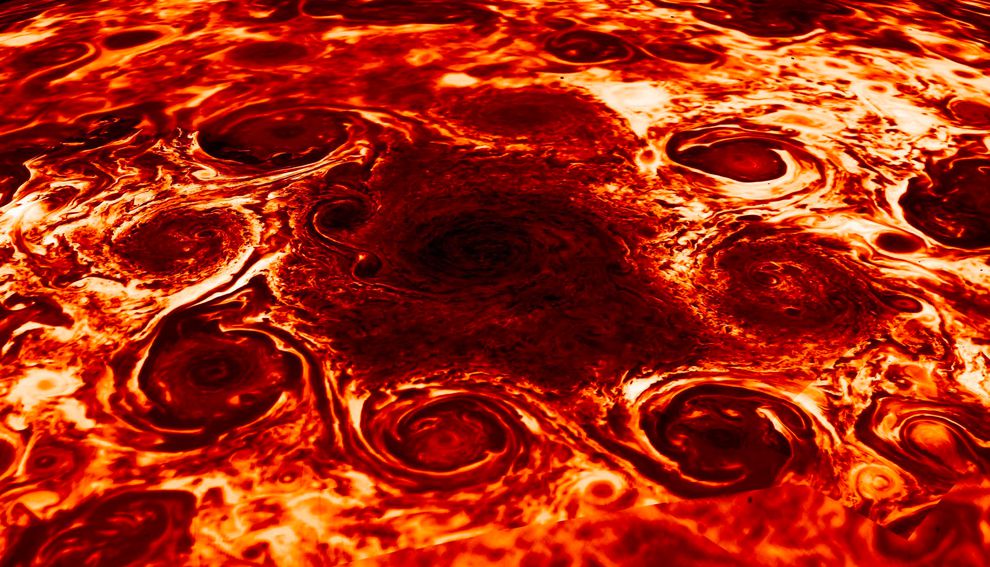
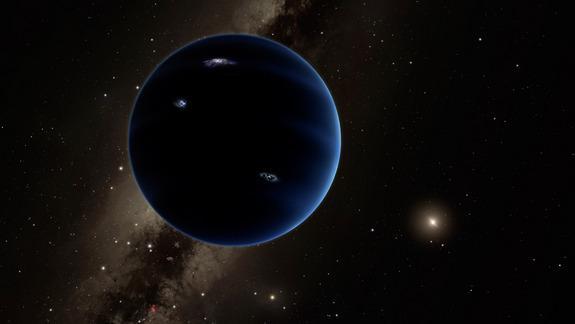 We talked in class about the discovery of a potential ninth planet with an orbit past pluto, and the idea of one more undiscovered planet in the solar system is quite fascinating. That’s why two astronomers – Mike Brown and Konstantin Batygin – decided to investigate into the peculiar clustering of six objects beyond Neptune, which they determined was extremely unlikely to be a coincidence. Their current theory is that this planet, suggested to be at least 10 times as massive as Earth, gets within 200 AU to the Sun at it’s closest once every 15,000 years. It’s furthest reach in its orbit is hypothesised to be between 600 and 1200 AU from the Sun.