Europa is one of Jupiter’s 79 moons and is slightly smaller than Earth’s moon. It’s surface is covered in salty water that is almost twice the amount of water in all of Earth’s oceans combined. Covering all this water is a 10-15 mile thick sheet of ice. The inner part of the moon is thought to be similar to Earth with an iron core and rocky mantle. Because of these traits, Europa appears to be the most likely place in our solar system where life could be found. However, due to its thin oxygen atmosphere and cold temperatures, the organisms would likely be very different from what is found on Earth. Personally, I think if there is life on Europa, it would be in the form of small micro-organisms and bacteria. Do you think there could be life on Europa? Comment below!
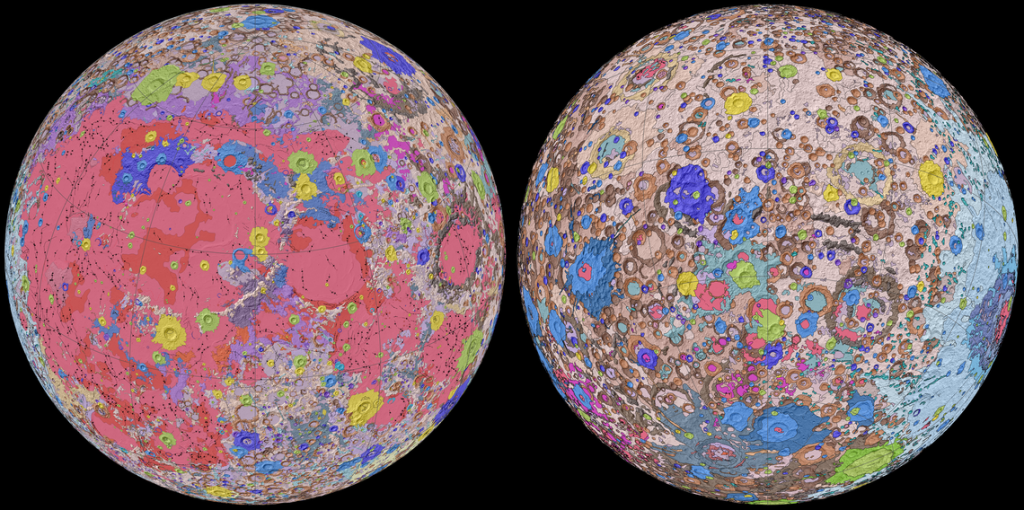
The United States Geological Survey Astrogeology Science Center and NASA worked together to create a complete geological map of the Moon in early 2020. The map shows the immense amount of impact craters on the moon’s surface. It was made with information from six maps from the Apollo-era in conjunction with modern data. Specifically, data about the elevation of the equatorial region was from observations of the Terrain Camera on the Selenological and Engineering Explorer from the Japan Aerospace Exploration Agency. Information about the topography of the north and south poles was from data from NASA’s Lunar Orbiter Laser Altimeter. Overall, it created a more consistent and accurate map. This image is the result of international and interdecadal work! Hopefully it will be able to inform future missions to the moon and research here at home.
Since the industrial revolution humans have become the most selfish species in the world. With growth in mind we started removing trees and releasing chemicals into the air and water with no regards for it’s potential impact. Now a few centuries later its impact is seen in climate change. Climate change has been caused by something known as the greenhouse gas effect which essentially is that as we release more and more gas into the atmosphere(carbon is up 47 percent in the last few hundred years) the gas blocks heat from leaving the atmosphere which is causing a heating effect. Because of this we are seeing higher average temperatures, which is melting away the ice caps. This combined with us cutting down habitats for expansion is causing many animals to be on the extinction list. This is very sad to see, as we are aware of what we are doing but aren’t stopping. The world is fighting back against us and if we don’t fix it it will surely come back to haunt us. Nasa video
When the Perseverance Rover landed on Feb.18, 2021, the parachute that was used appeared very unique, with a combination of orange and white strips. Coupled with the fact that in a conference, Allen Chen (the engineer in charge of the landing system) said, “we leave messages in our work”, it became clear that there was a riddle embedded within the parachute.
As covered by the New York Times, the man responsible for leaving a message was Ian Clark. He encoded the parachute in 10-digit chunks of binary code in a clockwise fashion that corresponded to numbers and letters of the alphabet. As someone who has no exposure to programming, I have little idea of what this actually means, but the result is that the strips of orange and white could be translated to messages. The inner ring read, “Dare Mighty Things”, which was a saying often used by the Jet Propulsion Lab. Another section of the parachute was code for the longitude and latitude of the JPL visitor center at 34°11’58” N 118°10’31” W.
The solution to the riddle embedded in the parachute was eventually revealed by Adam Steltzner, the chief engineer of Perseverance in a Tweet and is shown above. What I find particularly amusing is that there were other riddles or “extras” put on the Rover in a practice called “festooning” that dates back to many other Rovers sent by NASA. In the case of the Perseverance, these included almost 11 million names stenciled on a microchip, images of dinosaurs and DNA on calibration instruments, and even parts of a Martian meteorite that finally made their journey home. Lastly, there was a COVID-19 memorial that was placed on a plate for the Rover. I personally think that these are really nice touches on the Rover that are synonymous with “easter eggs” in video games. It shows that even engineers at JPL and NASA of all people, have a good sense of humor.
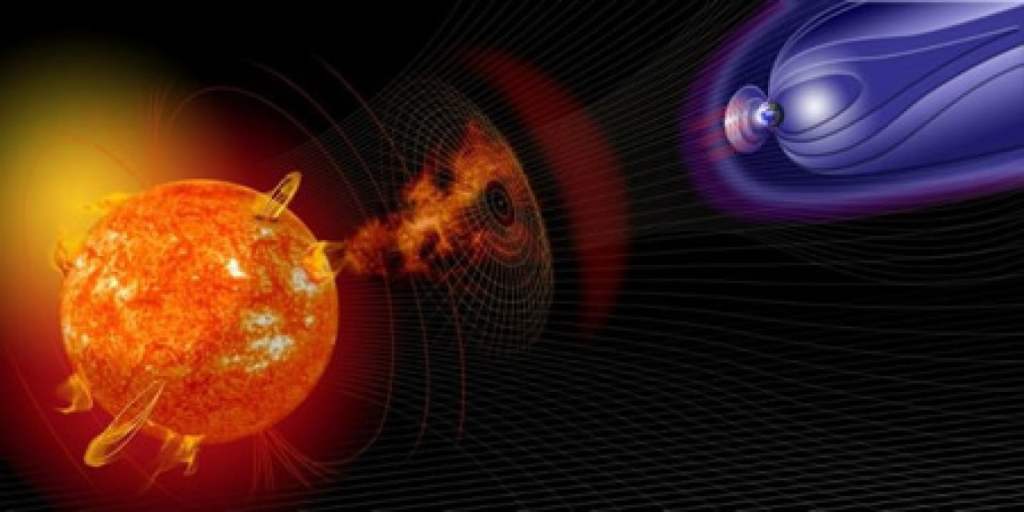
A Coronal Mass Ejection (CME) is essentially a powerful expulsion of plasma and accompanying magnetic field from the solar corona, or the sort of aura of plasma that surrounds our Sun. While they have an extremely cool name, and seem pretty neat, they could actually have a pretty significant impact on humanity.
Artist’s representation of a Coronal Mass Ejection, from The Washington Post
The Sun has an incredibly powerful magnetic field, which leaks out into our solar system. This leakage is normal, and is actually what drives solar wind, a “breeze” of plasma. However, the “solar weather” so to speak isn’t always regular. The Sun is a big burning ball of plasma, and as it mixes and churns, it also knots and twists its magnetic field. These knots can build up on the corona and eventually burst, vomiting plasma into the solar system, resulting in a solar storm. These storms come in a few forms, one of which is a Coronal Mass Ejection. The most powerful CME can take billions of tons of plasma away from the Sun, and hurtle it through space at incomprehensible speeds. When a CME this powerful arrives at Earth, it compresses our magnetic field through a violent shockwave, and transfers energy to the magnetosphere.
In the worst case scenario, the CME magnetic field merges with Earth’s, which is very bad. Eventually, this merging results in an explosion of energy towards our surface. While this isn’t very noticeable for us living beings, it’s very noticeable for all our technology. The energy from the CME induces currents in our power grids that can either shut them down or even destroy them. A CME could shut down all of our technology, just like an EMP from your favorite sci-fi/action movie. Similar to neutron stars, they are super cool and super dangerous. Thankfully, with the appropriate designs in place, we can counteract these induced currents and stay safe. So, as long as politicians are okay with funding these designs, we should all be safe…
If you’re interested in CMEs, I would recommend watching this video about them from Kurzgesagt on YouTube. They explain CMEs way better than I just did, and there’s lots of pretty animations.
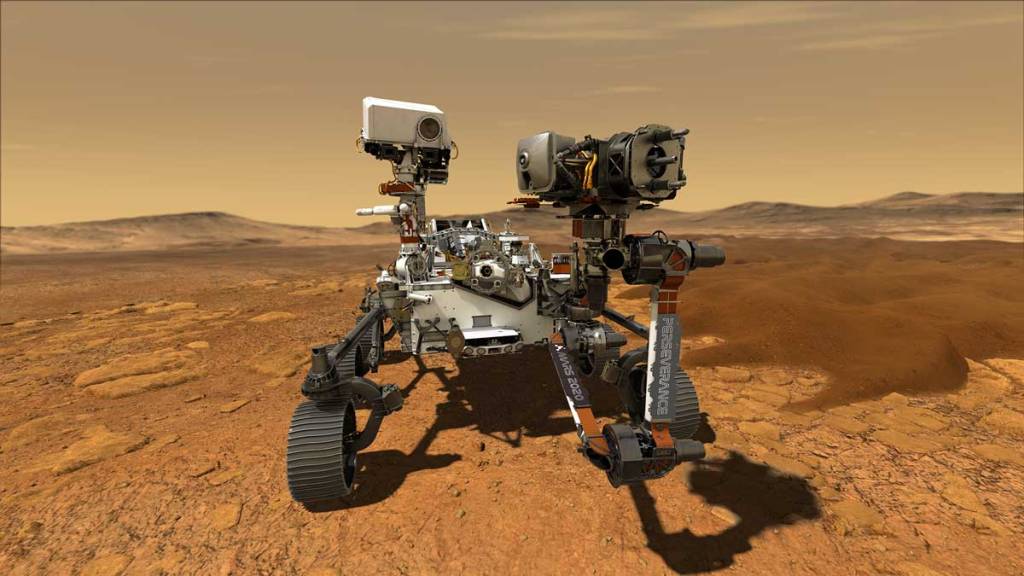
NASA’s most recent Mars mission sent a new rover to the Red Planet – her name is Perseverance. The mission launched late last July and successfully landed just last month, utilizing a variation of the sky crane maneuver initially developed for the Curiosity mission (another blog post worth of material). Perseverance is now searching for signs of ancient life by collecting Martian rock and regolith. The rover will use its drill to collect samples of the Martian earth, then store them in sealed tubes for pickup by a future mission. This future mission will take the samples back to Earth, and allow scientists to physically interact with the dirt they study – a big step up from looking at pictures, which is what the scientists originally had to deal with.
Perseverance is searching for mircofossils because Curiosity proved that life COULD have lived on Mars. One of Curiosity’s samples of clay demonstrated a past environment of fresh water and a neutral pH level. At this point, scientists had already proven that Mars had been wet, not too salty, and warm for a long period of time. Additionally, the sample contained all the elements life needs to survive – carbon, hydrogen, nitrogen, oxygen, phosphorus, and sulfur. The only thing to confirm a suitable environment for life was an energy source. After further analysis, the sample was also shown to contain chemical compounds that some microbes here on Earth use for energy. All this information together means that Mars could have supported microbial life. So now, Perseverance is searching for that very evidence. Maybe we’ll get some exciting news in the upcoming year!
I’m sure many people have seen companies offering an acre of land for sale on the moon (here’s an example). Many people, celebrities included, have bought into this and have purchased acres of land. However, how real is this claim to land on the moon?
There are certain parts of treaties that become confusing when counties start to explore the possibility of building settlements on other planets. Despite this however, the fact of the matter is that any person or company currently offering land on the moon is simply looking to make a few dollars.
Mercury is a terrestrial planet, though it is quite different in appearance than Earth. It’s grey rocky surface more resembles that of the moon, however unlike the moon Mercury has a liquid iron core and is much denser. Moreover, Mercury’s surface features paint an interesting story of past geological occurrences.
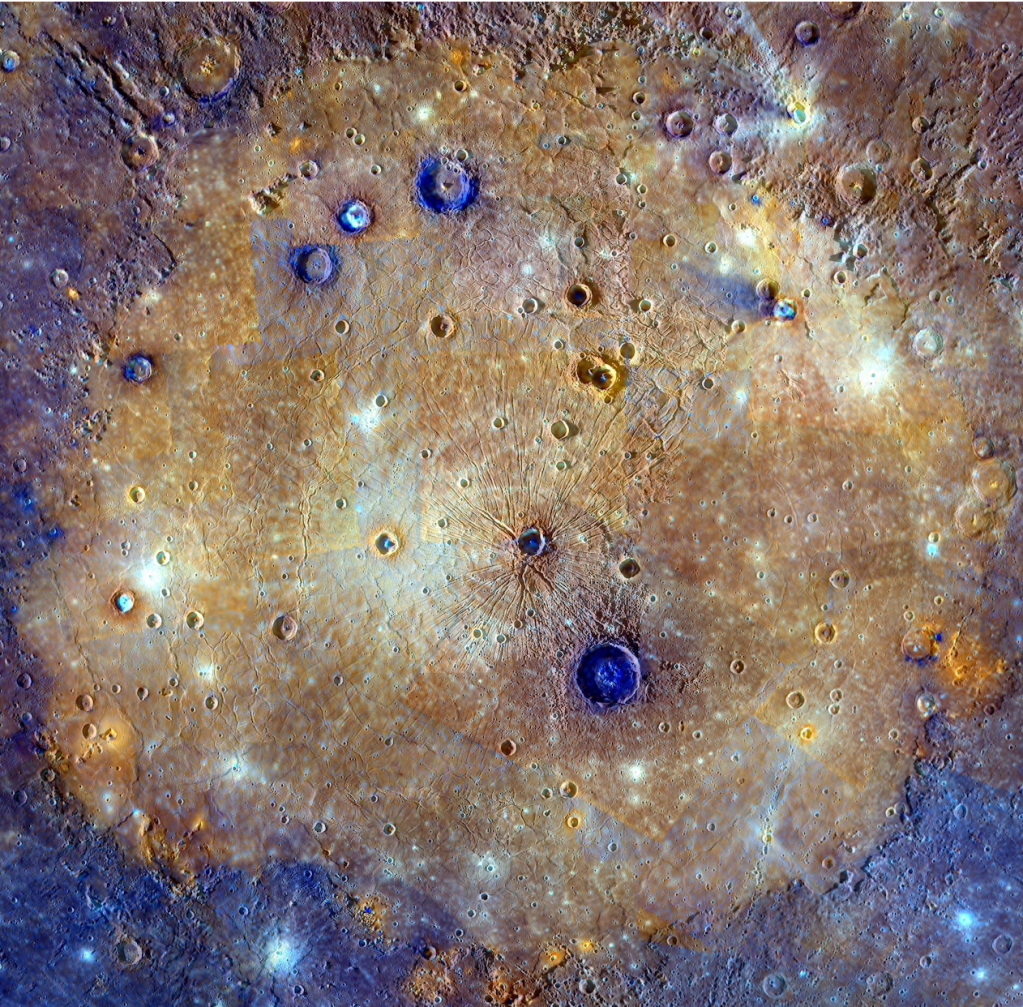
Mercury formed around 4.6 billion years ago and was thus present for the period of heavy fall of asteroids and comets which caused intense cratering on many planets. Mercury is home to many impact basins including the Carolis Basin which has an immense diameter of 810 miles.
Mercury’s surface also shows a past of volcanism as telescopes have discovered vents, lava flows and impact craters that have been filled in with lava. Mercury also has the possibility of ice. Data from the MESSENGER spacecraft has led many to believe that there is ice present in Mercury’s poles.
However, despite the many surface features, it appears that many of these events occurred far in the past, explaining the current moon-like appearance of Mercury.
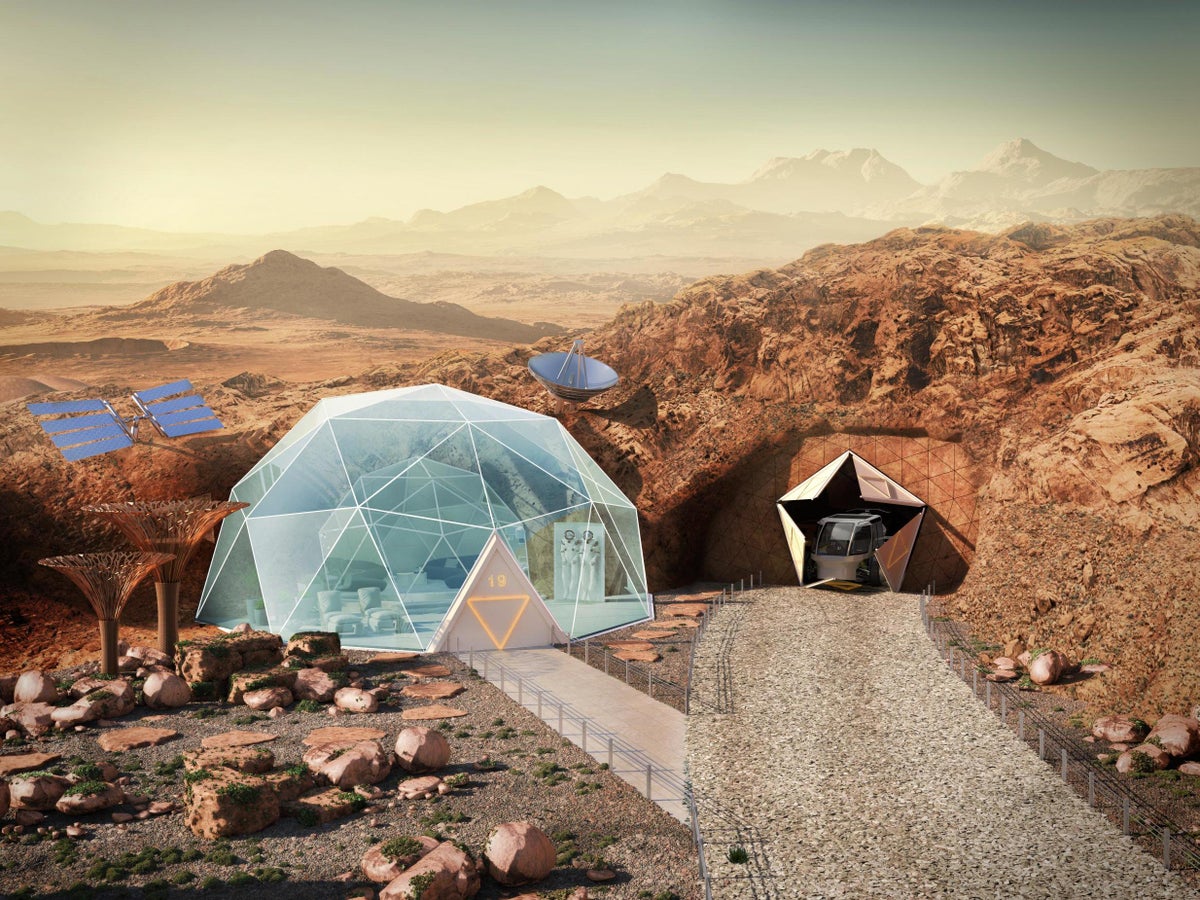
In an interview with USA Today, NASA Scientist Jim Green talked about the high possibility that humans can and will occupy Mars. He went as far as to say that he sees the first human being sent to Mars by 2040. However, before sending a human to Mars, NASA needs to figure out a few things. First off, a spacecraft big enough to house a human has never landed on Mars, which is tricky due the Mars’ rocky terrain. Secondly, no spacecraft has had a return route to Earth from Mars, which would be necessary for someone to come back since Mars is not habitable just yet! Life on Mars would also be very different, requiring constant wear of a spacesuit due to extreme temperatures and no oxygen. If humans ever do make it Mars, they will need to build up a civilization with a food source and homes braced for dust storms and the temperatures! Read the USA Today article here.
Even though the vast majority of the scientific community is in agreement about the reality and seriousness of climate change, there are still many people, especially in the United States, who believe climate change is a hoax. In this post, I want to address some of the most common arguments climate change deniers use, so you and I can be more effective and more convincing science communicators in our everyday lives.
1. “The climate has changed lots of times over Earth’s history. How can we know that humans are what’s causing the climate to change this time?”
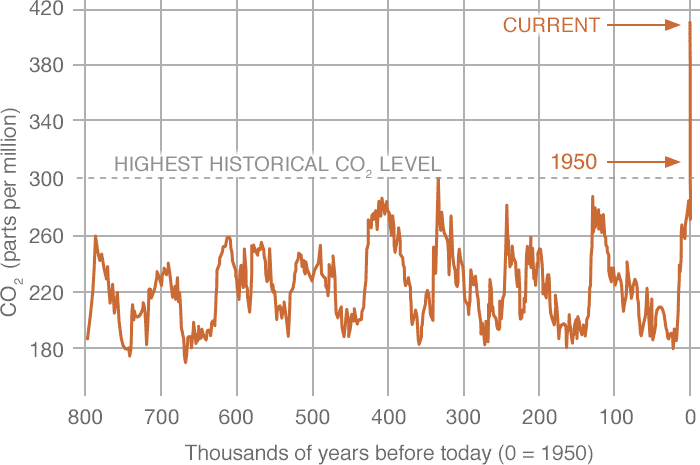
As we can see from the graph above, the carbon dioxide levels in Earth’s atmosphere, and therefore Earth’s climate, have been changing for thousands and thousands of years! What’s most alarming about how our climate is changing today is not that it’s changing at all but rather the rate at which our climate is changing. In Earth’s history, it could be a hundred thousand years from peak to peak in carbon dioxide levels, but on the far right side of the graph we can see atmospheric carbon dioxide skyrocketing to unprecedented levels over the course of only a couple of centuries! This is definitely not a part of Earth’s natural climate-changing processes, and since the major increases in atmospheric carbon dioxide have occurred as human civilization has rapidly expanded, we can conclude that the recent uptick in atmospheric carbon dioxide must be due to human activity.
2. “Even if atmospheric carbon dioxide is increasing, how can we be sure that it’s causing the climate to change?”
The greenhouse effect is a key concept in connecting increases in atmospheric carbon dioxide with overall increases in average global temperature. Just like a greenhouse used to grow plants, the carbon dioxide in our atmosphere is able to trap the Sun’s heat that is reflected off the Earth’s surface, thus keeping that heat within our atmosphere. All of this trapped heat makes the Earth warmer overall. Carbon dioxide and other gases like methane are great at trapping heat, and the increased presence of these gases in our atmosphere is causing an enhanced greenhouse effect that is making our planet warmer than it should be!
3. “So what? Climate change won’t affect me or anyone I know. Plus, life on Earth can just adapt to these changes!”
First, climate change is already affecting you and the people in your life. First, the burning of fossil fuels doesn’t just increase the amount of carbon dioxide and other greenhouse gases in our atmosphere — it also can have serious negative health effects on humans. Air pollution, which goes hand-in-hand with climate change, can lead to respiratory disease, such as asthma.
Moreover, rising sea levels (a result of a warmer climate melting glaciers and other large ice sources on land resulting in a greater volume of water in our oceans) have already seen significant effects on people’s homes, especially on the world’s coasts. The sea level has already risen 7 to 8 inches since 1900, with 3 of those inches occurring just since 1993, causing increased flooding and home loss.
Lastly, increasing in weather variability due to a changing climate has had serious effects on residential areas, but it also can negatively impact farming and even the nutritional composition of fruits and vegetables. Inclement weather and seasonal weather variability hinder crops, and increased atmospheric carbon dioxide is actually changing the composition of our produce, making them less nutritious!
There are many more examples over than these three of how climate change is already affected so many people. We’re already seeing the effects of climate change on our society, and it will only get worse unless we take serious action. Climate change is also happening too rapidly for plant and animal life to properly adapt to the changes, which has already had serious consequences for Earth’s ecosystems.
It’s important that we do our part to educate our friends and family about climate change. It’s hard to make the necessary changes to stop climate change from worsening when so many people don’t even believe in climate change in the first place. Let me know how you plan on using the information from this blog post to keep your loved ones informed about the serious reality of climate change in the comments!