Amazing Auroras

Auroras happen when charged particles within solar winds go through Earth’s magnetic field. Solar winds are fast moving, plasma particles discharged by sunspot regions, areas where the Sun’s magnetic fields become tangled and burst. These particles bump into different atomic elements, such as nitrogen and oxygen, to create ions in excited states that release light at numerous wavelengths and give an aurora its color. Auroras are usually pink, green, yellow, blue, and violet. Sometimes, auroras can be orange and white as well. The color of an aurora is dependent on altitude as well as what molecular or atomic elements the particles bump into. For example, particle collisions with oxygen generally produce an aurora that is yellow and green while particle collisions with nitrogen usually generate an aurora that is red, violet, and sometimes blue. Additionally, other planets like Jupiter, Saturn, Uranus, and Neptune can have auroras, but they are slightly different from the ones on Earth.

In the Northern Hemisphere, auroras are called aurora borealis or the northern lights whereas in the Southern Hemisphere, they are known as aurora australis or the southern lights. The northern lights can best be seen in Alaska, northern Canada, Norway, Sweden, and Finland. I have always wanted to see an aurora, so it looks like I have some new additions to my list of places to visit. Has anyone seen an aurora in person? If so, where?

The northern lights seen over Bear Lake in Alaska (taken from Britannica)

Posted in Class, Light, Observables | Tagged , , , , | Comments Off on Amazing Auroras

Perseverance and Ingenuity

Just 16 days ago, the newest rover to explore Mars embarked on its first ride around the planet! It took Perseverance a total of 7 months to get there, that must have taken a lot of… Perseverance’s mission is to collect samples from the surface of Mars to be returned to Earth and tested by scientists to explore the possibility that there was once life on Mars. The findings from this mission could both help to develop our understanding of Mars and also expand upon our knowledge about the possibility of life outside of our solar system. The rover also contains one instrument for potentially proving that it is possible to someday have humans land and explore on the surface of Mars. On top of that, Perseverance is the first rover to provide a recording of sound on another planet!

Perseverance also arrived with a friend! Strapped to the bottom of the rover on the journey from Earth to Mars was Ingenuity, a helicopter and the first of its kind. Ingenuity’s purpose is simply to perform flight tests in order for scientists to collect data for future Mars flights. Ingenuity and Perseverance will surely collect groundbreaking information (some through literally breaking the ground of Mars) that will pave the way of space exploration for years to come!

Perseverance on Mars!
Posted in Class | Tagged , , , , | Comments Off on Perseverance and Ingenuity

earth’s rings?

Ever look at a picture of Saturn (or anything else with rings) and think “Wow, I wonder what those rings are made of?”

Spoiler alert – they’re just very pretty rocks and ices and dusts.

How about this one – Ever look up at the Moon (or any other moon) and think “Wow, I wonder what that thing’s made of?”

I don’t know, maybe not. Could just be me.

But, spoiler alert, again – it’s essentially made of rocks and ices and dusts with a few bonus gases here and there.

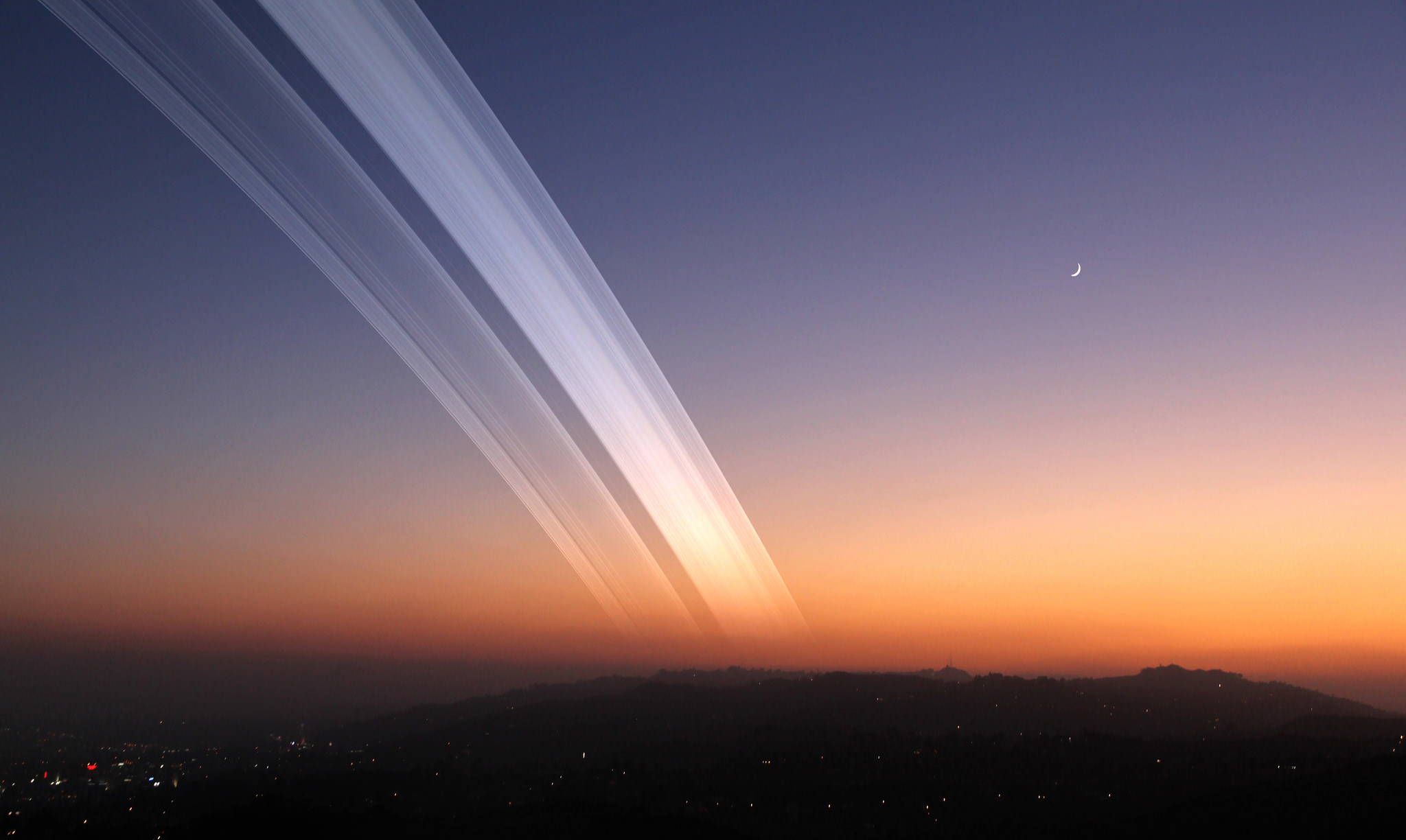
artist rendition of what Earth’s sky could look like if we had rings

But then if rings and moons are made of the same stuff and they both orbit planets, why do they both exist? Why would both rings and moons form in the universe when they are made of and do basically the exact same thing? And then why does Earth have a moon but no rings?

Good question(s), and, believe it or not, our friend Science has an answer.

Our moon is located well beyond an astronomical distance known as the Roche limit. The Roche limit is generally defined as the maximum distance an orbiting object can approach the gravitational body it is orbiting without being torn apart by the tidal forces, and it is usually considered to be at a distance of about 2.5 times the planet’s radius. Therefore, at the Roche limit, the gravitational force on the object is equal to the internal gravity holding the object together. Regarding moons, then, moons can only form outside the Roche limit of the planet they are orbiting, and, theoretically, any relatively large satellite inside the Roche limit will be torn apart and will form rings.

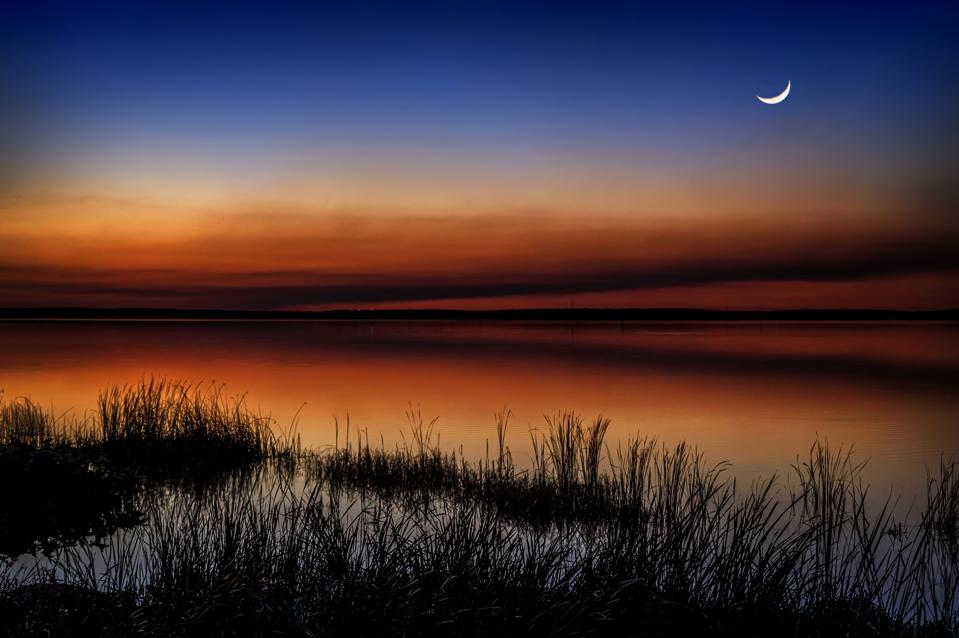
Nightscape with new moon
a sunset on Earth with our dearest celestial companion

On a related note, some scientists believe that most if not all of the planets had rings at one point in astronomical time. However, as the rings expanded outwards, they passed their respective planet’s Roche limits and then condensed into moons. So maybe our night sky once did look like the picture above, which probably would have been cool to see.

But I still like the sky we have.

Posted in Class, Moons, Planet Rings | Tagged , , | Comments Off on earth’s rings?

Mars, Water trapped in Rocks

An Artist’s Rendition of what Mars may have looked like 4 billion years ago

As we have discussed in class, Mars looks very different today than it did billions of years ago. One notable difference is that Mars may have liquid water, as we see evidence of this in canyons and dried river beds in the planet’s geology. This water was eventually ejected into space from solar wind and lost from the planet. However, scientists recently discovered that most of the water may still be trapped on Mars’ in the form of rocks. This water is embedded in rocks, essentially hydrating minerals that are on the planet. As covered by The New York Times, up to 99 percent of the water that was once on Mars may still be on the planet. Because of a lack of tectonic and volcanic activity, this water is trapped in the crust permanently and cannot be released like it is on Earth. On Earth, water trapped in rocks is melted and eventually released through volcanoes. 

Another interesting piece of evidence that points to the presence of water in rock has to do with the composition of Mars’ thin atmosphere. After water evaporated on Mars, the hydrogen atoms were lost in space. However, deuterium — a heavier isotope of hydrogen — is less likely to escape. The ratio of deuterium in Mars’ atmosphere is significantly higher than Earth’s because of this. But the rate of hydrogen loss has not been quick enough. According to Dr. Renyu Hu at JPL, the hydrogen loss extrapolated over 4 billion years accounts for only a relatively small percent of water loss. Thus, the loss of Mars’ water cannot solely be because of this phenomenon, and may have been absorbed by the planet’s rocks. 

Posted in Terrestrials | Tagged , , , , | Comments Off on Mars, Water trapped in Rocks

solar system superlatives: Mars

Welcome to solar system superlatives – a blog series where we’ll learn about some of the craziest phenomena found in our solar system. First up, Mars.

a large body of water
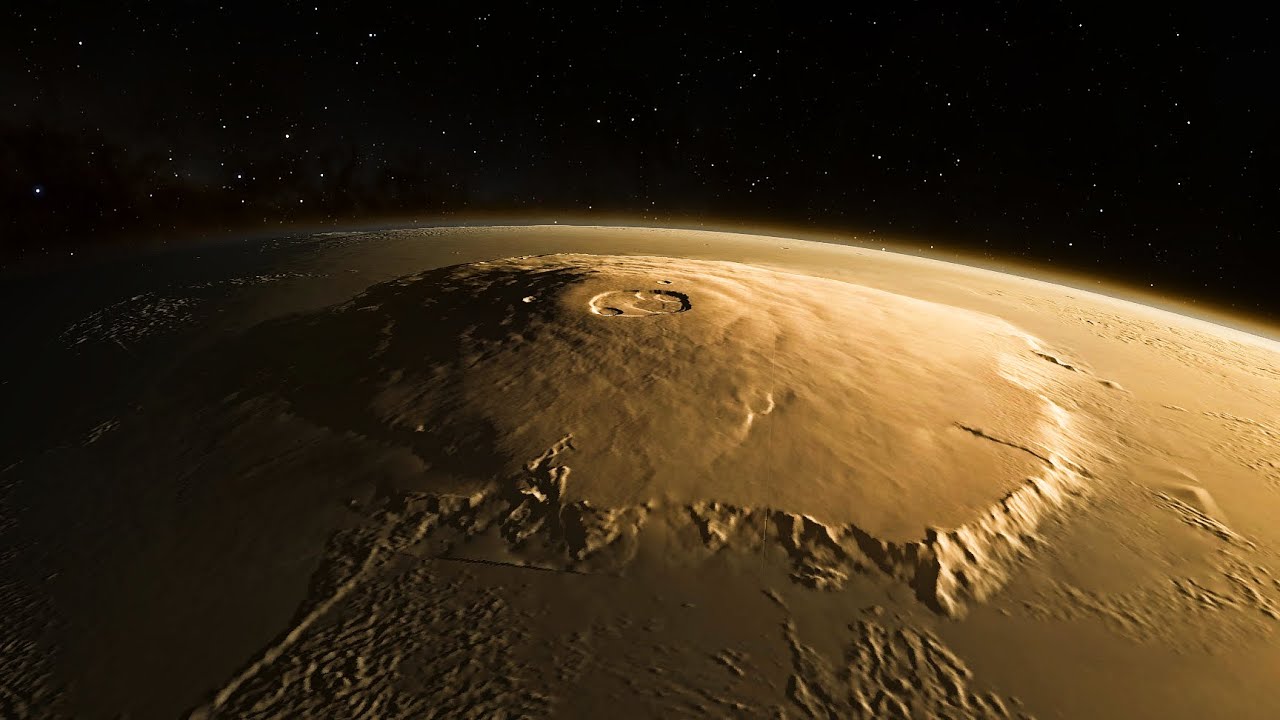
Olympus Mons from space

Mars is home to some of our solar system’s most impressive geological formations. Olympus Mons, for instance is the largest mountain in the solar system, and, as I am sure you guessed, it is absolutely massive. Standing at over 72,000 feet tall, Olympus Mons is literally taller than Mars’ thin atmosphere, and it naturally dwarfs Mt. Everest, which is just under 30,000 feet tall. Olympus Mons is a shield volcano that formed over a Martian hotspot, and, because Mars has minimal tectonic activity (if any at all), the volcano just kept growing as it stood rooted in place. Also, because shield volcanoes are typically very wide (they grow at an average incline of 5%), Olympus Mons’ height necessitates an equally fantastic base. As such, Olympus Mons covers a geographic area approximately the size of France. In other words, if you stood at the top of Olympus Mons, you would not be able to see the ground, and, in every direction, all you would see is more Olympus Mons.

Posted in Class, Terrestrials | Tagged , , , | Comments Off on solar system superlatives: Mars

Mount Vesuvius and the Pompeiian Disaster: How it happened

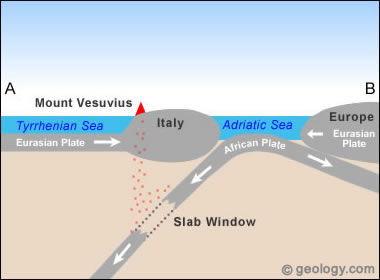
Plate tectonics of Mount Vesuvius

I was watching a documentary about the sheer power and destruction that Mount Vesuvius lay upon those heedless Roman citizens in Pompeii, and it got me thinking about the movement of the tectonic plates. What needs to happen underneath the land to create enough power to bury a city in 15 feet of rubble and ash?

Mount Vesuvius was formed because it is located on the subduction zone at the connection of the African and Eurasian Plates. As you can see in the picture, the Eurasian plate is pushing down onto the African plate, and the sliding of the tectonic plates causes a build-up of extreme subterraneous pressure.

The eruption process really started in 62 A.D, as there was a major Earthquake cause by the sliding of the African Plate underneath the Eurasian Plate. This began a series of intermittent earthquakes over the next 15 years, and with every slide, more gas and steam became compressed in between the plates. The layers of compressed magma, gas, and steam, continued to build, and unfortunately, Mount Vesuvius was the pressure’s release point. In 79 A.D, the pressure became too much, and these layers of toxic gasses and magma came ripping out of Vesuvius. The immense pressure ripped off massive chucks of the volcano itself and blew carnage over 10 kilometers from the site.  

Here is a cool animation of what the explosion would have looked like in Pompeii. Glad I wasn’t there.

Posted in Science | Tagged , , | Comments Off on Mount Vesuvius and the Pompeiian Disaster: How it happened

Radioactive Proof of the Earth’s Age

Oldest dated rocks - Wikipedia

Radioactivity of elements starts with an unstable elemental isotope. An unstable atom on radioactive elements carries too many protons or neutrons, and eventually, it must expel energy from the atom, and become an entirely new stable element through the process of beta decay. This process, for every unstable atom, is completely spontaneous and there is no specific timeline. But in a large group of these radioactive isotopes, scientists have found statistical averages for these element’s half-lives, or the average time required for half of the radioactive isotopes in a sample to decay. From this 50 percent mark, the process starts over, and it will take approximately the same amount of time for the 50 percent of leftover radioactive isotopes to decay. The discovery of radioactive half-lives has led to the discovery of Earth’s age.

The timelines of radioactive half-lives vary greatly between elements. Carbon-14, for example, has a half-life of 5,730 years. It is great for short term dating accuracy, as the percentage of Carbon-14 molecules will tell you how many half-lives the objects has lived. But at around 57,000 years, basically all of the Carbon-14 molecules have transformed. Uranium-235, however, has a half-life of 700 million years. Scientists have found large clusters of this isotope in the Earth’s oldest meteorites, and based on the unstable uranium’s half-live, and the concentration of the decayed elements surrounding it, scientists have dated the oldest existing rocks on Earth to about 4.3 billion years old.

This is just one of so many examples showing us how creative scientists can be in their quest for new information!

Posted in Instruments | Tagged , , | Comments Off on Radioactive Proof of the Earth’s Age

The Ranking System of Solar Flares

Solar flares are solar storms and explosions that release ultraviolet light, x-rays, energy, and very fast, charged particles. They are categorized into classes based on their strength. The classes ranked from smallest to biggest solar flares are: A, B, C, M, and X. Each class increases 10-fold in energy and has a subscale that goes from 1 to 9, where 1 is the weakest solar flare and 9 is the strongest solar flare in its respective class. A, B, and C-class solar flares are not strong enough to greatly affect Earth while M-class solar flares can create temporary radio blackouts at Earth’s poles and minor radiation storms. X-class solar flares can cause magnetic field loops to come from the Sun’s surface that are approximately tens of times the size of Earth. Additionally, X-class solar flares can cause strong and enduring radiation storms that can negatively affect satellites, communication systems, ground-based technologies and power grids.

Recently, in November 2020, the Sun had its largest solar flare in more than 3 years. The solar flare was ranked as a M4.4 and caused a shortwave radio blackout over the Southern Atlantic Ocean. There are some speculations that this solar flare could have actually been an X-class solar flare and it occurring partially behind the Sun could have made it seem like an M-class solar flare from Earth’s perspective.

Photo of solar flare from NASA’s Skylab 4 mission (taken from Britannica)

Posted in Class, Observables | Tagged , , | Comments Off on The Ranking System of Solar Flares

Binary Stars

Source: Space.com

A binary star is a star system of two stars that orbit around the central point, called the barycenter. In conversation, binary stars are sometimes casually referred to as double stars. Binary star systems or multiple star systems (3+ stars in orbit in the same system) are actually way more common than you might think. Over four-fifths of the single points of light seen in the sky are binary or multiple star systems. The brighter star of the two in a binary system is deemed the primary star, and the dimmer star is the secondary star.

Binary star systems are important to astrophysics because calculations can be made due to the “pair” structure of the star system. One can calculate the stars’ masses because of their orbits, and the mass allows for other measures to be estimated.

Binary stars are classified based on their orbits. Wide binaries are pairs that stay apart from each other in their orbits. Close binaries orbit close to each other and are able to transfer their mass from one to the other. Visual binaries are wide enough apart that they both appear as distinct stars in a telescope. Spectroscopic binaries appear close when viewed through a telescope. Eclipsing binary stars are aligned at an angle such that one star passes in front of the other, and it causes an eclipse when looking from Earth. Astrometric binaries are stars that seem to be orbiting alone; the pair is too dim to see but its presence is inferred. Double stars are stars that appear to be in the same star system but are in reality not close to one another.

Posted in Light, Physics, Stars | Tagged , , | Comments Off on Binary Stars

Comet

Is it a bird? a plane? a superhero? No it’s a Comet! Comet’s are “cosmic snowballs of frozen gases, rock and dust that orbit the Sun”. Comet’s generally range from the size of 750 meters to 20 kilometers. Currently there are 3,717 comets known to man. Comet’s form from dust particles combining to form icy rocks that are joined together under the force of gravity. Comet’s formed 4.5 billion years ago from the dust and gas of the protoplanetary disk, which was a donut-shaped cloud of debris surrounding our newborn star. In the past civilizations thought that comets were shooting stars, and were memorized by the bright objects flashing through the sky. Comets were thought to potentially have brought “water and organic compounds, the building blocks of life, to the early Earth and other parts of the solar system”. Scientists have wanted to study comets for a while and have come as close as 236 kilometers of the nucleus of Comet Wild 2 in January 2004. Surely as technology advances we will learn more and come closer to the comets.

Posted in Stars, Universe | Tagged , | Comments Off on Comet