What makes the Tides happen?

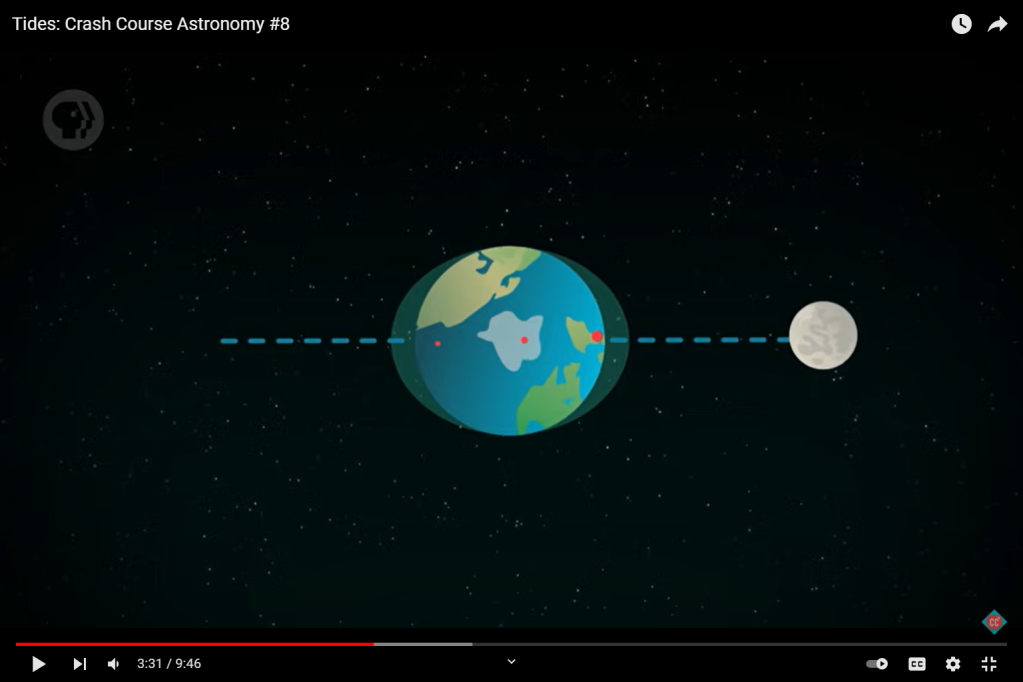
This blog will be referencing information sourced from the Tides: Crash Course Astronomy #8 video. We know that mass has gravity, and more mass had more gravity. This raises the question, why does the moon have a greater impact on the Earth’s tides than the Sun, even though the Sun has such a greater gravitational force? This is because of the close distance to the Earth the Moon has. Think of the gravitational effect that causes the tides as the Earth stretching. As shown in the picture above, the side of the Earth the is closer to the moon gets stretched towards the moon because of the Moon’s gravity. This causes a bulge, making the Earth slightly football shaped. You may be wondering why in the picture both sides of the Earth appear to be bulging then, since the Moon is pulling on the near side of the Earth. This is because the center of the Earth is also getting pulled slightly, while the far side of the Earth stays in place. This creates the effect that makes it look like both sides are getting pulled on. This stretching is what causes the tides. The gravity stretches the oceans. When you are on the side of the Earth getting stretched, you experience high tide, you can visualize the oceans stretching farther onto shore. Then the Earth rotates, and you experience low tide, and the oceans recede because you are on the side of the Earth that is not getting stretched. Then high tide again, then low tide. This is why there are two high tides and two low tides everyday. This affect of the tide seems to only be meaningful on large objects, like the ocean. Humans and other small things are not affected. However, the Earth itself is as well. Each day the surface of the Earth rises and falls about 30 centimeters, with the tides, yet you are moving with it so you would never notice it.
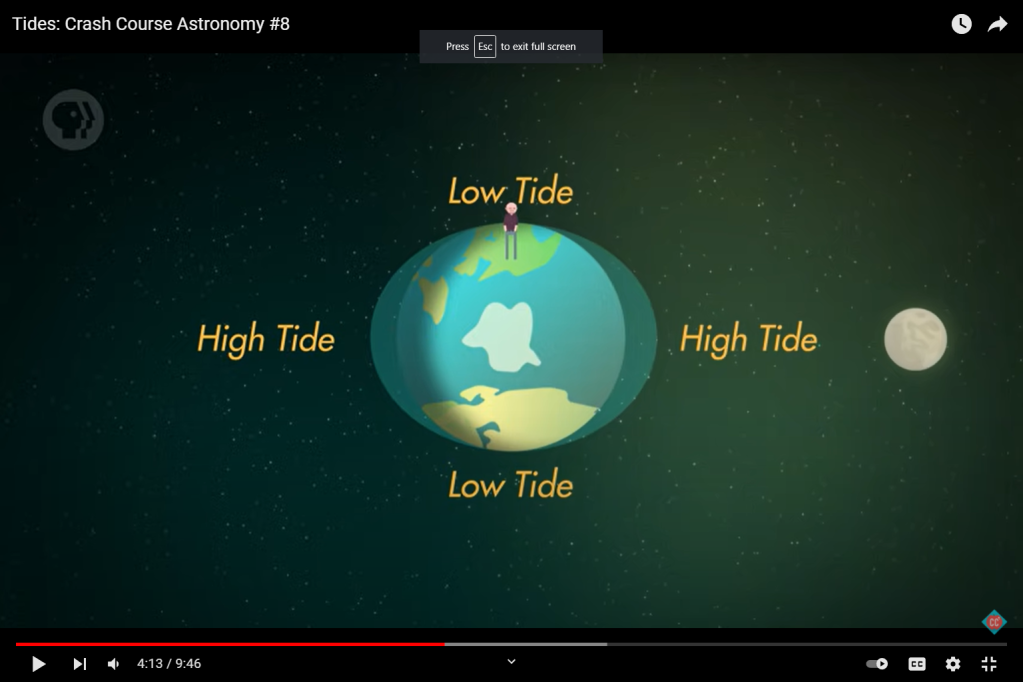
Pictures both taken from the Tides: Crash Course Astronomy #8 video.

Posted in Class, Moons | Tagged , , , , , | Comments Off on What makes the Tides happen?

How Stonehenge is Astronomical

Stonehenge is a prehistoric monument that is basically a ring of stones. Located in Salisbury, England, tourists come everyday to see the beautiful mystery. There are many legends and myths about how Stonehenge was created. According to different theories it could have been built by wizards, Danes or it was ruins from Roman Temples. Although these theories are entertaining to read about, the real reason why Stonehenge exists is because of astronomy. 

STONEHENGE

Stonehenge is astronomical because of where the rocks are placed. If someone were to sit in the center of the rocks, there is a perfect view of the summer solstice rising above the heel stone. According to The Guardian, it is believed that summer solstices have been celebrated at Stonehenge for thousands of years. I think that is very interesting and it raised some questions in my mind. For example, why the summer solstice? Are there any other reasons for Stonehenge? Who was the real creator of the structure? 

SUMMER SOLSTICE

I also find it interesting that there are many other structures similar to Stonehenge that are astronomical. For example, Nabta or Karnak in Egypt, Teotihuacan in Mexico, Moose Mountain in Saskatchewan, and many more. The Great Sphinx of Giza is also an astronomical clock. The dials point to the four constellations: Taurus, Leo, Scorpio and Aquarius. It tracks the stars as they orbit every 26,000 years. 

Have you ever been to an ancient astronomical structure? Leave a comment saying where you went!  

Posted in Class | Tagged , , , | Comments Off on How Stonehenge is Astronomical

Gravity in Solar System

from Word Economic Forum

Acceleration due to gravity (g) is different for different planets due to their diverse masses and radii. Physicists usually figure out the by the formula g = GM/r**2, where G is the Universal Constant of Gravitation (6.67 * 10**(-11)), M is the mass of the planet, and r is the radius of the planet. By this calculation, the acceleration due to gravity, which is equivalent to gravitational strength, of all planets in our solar system is successfully figured out. Among all, Jupiter has the largest gravity as Jupiter is the largest planet within the Solar System, thus the largest mass. As mass is directly proportional to the acceleration due to gravity, Jupiter obviously has the largest g. Noticeably, as a gas giant, Jupiter does not have a true surface. Therefore, if people stepped on Jupiter, he/she will sink until reaching Jupiter’s solid core. The gravity of Jupiter is approximately 24.79m/s**2, which is 2.5 times the gravity of the Earth. In contrast, Mercury has the smallest g due to its small size, only 3.7m/s**2. Gravity runs the gamut in the Solar system, ranging from 3.7m/s**2 to 24.79m/s**2, which can be useful in space travel. For example, gravity assist maneuver can be especially useful in aerospace engineering to reduce expense and energy.

Posted in Class, Physics | Tagged , | Comments Off on Gravity in Solar System

Tides on Titan

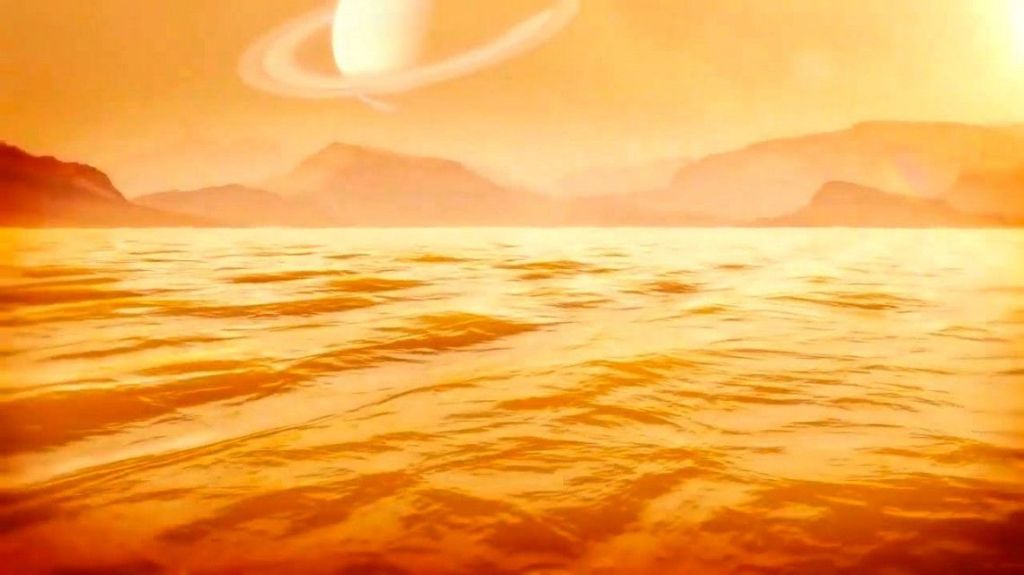
An artist’s depiction of a sea on Titan’s surface

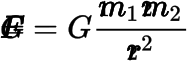
As we learned in class, different celestial bodies can have varying tidal forces depending on their masses in relation to the object of interest. This phenomenon was mainly explored by the tidal forces on the Earth by the Moon and the Sun. In order to calculate the gravitational forces between two objects, we utilized the following equation for gravitational force:

F=G{\frac{m_1m_2}{r^2}}

As was concluded, the gravitational force exerted on Earth by the Sun was roughly 200 times stronger than that of the Moon on Earth. This was due solely to the massive size of the Sun in comparison to Earth even though it is much farther away from Earth than the Moon. Consequently, as a result of these two gravitational forces on Earth, we experience changes in the tides of our oceans along coasts around Earth.

The physics of tidal forces can also be applied to celestial bodies that are not Earth, specifically one of Saturn’s moons, Titan. Titan is the largest of Saturn’s 82 moons, and it’s been an object of interest for NASA’s Cassini probe. One of the most interesting facts about Titan is that, currently, it is the only other celestial body that has an Earth-like water cycle where liquid from its surface goes through similar steps such as evaporation from lakes and condensation from clouds. Not only does Saturn contain lakes of liquid ethane and methane on its surface, but because of the detected tidal forces due to Saturn, it is hypothesized that the top layer of water ice actually sits afloat a large subsurface ocean. This hypothesis was developed after the Cassini probe detected that the surface of Titan actually rises and falls 10 meters, given its location relative to Saturn. This rising and falling is quite clearly due to the gravitational force of Saturn which in comparison would be much more massive than Titan, also causing it to be tidally locked much like our Moon to Earth. This rising and falling of the surface is actually quite significant, for comparison Earth’s surface only moves about 0 to 4 inches depending on its location relative to the Moon and Sun. As a result, it’s very likely that underneath the top layer of water ice, there is a massive subsurface ocean that experiences massive gravitational forces, causing tides to significantly change the altitude of the entire top ice layer. It’s quite interesting to observe how there are common phenomena within the solar system, yet they can have much greater effects in some cases.

Posted in Physics | Tagged , , , | Comments Off on Tides on Titan

Black holes and spacetime | blog post II

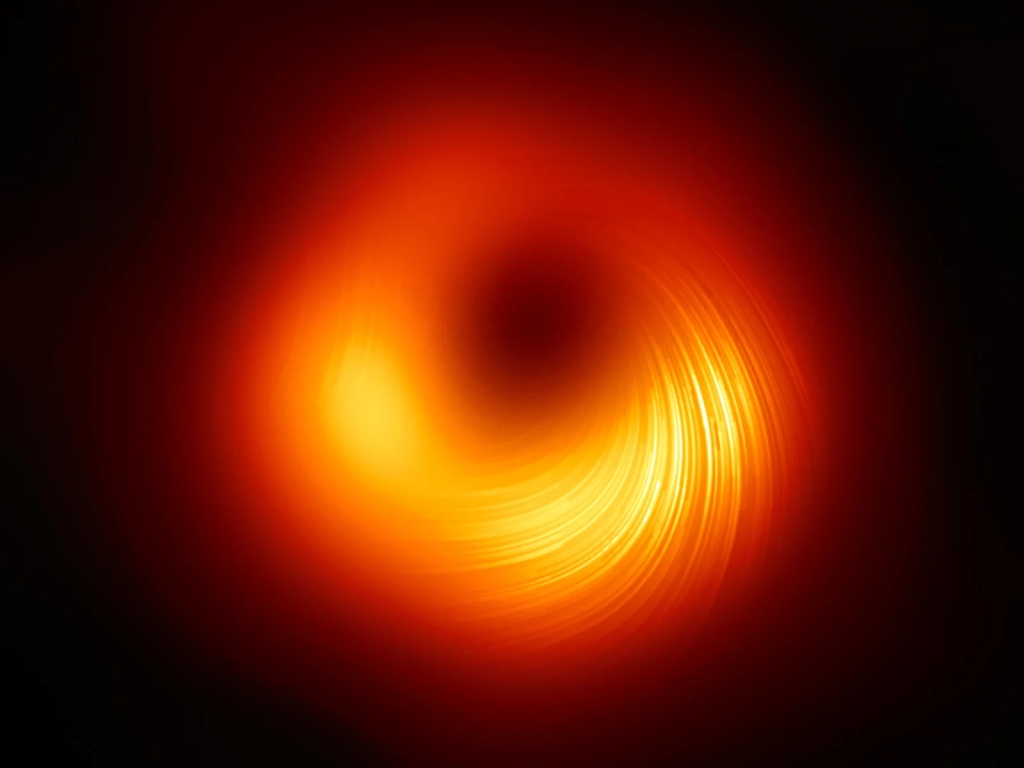
Black holes are areas in spacetime where the gravitational force is so strong that nothing can escape. This includes forms of electromagnetic radiation like light. Current general relativistic models depict black holes as a taking on spheroid shapes, with an interminably long “tail” leading to its point of singularity. Singularity is a geometric point where any amount of mass is compressed into an infinitesimal density. This point has no volume; envision dropping a pen a piece of paper so that barely a dot shows up. Singularity is incalculably smaller than this dot. Surrounding every black hole is its event horizon, which is the area in which the escape velocity is equal to the speed of light. The breath of black holes’ event horizons do change based on the size and mass of their parent stars. Larger parent stars create larger (more distally expansive across spacetime) event horizons. Regardless of the event horizon, the escape velocity is the same. What changes is the distance at which the effects of the black hole cease to be felt; think about this also as the radius of the boundary at which nothing can ever escape. In 1971, Stephen Hawking proposed that the event horizon of a black hole should never shrink, a rule recognized as Hawking’s Area Theorem. This has become one of the most important laws in understanding black hole mechanics. A report published by MIT in July 2021 confirms this principle observationally—for the first time ever, some fifty years after it was introduced.  

Magnetic fields surrounding a black hole located at the center of galaxy Messier 87; first ever image of its kind. NPR/Event Horizon Telescope.
Posted in Class | Astr 2110 | Tagged , , | Comments Off on Black holes and spacetime | blog post II

Archeoastronomy: the Ancient Greeks

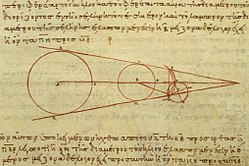
Ancient Greek Calculations on Relative Sizes of the Moon, Sun, and Earth

The quest for knowledge about the universe we live in is not a modern phenomenon. Many cultures throughout history have devoted a significant amount of time and resources in pursuit of this knowledge. One ancient civilization that dramatically improved our knowledge of astronomy was the ancient Greeks.

One of the main goals of Greek astronomers was to determine an accurate geometrical model for celestial occurrences. One model was the Eudoxan model (created by Eudoxus of Cnidus, 410 – 347 BC), which presented the universe as a two-sphere model in which Earth was the stationary center with a larger sphere (termed the “heavenly realm”) centered around it that included all other celestial bodies (such as stars and planets). Using this model, Eudoxan was able to relatively accurately predict where and when planets would appear in the night sky. While his model was quite inaccurate, his attempts to geometrically model the world around us provided one of the earliest accounts of predicting planetary motion.

Another ancient Greek astronomer was Hipparchus (190-120 BC). He is most famous for his lunar theories. He used eclipses that occurred during his time to make conclusions about the period of the moon’s orbit. He also was one of the first people who recorded information about an apparent parallax of the moon and determined a somewhat accurate estimation for the summer solstice. Because of all of this and more, many consider him one of the best observational astronomers of all time.

Posted in Historical | Tagged , , | Comments Off on Archeoastronomy: the Ancient Greeks

We know the way

photo from twitter

A long time ago, before we had our fancy GPS and siri to tell us where to go and how to get to and from places, we had to rely on the sky, more specifically the stars (the Sun included). We learned to use the stars and Sun to tell time and by creating angle measuring instruments (such as the sextant), we were able to find our latitude. A mariner would use this technique in order to find his latitude by measuring the angle between the North star and the horizon. This is what is known as Celestial Navigation. It’s crazy to think about how many civilizations relied on this type of navigation, such as the ancient Minoans who lived in the Mediterranean Island of Crete from 3000 to 1100 BCE. Check out this story on the Polynesians and how they used way finding as a way of life!

Posted in Class | Tagged , , , , , | Comments Off on We know the way

Historical Astronomers in Context

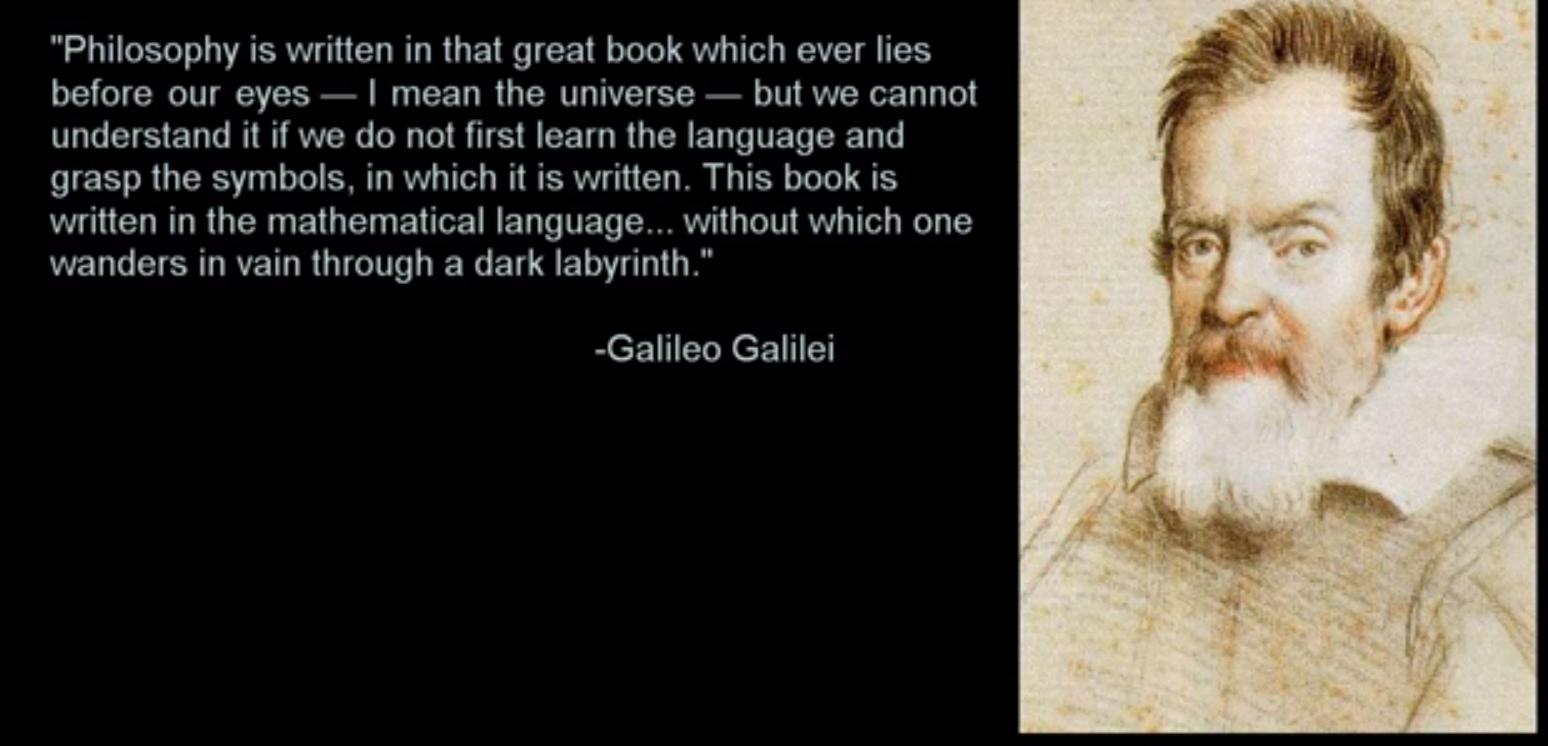
Galileo Galilei:

Galileo Galilei (1564 – 1642)

Galileo Galilei revolutionized the field of Astronomy by providing conclusive evidence to disprove astronomical misconceptions that had stagnated humanities understanding of the solar system, and the universe, for more than a thousand years. Prior to Galileo, scientists asserted that Earth could not be moving because under that scenario a falling object would land at a location behind that which it was dropped. Galileo experimented with rolling balls to demonstrate that moving objects stay in motion unless acted upon by a net force. Using this principle, he was able to explain how objects that exist on a moving Earth can maintain the same motion as the Earth and land directly beneath the point at which they were released. Galileo also built an improved telescope that allowed him to make observations that disproved the idea that the heavens are perfect. Galileo’s discoveries opened the door for the acceptance of elliptical planetary orbits. During his brief lifetime, Galileo helped disprove principles concerning the structure of the universe that had been widely held for over a millennium. Galileo also helped propagate the philosophy that experimentation and observation are key to scientific development.

Sources for Galileo Information:

Contemporary Events:

Jamestown, the first permanent British colony in North America, was established in 1607. This settlement marked the start of a prolonged English presence in North America, which lasted over 150 years and eventually became known as the 13 colonies.

In 1632, construction began on the Taj Mahal. This magnificent structure was commissioned as a mausoleum for Shah Jahan’s wife who died during child birth in 1961. Sadly, Galileo Galilei would not live to see this structure completed, as just the main mausoleum would not be completed for more than 15 years.

Contemporary Person:

William Shakespeare (1564 – 1616):

Born just 2 months after Galileo, William Shakespeare was an English playwright whose works include Hamlet, Romeo and Juliet, Macbeth, King Leer, and a Midsummer Night’s Dream. Shakespeare would go on to become the most famous English playwright of all time, and his plays are still read across the world in 2022.

Reflection:

It is interesting to learn about the events that occurred and the people who were alive during Galileo’s lifetime. Having studied the Cosmic Calendar, I realize how recently Galileo lived relative to the age of the universe. However, knowing that the Jamestown colony and the Taj Mahal were just in their infancies during Galileo’s lifetime makes me realize just how truly long-ago Galileo made his groundbreaking contributions to astronomy. Even more remarkable is that Galileo made these discoveries with relatively rudimentary instruments (during his lifetime most of the population of Jamestown died due to lack of basic necessities such as clean drinking water and food). Finally, understanding just how long ago it seems like Galileo lived (500 years) makes me fully appreciate the magnitude of Galileo upending logic and principles that had stood for more than a millennium.

Posted in Historical | Tagged , , | Comments Off on Historical Astronomers in Context

Historical Astronomers in Context

I chose to learn more about Galileo (February 15, 1564 – January 8, 1642).

Two major historical events that happened during Galileo’s lifetime were:

  • On May 14, 1607, when Galileo was around 43, the colony of Jamestown was founded in what is now Virginia. Jamestown was the first permanent English settlement in North America.
  • In 1636, when Galileo was around 72, Harvard university was founded. It is the oldest institution for higher learning in the United States.

A historical figure that lived at the same time as Galileo was Pocahontas, who lived from 1596 – March 1617. She is remembered for helping relations between the English colonists and Powhatans, marrying a Jamestown Settler, John Rolfe and being captured by English colonists, and converting to Christianity.

It was interesting to dive into the current events at the time of Galileo’s life. He lived during the time of some very important Western historical events. I noticed when researching, that in most of the “world historical timelines” I found, there was a heavy focus on European and Western history. I wonder if this is due to a lack of records for the rest of the world, bias in the sources I found, or some other reason.

Posted in Historical | Tagged , , | Comments Off on Historical Astronomers in Context

Historical Astronomers in Context

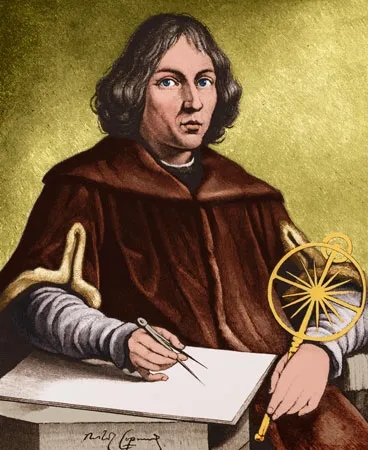
An Artist’s Depiction of Nicholas Copernicus

Nicholas Copernicus was born on February 19, 1473 and died on May 24, 1543. During the time that he was alive, a couple of historically interesting things happened. Of course, Copernicus himself was the first modern astronomer to propose a model of the Universe, called the ”Heliocentric Model,” that depicted the planets orbiting around the Sun instead of the Sun and planets orbiting around the Earth. More information about his life can be found here! Looking at what others did, we can see that during a large time of Copernicus’ life, Leonardo da Vinci was alive and creating art that is still well known and famous today! I found this website to be extremely interesting when trying to find out more about his life. However, he did die in 1519, during the middle of Copernicus’ lifetime. Another event was that of Vasco da Gama, who was the first European to travel around the Horn of Africa to reach India to attempt to establish a trading route. It was fascinating to learn how all of these historical lifetimes overlapped and even more so to think about the fact that during most of Leonardo da Vinci’s lifetime, it was believed to be a fact that the Universe orbited around the Earth.

Posted in Historical | Tagged , , | Comments Off on Historical Astronomers in Context